
Form guide
ACORD 126: Commercial General Liability Section
Limits, deductibles and the schedule of hazards for a general liability request.
Open the ACORD 126 guideACORD Forms
The first form in almost every commercial insurance submission. Download the blank fillable ACORD 125 and a filled sample, and see what each key field tells an underwriter.
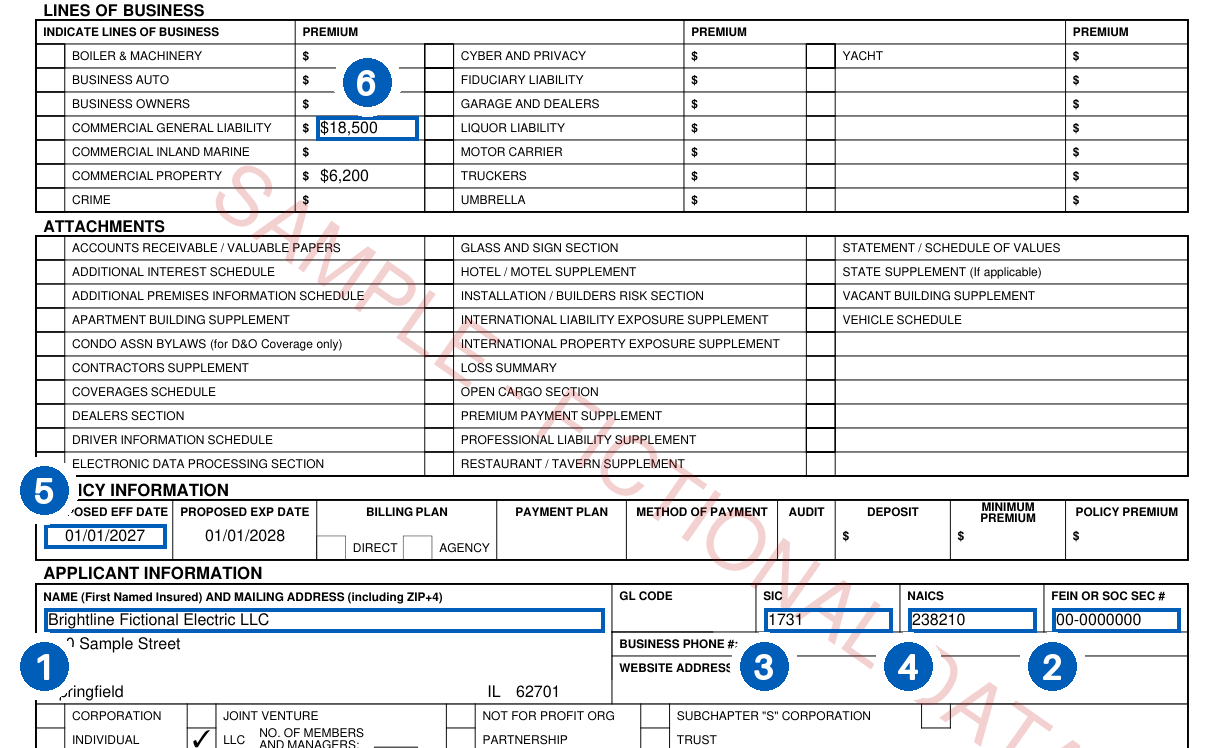
Numbered callouts are explained in the field guide below.
Definition
The ACORD 125 is the Commercial Insurance Application — the applicant section of a commercial submission. An agent or broker completes it to identify the applicant, the agency and carrier, the proposed policy dates, the lines of business requested, prior carriers and loss history. Line-specific sections such as the ACORD 126 and ACORD 140 attach to it.
Every section behind it refers back to the ACORD 125, so an error here — a wrong FEIN, a transposed effective date, a missing prior carrier — travels into every form in the submission. For how the three most common forms divide the work, see ACORD 125 vs 126 vs 140.
Both files are free, with no form to fill in first. The blank is the 2016/03 edition; the edition date is printed in the form's footer, so confirm it is the one your carrier accepts before you submit.
Every value is fictional and each page is stamped SAMPLE.
Download sample PDF (ACORD 125)What each key field on the ACORD 125 tells an underwriter, and the key it carries in the example output below. A number beside a field matches its callout on the sample image above.
| Field | What it tells an underwriter | Output key |
|---|---|---|
| Agency and carrier | ||
| Carrier | The insurer the application is addressed to. | carrier. |
| Agency | The producing agency or broker submitting the application. | agency. |
| Applicant information | ||
| Callout 1First named insured | The legal name coverage is written for; every attached section refers back to it. | applicant. |
| Mailing address | Where policy documents go — not necessarily a location being insured. | applicant. |
| City | Mailing address city. | applicant. |
| State | Mailing address state. | applicant. |
| ZIP code | Mailing address ZIP code. | applicant. |
| Callout 2FEIN | Federal employer identification number — the most reliable key for matching the applicant across systems. | applicant. |
| Callout 3SIC code | Industry classification many underwriters use for a first appetite check. | applicant. |
| Callout 4NAICS code | The newer industry code; it should describe the same business as the SIC code. | applicant. |
| Legal entity: LLC | Entity type, which affects who qualifies as an insured. | applicant. |
| Policy information | ||
| Callout 5Proposed effective date | When coverage would start; submission queues are often worked in this order. | policy. |
| Proposed expiration date | When coverage would end. | policy. |
| Lines of business | ||
| Callout 6General liability premium | Marks general liability as requested — an ACORD 126 should be attached. | lines_ |
| Commercial property premium | Marks property as requested — an ACORD 140 should be attached. | lines_ |
| Business information | ||
| Date business started | Years in business; newer ventures can fall outside a carrier's appetite. | applicant. |
| Full-time employees | An exposure measure for several lines, and a check on the revenue figure. | applicant. |
| Premises information | ||
| Annual revenues | Revenue at the premises — often the premium basis on the attached general liability section. | premises. |
| Prior carrier information | ||
| Prior general liability carrier | Who wrote the account before — the carrier to request loss runs from. | prior_ |
| Prior general liability premium | What the account paid before; a large gap to the requested premium is worth a question. | prior_ |
| Loss history | ||
| Loss date | Date of a reported loss; the loss history should reconcile with the carrier loss runs. | loss_ |
| Loss line of business | Which coverage the loss was under. | loss_ |
| Loss description | What happened, in the agent's words. | loss_ |
| Amount paid | What the carrier has paid on the loss so far. | loss_ |
These are the values filled into the sample above, keyed the way the field guide names them. When SortSpoke reads a completed ACORD 125, each value also carries a confidence score and a link back to where it sits on the page, so a reviewer can check it without hunting through the form.
| Field | Value in the sample | Output key |
|---|---|---|
| Agency and carrier | ||
| Carrier | Fictional Mutual Insurance Company | carrier. |
| Agency | Example Risk Partners (Fictional) | agency. |
| Applicant information | ||
| First named insured | Brightline Fictional Electric LLC | applicant. |
| Mailing address | 100 Sample Street | applicant. |
| City | Springfield | applicant. |
| State | IL | applicant. |
| ZIP code | 62701 | applicant. |
| FEIN | 00-0000000 | applicant. |
| SIC code | 1731 | applicant. |
| NAICS code | 238210 | applicant. |
| Legal entity: LLC | Yes | applicant. |
| Policy information | ||
| Proposed effective date | 01/01/2027 | policy. |
| Proposed expiration date | 01/01/2028 | policy. |
| Lines of business | ||
| General liability premium | $18,500 | lines_ |
| Commercial property premium | $6,200 | lines_ |
| Business information | ||
| Date business started | 03/15/2011 | applicant. |
| Full-time employees | 24 | applicant. |
| Premises information | ||
| Annual revenues | $4,200,000 | premises. |
| Prior carrier information | ||
| Prior general liability carrier | Example Casualty Company (Fictional) | prior_ |
| Prior general liability premium | $17,900 | prior_ |
| Loss history | ||
| Loss date | 06/12/2024 | loss_ |
| Loss line of business | General liability | loss_ |
| Loss description | Customer tripped over cable at job site | loss_ |
| Amount paid | $12,400 | loss_ |
The form is standard; what arrives rarely is. The problems that slow a submission down are consistent.
A skewed or low-resolution copy turns a clean form into a keying job.
A SIC code and a NAICS code describing two different businesses, and no note explaining which is right.
General liability or property marked as requested, with no ACORD 126 or ACORD 140 attached.
Losses on the application that do not match the carrier loss runs.
Extra named insureds and locations pushed onto an ACORD 101 remarks page or a spreadsheet.
SortSpoke reads completed ACORD 125s — typed or scanned — together with the rest of the submission, including the loss runs, and returns each field as structured data with a confidence score. Values below the threshold your team sets go to a reviewer before anything reaches your systems. See how it handles the whole ACORD form family.
The free extraction tool on this site handles the ACORD 25 certificate only — try it on a certificate. To see an ACORD 125 processed, book a demo and bring a real one.
It is the applicant section of a commercial insurance submission. It identifies the business applying, the agency submitting and the carrier, and records the requested policy dates and lines of business, prior coverage and loss history, so every line-specific section attached to it can refer back to one set of applicant facts.
Usually the agent or broker, working from information the applicant provides and often pre-populated from the agency management system. The applicant reviews and signs it.
The line-specific sections for the coverage requested — for example the ACORD 126 for general liability, the ACORD 140 for property, the ACORD 127 for business auto and the ACORD 131 for umbrella — plus schedules such as the ACORD 101 for additional remarks, and any supplements the carrier requires.
Yes. The blank on this page is a fillable PDF you can type into in any PDF reader. Its edition date is printed in the footer; confirm it is the edition your carrier accepts before you submit.
No. Every name, number and amount in the sample is fictional, and each page is stamped SAMPLE. It exists to show what a completed ACORD 125 looks like.
Yes. SortSpoke reads completed ACORD 125s alongside the other documents in a submission, returns each field with a confidence score, and routes low-confidence values to a reviewer. The free extraction tool on this site supports the ACORD 25 only; to see an ACORD 125 processed, book a demo.
ACORD Forms