
Form guide
ACORD 125: Commercial Insurance Application
The applicant section every general liability request sits behind.
Open the ACORD 125 guideACORD Forms
The general liability detail of a commercial submission: limits, hazards and rating questions. Download the blank fillable ACORD 126 and a filled sample, and see what the key fields mean.
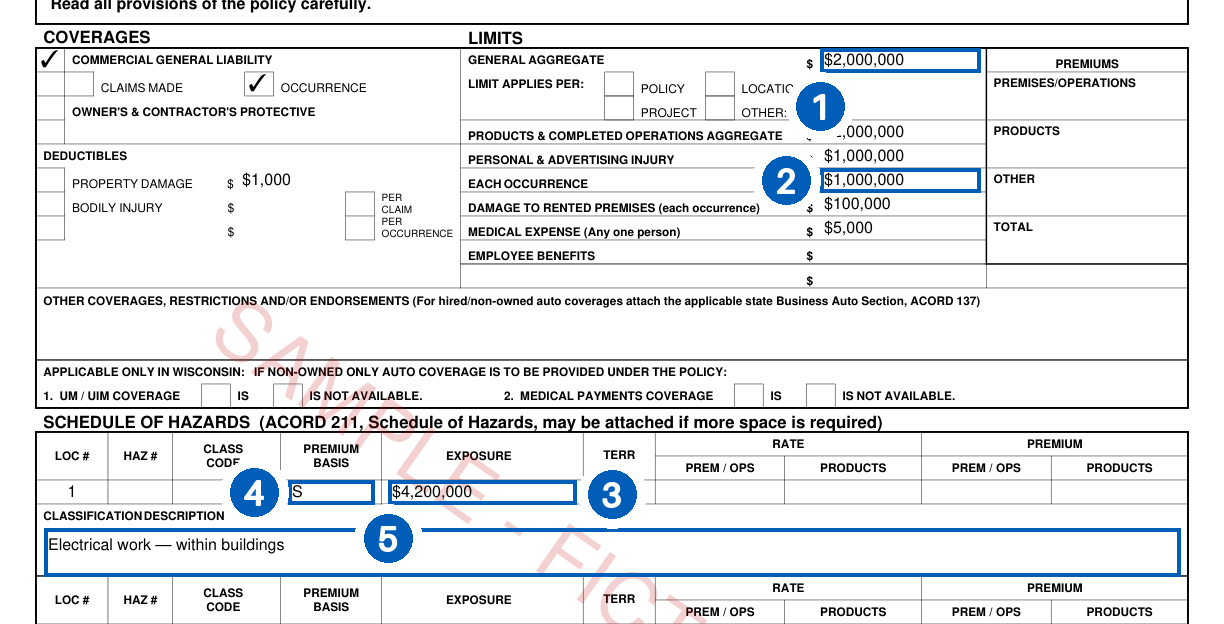
Numbered callouts are explained in the field guide below.
Definition
The ACORD 126 is the Commercial General Liability Section of a commercial insurance submission. An agent or broker attaches it to the ACORD 125 when general liability coverage is requested, to record the limits and deductibles wanted, whether coverage is occurrence or claims-made, the schedule of hazards with class codes and exposures, and underwriting questions about the operations.
The schedule of hazards is the part that drives price. Each row ties a location to a classification, a premium basis such as gross sales, payroll or area, and an exposure amount — so one transposed digit in an exposure moves the premium. The applicant itself is described on the ACORD 125.
Both files are free, with no form to fill in first. The blank is the 2016/09 edition; the edition date is printed in the form's footer, so confirm it is the one your carrier accepts before you submit.
Every value is fictional and each page is stamped SAMPLE.
Download sample PDF (ACORD 126)What each key field on the ACORD 126 tells an underwriter, and the key it carries in the example output below. A number beside a field matches its callout on the sample image above.
| Field | What it tells an underwriter | Output key |
|---|---|---|
| Header | ||
| Named insured | Ties the section to the applicant on the ACORD 125. | applicant. |
| Effective date | Must match the ACORD 125. | policy. |
| Coverages | ||
| Commercial general liability | The coverage being requested. | general_ |
| Occurrence basis | Occurrence or claims-made — claims-made brings retroactive-date questions. | general_ |
| Limits | ||
| Callout 1General aggregate | The most the policy pays in a policy period, outside products-completed operations. | general_ |
| Products-completed operations aggregate | The separate annual cap for injury or damage from finished work or products. | general_ |
| Personal and advertising injury | The limit for offences such as libel or copyright infringement in advertising. | general_ |
| Callout 2Each occurrence | The most paid for any one occurrence. | general_ |
| Damage to rented premises | Cover for fire and similar damage to premises rented to the insured. | general_ |
| Medical expense | Per-person medical payments regardless of fault. | general_ |
| Deductibles | ||
| Property damage deductible | What the insured retains per claim. | general_ |
| Schedule of hazards | ||
| Location number | Which premises on the ACORD 125 the hazard applies to. | general_ |
| Callout 3Classification | The operation being rated, in words. | general_ |
| Callout 4Premium basis | The premium basis code — S is gross sales, P payroll, A area (per the legend at the foot of the form). | general_ |
| Callout 5Exposure | The amount the rate is applied to; a transposed digit here moves the premium. | general_ |
These are the values filled into the sample above, keyed the way the field guide names them. When SortSpoke reads a completed ACORD 126, each value also carries a confidence score and a link back to where it sits on the page, so a reviewer can check a limit or an exposure without hunting through the form.
| Field | Value in the sample | Output key |
|---|---|---|
| Header | ||
| Named insured | Brightline Fictional Electric LLC | applicant. |
| Effective date | 01/01/2027 | policy. |
| Coverages | ||
| Commercial general liability | Yes | general_ |
| Occurrence basis | Yes | general_ |
| Limits | ||
| General aggregate | $2,000,000 | general_ |
| Products-completed operations aggregate | $2,000,000 | general_ |
| Personal and advertising injury | $1,000,000 | general_ |
| Each occurrence | $1,000,000 | general_ |
| Damage to rented premises | $100,000 | general_ |
| Medical expense | $5,000 | general_ |
| Deductibles | ||
| Property damage deductible | $1,000 | general_ |
| Schedule of hazards | ||
| Location number | 1 | general_ |
| Classification | Electrical work — within buildings | general_ |
| Premium basis | S | general_ |
| Exposure | $4,200,000 | general_ |
Most of the rework on a general liability section lands in the same places.
A classification written in words that does not match the class code beside it.
Gross sales on the hazard schedule that disagree with the revenue on the ACORD 125.
Schedule rows continued on an ACORD 101 remarks page or a carrier's own spreadsheet.
Claims-made coverage requested with no retroactive date recorded.
Contractor and products questions answered by reference to a document that is not in the submission.
SortSpoke reads completed ACORD 126s — typed or scanned — together with the ACORD 125 and the rest of the submission, including the loss runs, and returns each limit, hazard row and answer as structured data with a confidence score. Values below the threshold your team sets go to a reviewer first. See the whole ACORD form family.
The free extraction tool on this site handles the ACORD 25 certificate only. To see an ACORD 126 processed, book a demo and bring a real one.
To apply for commercial general liability coverage. It sits behind the ACORD 125 and records the coverage the applicant wants — limits, deductibles, occurrence or claims-made — plus the schedule of hazards and the liability questions an underwriter prices from.
The ACORD 125 describes the applicant and the submission as a whole; the ACORD 126 describes only the general liability request. A general liability submission needs both. The full comparison, including the ACORD 140, is in our ACORD 125 vs 126 vs 140 guide.
One row per rated operation: the location and hazard number, the classification and its code, the premium basis such as gross sales, payroll or area, and the exposure amount, plus rating details where the agent has them. It is the section that drives the premium.
Yes. The blank on this page is a fillable PDF you can type into in any PDF reader. Its edition date is printed in the footer; confirm it is the edition your carrier accepts before you submit.
No. Every name, limit and exposure in the sample is fictional, and each page is stamped SAMPLE. It exists to show what a completed ACORD 126 looks like.
Yes. SortSpoke reads completed ACORD 126s alongside the ACORD 125 and the rest of the submission, returns each field with a confidence score, and routes low-confidence values to a reviewer. The free extraction tool on this site supports the ACORD 25 only; to see an ACORD 126 processed, book a demo.
ACORD Forms