
Form guide
ACORD 125: Commercial Insurance Application
The applicant section every property request sits behind.
Open the ACORD 125 guideACORD Forms
The property detail of a commercial submission: what is insured, for how much, and how it is built. Download the blank fillable ACORD 140 and a filled sample.
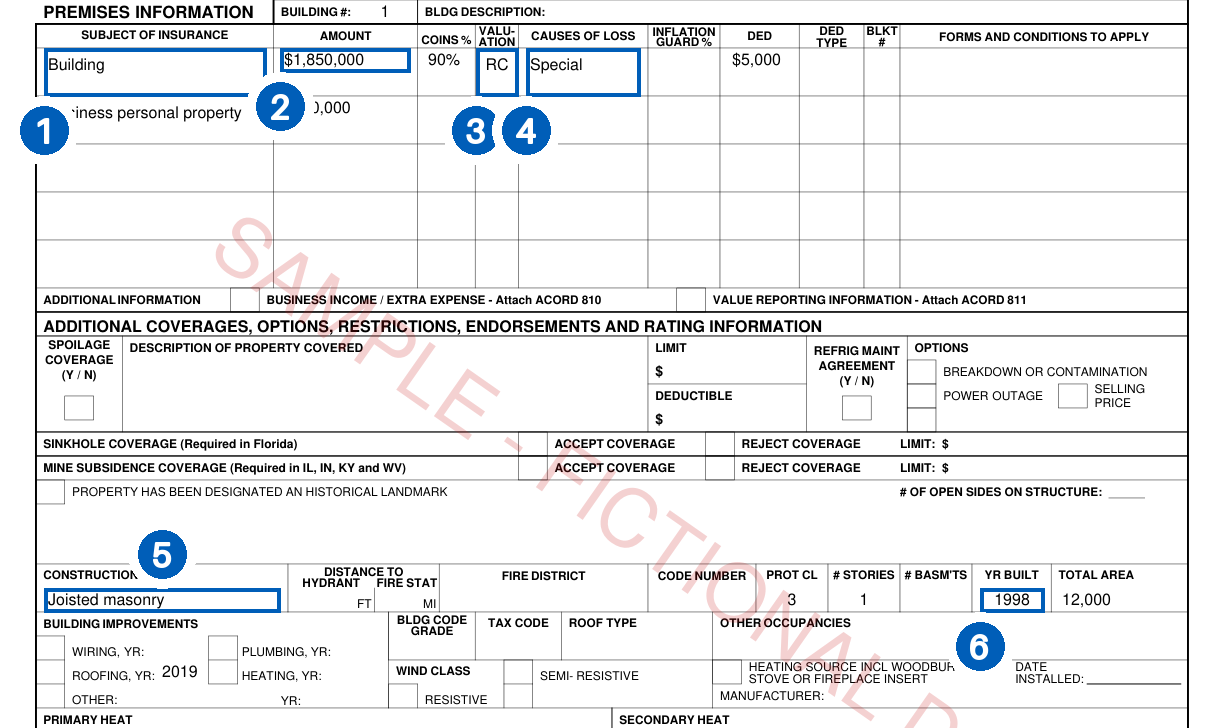
Numbered callouts are explained in the field guide below.
Definition
The ACORD 140 is the Property Section of a commercial insurance submission. An agent or broker attaches it to the ACORD 125 when property coverage is requested, to record each premises and building, the subjects of insurance and amounts, valuation, coinsurance, causes of loss and deductibles, and the construction and fire protection details underwriters rate from.
For a handful of buildings the form is complete on its own. For a schedule of dozens or hundreds of locations it is usually paired with a statement of values (SOV), because the form was not built to describe a large portfolio — see why SOVs are hard to standardize.
Both files are free, with no form to fill in first. The blank is the 2016/03 edition; the edition date is printed in the form's footer, so confirm it is the one your carrier accepts before you submit.
Every value is fictional and each page is stamped SAMPLE.
Download sample PDF (ACORD 140)What each key field on the ACORD 140 tells an underwriter, and the key it carries in the example output below. A number beside a field matches its callout on the sample image above.
| Field | What it tells an underwriter | Output key |
|---|---|---|
| Header | ||
| Named insured | Ties the section to the applicant on the ACORD 125. | applicant. |
| Effective date | Must match the ACORD 125. | policy. |
| Premises | ||
| Premises number | Which premises on the ACORD 125 this block describes. | property. |
| Building number | Which building at that premises. | property. |
| Street address | The insured location — not the mailing address. | property. |
| Subject of insurance | ||
| Callout 1Subject | What is being insured — building, business personal property, business income. | property. |
| Callout 2Amount | The limit requested for that subject. | property. |
| Coinsurance | The percentage of value the limit must meet to avoid a penalty at claim time. | property. |
| Callout 3Valuation | Replacement cost (RC) or actual cash value (ACV) — how a loss will be settled. | property. |
| Callout 4Causes of loss | Basic, broad or special form — which perils are covered. | property. |
| Deductible | What the insured retains per loss. | property. |
| Business personal property | The second subject-of-insurance line — contents rather than the building itself. | property. |
| Business personal property amount | The contents limit, on the second subject line. | property. |
| Construction | ||
| Callout 5Construction type | Frame, joisted masonry, fire resistive and so on — a core rating factor. | property. |
| Callout 6Year built | Age of the building; read alongside the update years. | property. |
| Number of stories | Height of the building. | property. |
| Total area | Floor area in square feet. | property. |
| Building improvements | ||
| Roof updated | When the roof was last replaced — often asked about on older buildings. | property. |
| Fire protection | ||
| Protection class | The public fire protection grade for the location. | property. |
These are the values filled into the sample above, keyed the way the field guide names them. When SortSpoke reads a completed ACORD 140, each value also carries a confidence score and a link back to where it sits on the page, so a reviewer can check a building value without hunting through the form.
| Field | Value in the sample | Output key |
|---|---|---|
| Header | ||
| Named insured | Brightline Fictional Electric LLC | applicant. |
| Effective date | 01/01/2027 | policy. |
| Premises | ||
| Premises number | 1 | property. |
| Building number | 1 | property. |
| Street address | 100 Sample Street, Springfield, IL | property. |
| Subject of insurance | ||
| Subject | Building | property. |
| Amount | $1,850,000 | property. |
| Coinsurance | 90% | property. |
| Valuation | RC | property. |
| Causes of loss | Special | property. |
| Deductible | $5,000 | property. |
| Business personal property | Business personal property | property. |
| Business personal property amount | $350,000 | property. |
| Construction | ||
| Construction type | Joisted masonry | property. |
| Year built | 1998 | property. |
| Number of stories | 1 | property. |
| Total area | 12,000 | property. |
| Building improvements | ||
| Roof updated | 2019 | property. |
| Fire protection | ||
| Protection class | 3 | property. |
Property sections go wrong in predictable ways.
A building amount on the ACORD 140 that does not match the same building on the SOV.
Premises and building numbers that follow one scheme on the form and another on the schedule.
"Brick" or "masonry" written where the rating needs a construction class.
An older year built with no roof, wiring or plumbing update dates beside it.
No protection class or alarm information for a location that needs it.
SortSpoke reads completed ACORD 140s — typed or scanned — together with the ACORD 125, the statement of values and the rest of the submission, and returns each building and subject of insurance as structured data with a confidence score. Values below the threshold your team sets go to a reviewer first. See the whole ACORD form family.
The free extraction tool on this site handles the ACORD 25 certificate only. To see an ACORD 140 processed, book a demo and bring a real one.
To apply for commercial property coverage. It sits behind the ACORD 125 and records, building by building, what is being insured, the amounts and terms requested, and the construction and protection details the property is rated on.
No. It is only needed when there is property to insure, which includes a tenant's contents and improvements as well as an owned building. A general-liability-only submission needs the ACORD 125 and the ACORD 126 and no ACORD 140.
The ACORD 140 describes each premises and building in detail on the form itself. A statement of values lists locations and insured values as a schedule — as an ACORD 139 or a broker's spreadsheet — and is what large property submissions rely on. Many submissions include both, and the values need to agree.
Yes. The blank on this page is a fillable PDF you can type into in any PDF reader. Its edition date is printed in the footer; confirm it is the edition your carrier accepts before you submit.
No. Every name, address and value in the sample is fictional, and each page is stamped SAMPLE. It exists to show what a completed ACORD 140 looks like.
Yes. SortSpoke reads completed ACORD 140s alongside the ACORD 125 and the rest of the submission, returns each field with a confidence score, and routes low-confidence values to a reviewer. The free extraction tool on this site supports the ACORD 25 only; to see an ACORD 140 processed, book a demo.
ACORD Forms