
For insurance teams
Loss runs, read before your team opens them
Loss runs arrive already read, with the rest of the submission. Your team checks only what SortSpoke flags.
Nothing to build. We set it up for your lines.
Preview: not live
Run 5 loss runs free with Loss Run Guru, no card needed.
Source: page 3, Totals row. The scan is smudged here.
The page reads $148,250: paid $96,400 plus open reserves of $51,850.
Approved as extracted: $184,250. The record goes on to your system.
Corrected to $148,250, the figure on the page. Your models learn from the fix.
Want this on your documents?
A fictional loss run. Four values cleared the confidence bar; one waits for a person. Open it, see where it came from, then approve or correct it.
Every carrier formats loss runs differently. Pre-trained loss run models read each layout as it arrives.
Greater than 95% real-world extraction accuracy on loss run documents.
Measured against actual production data across varied carrier formats, layouts, and document qualities.
You set the confidence threshold: the AI scores each value, it does not decide. Anything below your threshold goes to a person in Review.
No per-carrier templates. A carrier you’ve never seen before needs no setup.
OCR built in for scanned, faxed and photographed pages, with nothing to configure.
Carrier system exports and broker spreadsheets, alongside the PDFs.
Claims from different layouts come out as the same structured records, open, closed or reopened.
Three fictional carriers, three layouts, one record shape for every claim.
Scanned carrier PDF Faxed, skewed, one policy term.
Carrier system export Several policy years, a subtotal each.
Broker spreadsheet Columns in its own order.
The same claim record, from every carrier
claimNumberdateOfLossstatuspaidreserveincurredEach value carries a confidence score and the page it came from.
Send a loss run and get one structured record back.
| Field | Value | Confidence | Source |
|---|---|---|---|
| Carrier | Example Casualty Company (Fictional) | 99% | Page 1, header |
| Named insured | Alder Creek Freight LLC | 99% | Page 1, header |
| Policy period | Jul 1, 2024 to Jul 1, 2025 | 97% | Page 1, header |
| Valued as of | Sep 30, 2025 | 96% | Page 1, header |
| Claim 2024-104 | Aug 12, 2024ClosedPaid $18,600Reserve $0Incurred $18,600 | 95% | Page 2, claims table |
| Claim 2024-118 | Oct 14, 2024OpenPaid $12,300Reserve $23,600Incurred $35,900 | 95% | Page 2, claims table |
| Claim 2024-131 | Dec 9, 2024ClosedPaid $9,120Reserve $0Incurred $9,120 | 95% | Page 2, claims table |
| Claim 2025-007 | Feb 3, 2025OpenPaid $4,050Reserve $28,250Incurred $32,300 | 95% | Page 2, claims table |
| Claim 2025-022 | Mar 28, 2025ClosedPaid $23,480Reserve $0Incurred $23,480 | 95% | Page 2, claims table |
| Claim 2025-041 | May 6, 2025ClosedPaid $15,350Reserve $0Incurred $15,350 | 95% | Page 2, claims table |
| Claim 2025-058 | Jun 19, 2025ClosedPaid $13,500Reserve $0Incurred $13,500 | 95% | Page 2, claims table |
| Total paid | $96,400 | 98% | Page 3, totals row |
| Total incurred | $184,250 | 71% · Check this value | Page 3, totals row |
Why it waits for a person: the claim lines add up to $148,250 incurred ($96,400 paid plus $51,850 in open reserves), not the $184,250 read from the smudged totals row.
{
  "id": "doc_7f3a91c2",
  "documentType": "loss_run",
  "review": {
    "status": "needs_review",
    "fieldsToCheck": ["totalIncurred"]
  },
  "fields": {
    "carrier": {
      "value": "Example Casualty Company (Fictional)",
      "confidence": 0.99,
      "source": { "page": 1, "location": "Header, Carrier" }
    },
    "insured": {
      "value": "Alder Creek Freight LLC",
      "confidence": 0.99,
      "source": { "page": 1, "location": "Header, Named insured" }
    },
    "policyPeriod": {
      "value": { "start": "2024-07-01", "end": "2025-07-01" },
      "confidence": 0.97,
      "source": { "page": 1, "location": "Header, Policy term" }
    },
    "valuationDate": {
      "value": "2025-09-30",
      "confidence": 0.96,
      "source": { "page": 1, "location": "Header, Valued as of" }
    },
    "claims": {
      "value": [
        { "claimNumber": "2024-104", "dateOfLoss": "2024-08-12", "status": "closed",
          "paid": 18600, "reserve": 0, "incurred": 18600 },
        { "claimNumber": "2024-118", "dateOfLoss": "2024-10-14", "status": "open",
          "paid": 12300, "reserve": 23600, "incurred": 35900 },
        { "claimNumber": "2024-131", "dateOfLoss": "2024-12-09", "status": "closed",
          "paid": 9120, "reserve": 0, "incurred": 9120 },
        { "claimNumber": "2025-007", "dateOfLoss": "2025-02-03", "status": "open",
          "paid": 4050, "reserve": 28250, "incurred": 32300 },
        { "claimNumber": "2025-022", "dateOfLoss": "2025-03-28", "status": "closed",
          "paid": 23480, "reserve": 0, "incurred": 23480 },
        { "claimNumber": "2025-041", "dateOfLoss": "2025-05-06", "status": "closed",
          "paid": 15350, "reserve": 0, "incurred": 15350 },
        { "claimNumber": "2025-058", "dateOfLoss": "2025-06-19", "status": "closed",
          "paid": 13500, "reserve": 0, "incurred": 13500 }
      ],
      "confidence": 0.95,
      "source": { "page": 2, "location": "Claims table, 7 rows" }
    },
    "totalPaid": {
      "value": 96400,
      "confidence": 0.98,
      "source": { "page": 3, "location": "Totals row, Paid" }
    },
    "totalIncurred": {
      "value": 184250,
      "confidence": 0.71,
      "source": { "page": 3, "location": "Totals row, Incurred" }
    }
  }
}
curl -X POST https://api.sortspoke.com/v1/documents \
-H "Authorization: Bearer $SORTSPOKE_API_KEY" \
-F "file=@alder-creek-loss-run.pdf" \
-F "documentType=loss_run"The same loss run models and the same Review either way, and your experts have the final say.
For insurance teams
Loss runs arrive already read, with the rest of the submission. Your team checks only what SortSpoke flags.
Nothing to build. We set it up for your lines.
For developers
Send loss runs from your software or AI agent. Get every claim back as JSON, with confidence and source.
documentType: "loss_run"
“SortSpoke solves one of underwriting’s messiest problems. Enables faster reviews, better risk assessment, greatly reduced manual effort.”
A loss run is a report issued by an insurance carrier that lists a policyholder’s claims history over a set period, typically three to five years.
Each entry records the claim date, type, status, amount paid, and reserves. Underwriters use loss runs to assess risk and price renewals. Every carrier formats them differently, which is what makes them slow to process at scale.
Need one from a carrier? See how to get a loss run report.
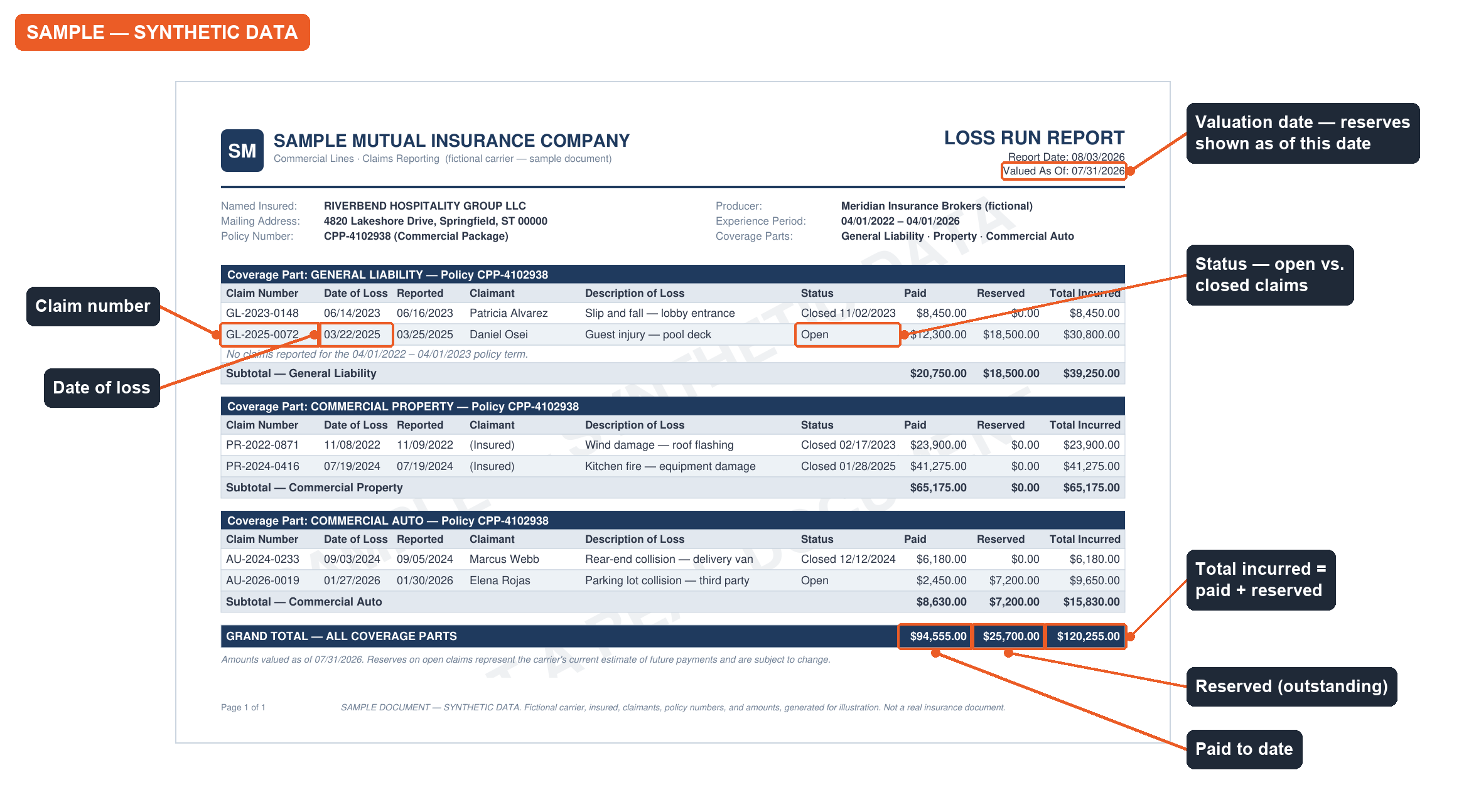
A report from an insurance carrier that lists a policyholder’s claims over a set period, usually three to five years: the date, type, status, amount paid and reserves of each claim. Underwriters use it to assess risk and price renewals.
A loss run report typically contains the policy number and effective dates, a line per claim with date of loss and claim status (open, closed, or reopened), amounts paid, outstanding reserves, and a total incurred figure. Carriers vary in whether they include claimant detail, cause-of-loss coding, and subrogation recovery.
Most submissions ask for three to five years of loss history. A 5 year loss run report is standard for commercial lines; a 3 year loss run report is common for smaller accounts.
Read a loss run by first checking the policy period and whether the report is valued to a recent date. Then review each claim line for status, paid amount, and reserves. Total incurred is paid plus reserves. Open claims with large reserves carry the most forward-looking risk.
No. Pre-trained loss run models read each carrier’s layout as it arrives, so a new carrier format needs no template setup. Scanned, faxed and photographed loss runs are handled too, with OCR built in, and claims in different layouts come out as the same structured records.
Yes, today. SortSpoke reads loss runs from any carrier, returns each claim and total with a confidence score and its source, and routes anything below your threshold to a reviewer in Review. Use it in SortSpoke Workspace, or build it into your own software with SortSpoke Elements.