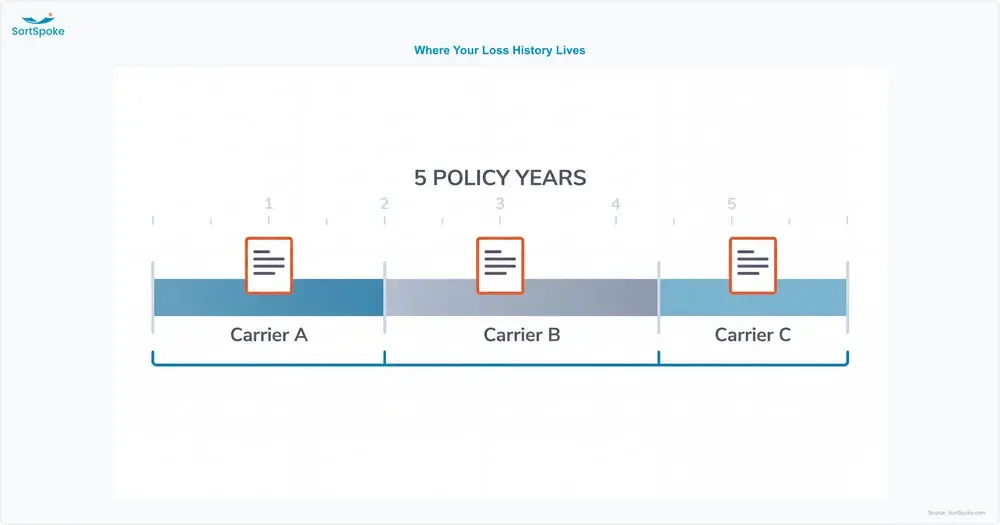
Getting a loss run report should be simple: the carrier already has the data, and you're entitled to it. In practice, requests stall because they go to the wrong place, leave out a policy number, or never make it into writing. This guide covers exactly how to get a loss run report — who can request one, where to send the request, what to include so the carrier can't bounce it back, and how long to expect to wait — plus a copy-ready request letter template.
Who Can Request a Loss Run Report?
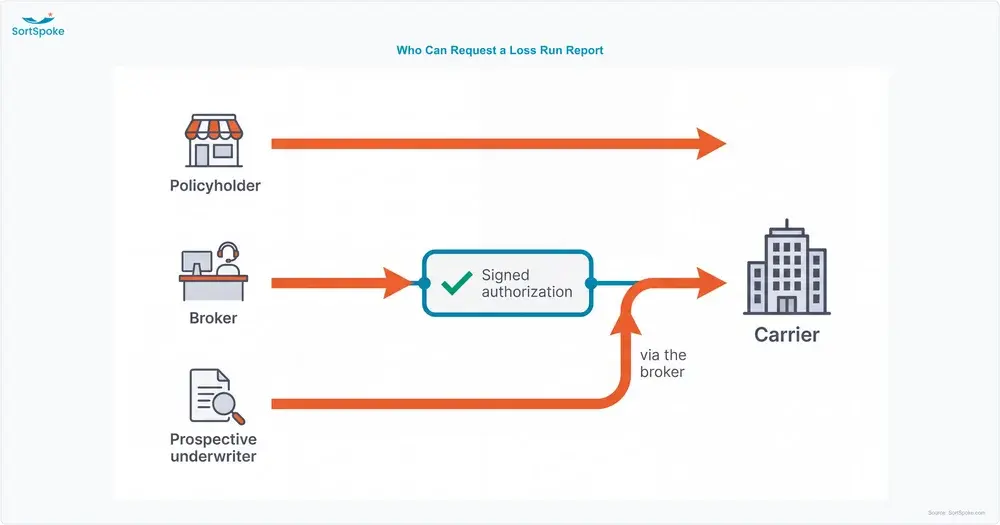
Loss runs are generated by the insurance carrier that wrote the policy, and carriers will only release them to parties with a right to the information:
- The policyholder (named insured). The business that bought the policy can always request its own loss runs, from its current carrier and from any prior carrier — even years after the policy ended.
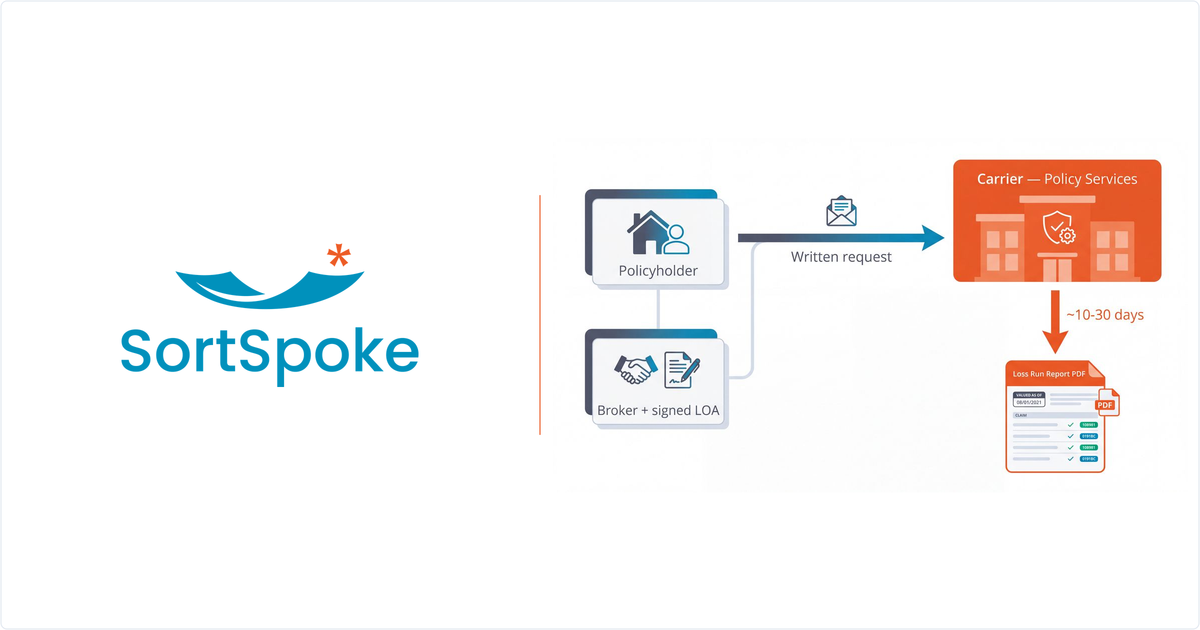
- A broker or agent with signed authorization. If a broker is requesting loss runs on a client's behalf — common when remarketing an account — the carrier will typically require a letter of authorization (LOA) signed by the insured before releasing the reports.
- A prospective carrier or underwriter, via the broker. Underwriters quoting new business don't request loss runs from a competing carrier directly; the broker gathers them from the insured's current and prior carriers and includes them in the submission.
Not sure what you're asking for? Start with what a loss run report contains — this guide focuses on getting one in hand.
How to Request a Loss Run Report, Step by Step
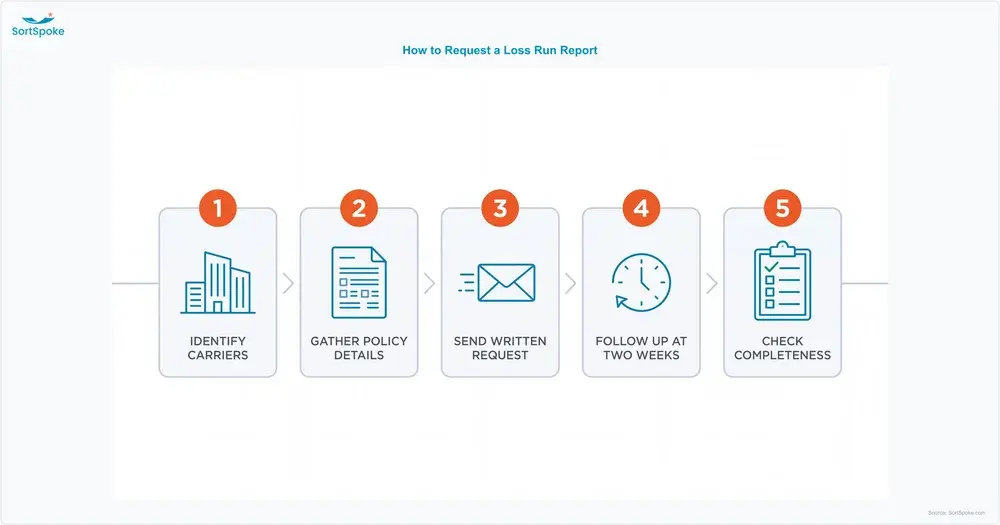
- Identify every carrier that wrote coverage in the period you need. Underwriters typically expect 5 years of history, and accounts change carriers — so list the current carrier plus every prior carrier across that window. Policy declarations pages and the broker of record are the fastest sources.
- Gather the policy details for each carrier. Named insured (including any DBAs), policy numbers, and policy effective dates. A request that includes exact policy numbers is dramatically harder for a carrier service desk to stall on.
- Send a written request to each carrier. Address it to the carrier's policy services, customer service, or loss run department — or route it through the agent of record. Written requests matter: state turnaround requirements are generally measured from a written request, and a paper trail gives you something to escalate with. Use the letter template below.
- Follow up if nothing arrives within two weeks. Reply to your original request rather than starting a new thread, restate its date, and ask for a delivery date. If the account is with an agent or broker, copy them — they often have contacts who can move it.
- Check the reports for completeness when they arrive. Confirm every policy year you requested is covered, the valuation date is recent, and each line of coverage is included. Gaps are easier to fix while the request is fresh in the carrier's queue.
How Long Does It Take to Get Loss Runs?
Most U.S. states require carriers to produce loss runs within roughly 10 to 30 days of receiving a written request from the insured or their authorized representative. The exact requirement varies by state, but the practical takeaway is the same: a written request starts a clock carriers take seriously, and many deliver inside it — often within 7-10 business days.
Three things reliably slow requests down: missing policy numbers, a missing signed authorization on broker-submitted requests, and requests sent to a general inbox instead of the carrier's policy services or loss run team. Getting those three right up front is usually the difference between a one-week turnaround and a one-month one.
Renewal timing tip
Request loss runs 60-90 days before a renewal or remarketing effort — enough room for a slow carrier, a follow-up cycle, and a re-request if a report comes back incomplete.
What to Include in Your Loss Run Request
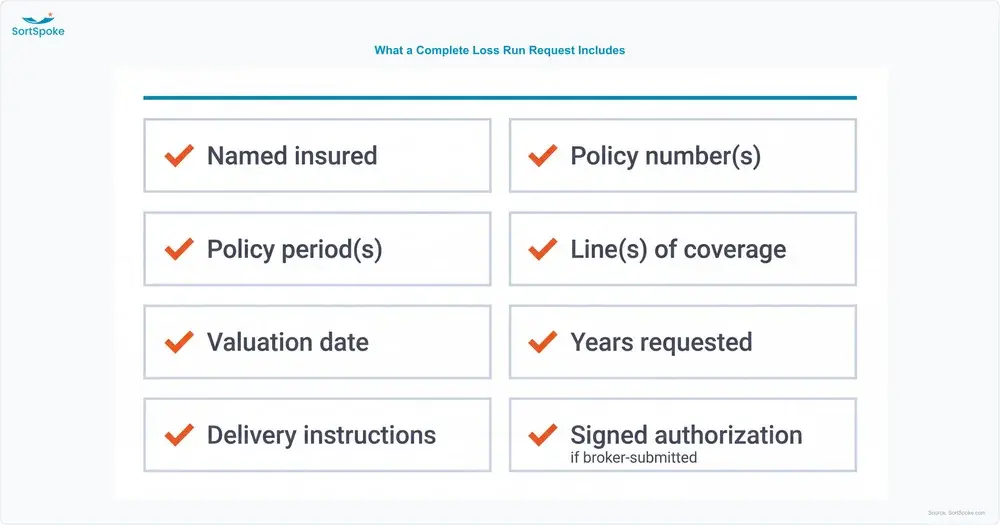
A complete request gives the carrier everything it needs to pull the report without a clarification round trip:
- Named insured — the full legal name on the policy, including any DBAs or subsidiary names coverage was written under
- Policy number(s) — every policy you need history for; if a number is unknown, say so and give the effective dates instead
- Policy period(s) — the effective dates for each year requested
- Line(s) of coverage — general liability, workers compensation, commercial auto, property, umbrella — name each one explicitly
- Valuation date — ask for currently valued loss runs (valued as of the most recent date available), so open-claim reserves reflect today's numbers
- Years requested — 5 years is the standard ask; request more if the account has long-tail claims history, as workers comp loss runs often do
- Delivery instructions — the exact email address or portal the reports should go to
- Signed authorization — if a broker or other representative is requesting on the insured's behalf, attach the signed LOA to the request itself
Loss Run Request Letter Template (Copy and Send)
Fill in the bracketed fields and send this to each carrier's policy services or loss run department — or to the agent of record for that policy. If you're a broker requesting on a client's behalf, attach the signed authorization.
[Date]
[Carrier Name]
Attn: Policy Services / Loss Run Department
[Carrier Address or Email]
Re: Loss Run Request — [Named Insured] — Policy #[Policy Number(s)]
To Whom It May Concern:
Please provide currently valued loss run reports for the insured below, covering the past five (5) policy years:
Named insured: [Full legal name, including any DBAs]
Policy number(s): [All applicable policy numbers]
Policy period(s): [Effective dates for each year requested]
Line(s) of coverage: [General liability / workers compensation / commercial auto / property / other]
Valuation date: [Most recent available]
Please deliver the reports to [Name] at [Email Address]. If anything further is required to release these records, contact me at [Phone / Email].
[If submitted by a broker or representative:] A letter of authorization signed by the insured is enclosed.
Thank you for your prompt attention. We would appreciate delivery within your standard turnaround and in accordance with applicable state requirements.
Sincerely,
[Name]
[Title, Company]
[Phone / Email]
Send one request per carrier — each can only produce loss runs for the policies it wrote, and per-carrier requests keep the follow-up trail clean.
Can You Get a Loss Run Report Online?
Sometimes — it depends on the carrier. Some carriers let policyholders or their agents download loss runs directly from a self-service portal, which is the fastest path when it exists. There's no universal system, though: each carrier's portal covers only its own policies, so an account with three prior carriers still means three separate retrievals.
Third-party retrieval services — Loss Run Pro is the best-known — route requests to thousands of carriers and MGAs from one place, and can save real chasing time on accounts with many prior carriers. What no retrieval service changes is what arrives: each carrier still sends its own report, in its own format — which is where the next section picks up.
What to Do When the Loss Runs Arrive
Getting the reports is the halfway point. Before anyone quotes off them, confirm every requested policy year and line of coverage is present, the valuation date is recent enough to trust the open-claim reserves, and the named insured matches across reports (DBAs and subsidiary names cause silent gaps).
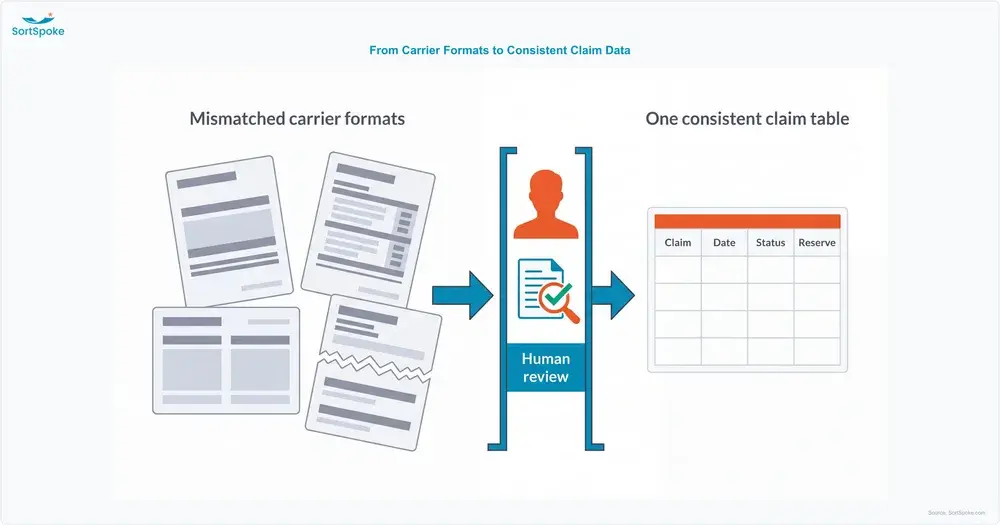
Then comes the real work: turning a stack of carrier-specific PDFs — each with different columns, layouts, and claim descriptions — into consistent claim-level data an underwriter can actually price from. For teams handling this at volume, that's the step worth automating, and the loss run processing tools on the market range from outsourced data entry to AI extraction. SortSpoke handles extracting loss run data across carrier formats with greater than 95% real-world extraction accuracy on loss run documents, measured against actual production data across varied carrier formats, layouts, and document qualities — and every extracted field either clears the confidence threshold your team sets or routes to your own reviewers before it's used. The underwriting team stays in control of what the data says, no matter which carrier's format it arrived in.
FAQ
How long does it take to get loss runs?
Most U.S. states require carriers to produce loss runs within roughly 10 to 30 days of a written request, and many carriers deliver in 7-10 business days in practice. Follow up in writing if nothing has arrived within two weeks; a complete request with policy numbers and any needed authorization keeps you on the fast end of that range.
Can I get loss runs online?
Some carriers offer self-service portals where policyholders or their agents can download loss runs directly, but there is no universal system — each portal covers only its own policies. Brokers sometimes use third-party retrieval services that route requests to many carriers at once; otherwise, a written request to each carrier is the standard path.
Are loss run reports free?
Carriers generally provide loss runs at no charge to the current or former policyholder or their authorized representative — producing them is treated as part of servicing the policy. Third-party retrieval services that request loss runs on your behalf may charge for the convenience, but the reports themselves typically cost nothing.
How many years of loss runs do I need?
Five years is the standard request — it's what most underwriters expect to see before quoting a risk. For accounts with long-tail claims history, such as workers compensation claims that stay open for years, some underwriters ask for 7-10 years to see how those claims developed.
Getting Loss Runs: Key Takeaways
1
Loss runs come from the carrier that wrote each policy. The policyholder can request them directly; a broker needs the insured's signed authorization.
2
Put the request in writing, with the details that prevent stalls — named insured, policy numbers, policy periods, lines of coverage, valuation date, and 5 years of history.
3
Expect roughly 10-30 days, often faster. Most states require carriers to produce loss runs within that window of a written request; follow up after two weeks.
4
Arrival isn't the finish line. Check completeness, then plan for the format problem — every carrier's report looks different, and governed, human-reviewed extraction is how teams turn them into consistent data at volume.
Once the loss runs are in hand, see how SortSpoke turns any carrier's format into claim-level data — under your own team's review. See a demo →