Loss Runs and Submission Intake Are Getting the Industry's Attention. Here's What Comes Next.
- Two deals aimed at intake
- Speed moves the bottleneck
- Count the steps you remove
TL;DR
- The industry is spending on intake. Applied bought Tailwind to retrieve loss runs for brokers, Guidewire agreed to buy hyperexponential to speed up carrier pricing, and underwriting leaders told Insurance Business that submission intake is their biggest challenge.
- Neither deal covers the step in between: turning a stack of loss runs and submission documents into data a pricing model can trust.
- Win the broker, not the extraction benchmark. Count the steps you remove and the time to first quote, not the fields you prefill.
In the space of a month, two of the biggest software vendors in insurance made acquisitions, and one of the industry's main trade publications explained why.
On October 27, Guidewire agreed to acquire hyperexponential for $1.7 billion in cash. hyperexponential makes AI underwriting and pricing software for commercial P&C insurers. On November 24, Applied Systems announced it has acquired Tailwind, a company whose AI retrieves loss runs, policies and other carrier documents for brokerages. The next day, Insurance Business published a feature drawn from about 150 interviews with carrier, MGA and wholesale leaders. It found that submission intake came up more than any other challenge.
Two of these are acquisitions and one is reporting, but all three make the same point. The work of turning loss runs and submissions into usable data used to be back-office plumbing. Now it is where the industry is spending its money and its attention.
What Applied is buying
Tailwind calls itself the brokerage's "digital mailroom." It pulls loss runs and non-downloaded policy documents from carriers and files them. According to Applied, it serves top 100 brokerages across the US.
The integration plan is the interesting part. Applied says loss run data retrieved through Tailwind will be pre-populated into renewal and new business submissions, as part of its Epic Conductor AI platform. Applied CEO Graham Blackwell described the problem as data "locked in documents behind carrier portals and across fragmented systems."
So the largest agency management vendor is treating loss run retrieval as core infrastructure, and it is putting that capability inside the system brokers already use every day, not in another tool.
What Guidewire is buying
hyperexponential sits at the other end of the same transaction. Its software helps carrier underwriters triage submissions, assess risk and price it. Guidewire says insurers using it "will be able to respond to more submissions, faster," and hyperexponential CEO Amrit Santhirasenan describes the combination as covering everything "from submission to bind."
So the core-systems vendor for carriers and the management-system vendor for brokers are both paying to speed up the same submission, one from each side. The Guidewire deal hasn't closed yet; Guidewire expects it to complete in its fiscal second quarter of 2027.
What underwriting leaders told Insurance Business
The Insurance Business piece looks at the other side of the same transaction: the carriers, MGAs and wholesalers who receive submissions. Its findings:
- Extraction is largely solved. The harder question is what happens to the data once it arrives.
- Prefilling fields isn't the same as removing steps. Amwins CTO Michael DeGusta warned that faster extraction alone can disappoint. More on his point below.
- Speed to quote is what counts. Kate Walas, COO of Upland Specialty, said: "In the midsize casualty space, the first quote back to the broker is usually the winner."
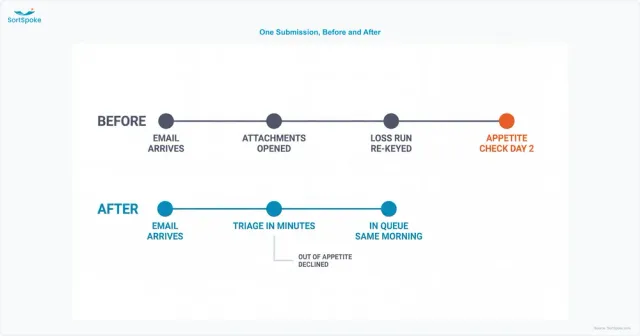
- Triage comes before extraction. The leaders furthest along check appetite before anyone opens a file, and missing loss runs trigger a note back to the producer automatically.
- Judgment still matters. Jimcor's Kristen Skender: "AI can analyze the loss runs, but it's not going to know what's behind the curtain."
Why these stories belong together
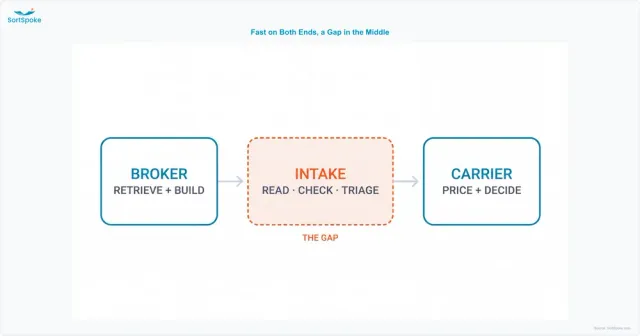
Put them side by side and you can see where things are heading. On the broker side, Applied is making it faster to pull loss runs and assemble submissions. On the carrier side, Guidewire is making it faster to price and decide. That means more complete submissions arriving sooner, and pricing tools waiting to act on them.
That's good news for underwriters, but only if the receiving side keeps up. If brokers speed up and carriers and MGAs don't, the bottleneck moves to underwriting instead of going away. A broker who can send a full submission in an hour will send it to whichever market quotes first.
What neither deal covers is the step in between: turning a stack of PDFs into data a pricing model can trust. A rating engine is only as good as the loss history and exposure data it receives. hyperexponential's own 2025 survey of 350 underwriters and actuaries found that commercial and specialty underwriters spend up to three hours a day on manual tasks like data entry. That's the gap between the two acquisitions.
The loss run is the clearest example. Every carrier formats them differently, a single PDF can hold dozens of claims across several policy years, and underwriters still often re-key them into a spreadsheet before they can price anything. Retrieving loss runs faster doesn't help much if reading them still takes an afternoon.
Our take: win the broker, not the extraction benchmark
The line from the Insurance Business piece that we agree with most comes from DeGusta:
"Are we going from we prefilled nothing back in the day to now we can prefill 10 fields, now we can prefill 20 fields, but you're still fundamentally clicking through the same process that you always had? Or can you actually change the process? Skip whole steps."
He said the payoff comes when brokers can approach more carrier markets because each submission is easier to send. That's the right way to think about it. Intake isn't a data-entry problem. It's a broker-relationship problem.
Here's what we think wins:
- Make it easy for brokers to send you submissions. Take them the way brokers already send them: an email with a pile of attachments in whatever format the last carrier produced.
- Reply quickly. The first quote back is usually the winner, and a fast "no, this isn't for us" beats a slow one too.
- Make the reply relevant and insightful. Tell the broker exactly what's missing, what you noticed in the loss history, and what it would take to get to a quote.
- Show you want to help place the risk. Brokers remember the markets that worked with them, not the ones that sent a form letter.
Technology doesn't do any of this on its own. It's the key that unlocks the opportunity: it gives your underwriters back the hours they spend re-keying loss runs, so they can spend them on the broker. Your people will always be the difference maker. That's why the teams getting the most out of AI in underwriting treat it as a change management project as much as a technology one. They keep underwriters in the driver's seat, take the admin work off their plate, and let them spend the time on what they're best at: judging risk and working with brokers.
Here is how we build the technology side of that, so steps actually disappear instead of fields getting prefilled.
1. Take any submission, and triage the whole thing
SortSpoke reads submissions as they arrive, in whatever layout the broker sends, without templates to maintain for each carrier's loss run format. And a loss run on its own doesn't tell you whether a risk fits your appetite. You need it alongside the ACORD application, the schedule and the broker's email. SortSpoke's submission triage runs your appetite rules on the data extracted from the submission's documents, and a conflict between two documents doesn't stop triage. Out-of-appetite risks can be declined, missing documents flagged and priority accounts moved up before an underwriter opens anything. That's what makes a fast, specific reply to the broker possible.
2. Work inside the tools your team already uses
Applied and Guidewire are both betting that data should land in the systems where the work already happens, and we agree. SortSpoke embeds inside underwriting workbenches, policy admin systems and in-house tools, and passes clean, structured data to the pricing and rating tools downstream, so underwriters review documents without a new login or another screen. That's how you get rid of a step instead of adding a tab.
3. Keep a person on the judgment call
Skender's point about what's "behind the curtain" is the right one, and it's the same point as above: the people are the difference. AI should do the reading. Underwriters should make the decisions and own the broker relationship. Every SortSpoke extraction carries a confidence score, and the human-in-the-loop review sends low-confidence fields to a person to check. Reviewing is not a drag on speed. It's what lets a team trust the data enough to stop double-checking it, and that's where the time actually comes back.
Teams using SortSpoke this way have seen:
- Submission review times down nearly 90% at a major Canadian P&C carrier
- Document review cut from up to an hour to about 8 minutes at OneDigital
- 50% less manual data entry for underwriters at RGA
Five questions to ask about your own intake
If loss runs and submissions are on your 2027 roadmap, these are better tests than "how many fields can it extract?":
- How easy is it for a broker to send you a submission, and how quickly do they hear back?
- Which steps went away? Count the steps you removed, not the fields you prefilled.
- How long does it take from submission received to first quote? Measure it before you change anything.
- Does triage happen before or after someone opens the file?
- Where do loss runs end up, and who re-keys them? If the answer is "an analyst, into Excel," start there.
For a deeper look at the document itself, read our complete guide to loss run reports or see how loss run automation works in SortSpoke.
Try it
Check a real loss run yourself.
Open a sample loss run, see every extracted claim with its source, and check the values flagged for review.