The Winning AI Strategy in Underwriting Isn't the Technology. It's Your People.
- Adoption is a people problem
- Remove the admin, not the underwriter
- Put AI where underwriters work
TL;DR
- AI in underwriting usually stalls for people reasons, not technology reasons. The team wasn't asked, the tool added a screen, or nobody said what the time saved was for.
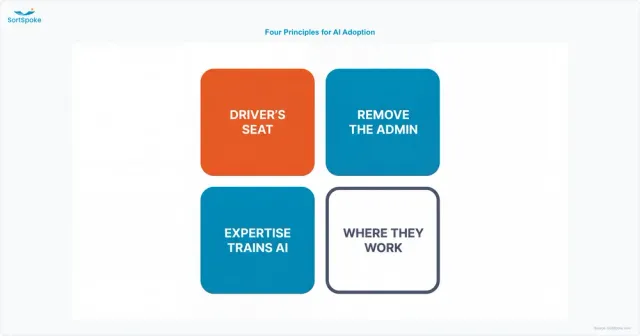
- The teams getting it right treat AI as a change management project with four principles: keep underwriters in the driver's seat, remove the admin work (not the underwriter), let their expertise train the AI, and meet them where they already work.
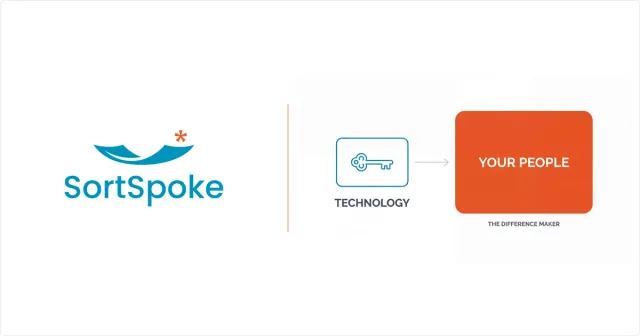
- The technology is the key that unlocks the opportunity. Your people are the difference maker.
In our recent post on loss runs and submission intake, we argued that technology alone doesn't win brokers. People do. This post is the practical follow-up: how to roll out AI in underwriting so your team actually uses it, and what to do with the time it gives back.
Why AI adoption in insurance stalls after the pilot
Most insurers have tried AI. Far fewer have made it part of how they work every day. In Bain's 2025 survey of 81 P&C insurers' claims functions, 78% were using generative AI but only 4% had reached scale.
When we look at stalled rollouts, the cause is rarely the model. It's usually one of three things:
- The underwriters weren't asked. A tool chosen by IT or innovation gets handed to a team that never agreed on the problem it was meant to solve.
- The tool added a screen instead of removing a step. If underwriters have to log into something new, check its output, then re-key it into the system they already use, AI has added work.
- Nobody said what the time saved was for. Silence gets filled with the worst assumption: that "efficiency" means fewer seats.
None of these are technology problems, and better extraction accuracy won't fix them. That's why BCG says most of an AI transformation is people and process, and why we treat every underwriting rollout as a change management project first.
Principle 1: Keep underwriters in the driver's seat
AI should do the reading. Underwriters should make the decisions and own the broker relationship.
Kristen Skender, chief growth officer at Jimcor, put it simply in a recent Insurance Business feature on submission intake: "AI can analyze the loss runs, but it's not going to know what's behind the curtain." The account history, the broker's context and the reason a risk is better than its paperwork suggests all live with your people.
In practice, keeping underwriters in the driver's seat means three things:
- AI shows its confidence. In SortSpoke, every extracted field has a confidence score. Uncertain values go to a person to check instead of flowing silently downstream.
- Someone owns every decision. Approval gates mean nothing moves on until someone signs off, so accountability doesn't get lost in the automation.
- Overrides are easy. If correcting the AI takes longer than doing the work by hand, people will stop correcting it and start ignoring it.
Regulators are heading the same way. The NAIC's AI Model Bulletin names the extent of human involvement in final decisions as one of the factors insurers should weigh. For more on this design choice, read why the best insurance AI keeps humans in the driver's seat.
Principle 2: Remove the admin work, not the underwriter
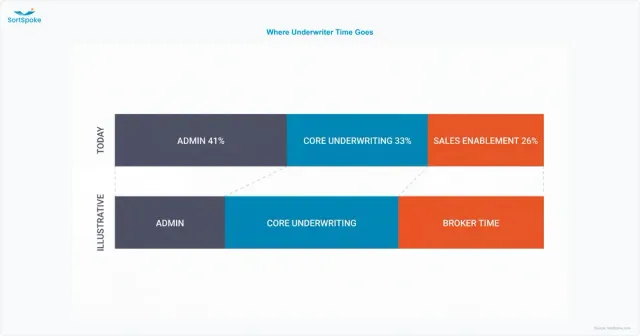
The burden is real. Commercial underwriters spend about 41% of their time on administrative work such as data entry and record keeping, against 33% on core underwriting (Capgemini, 2024 survey of 201 underwriters). In hyperexponential's 2025 survey, 73% of underwriters said burnout was a growing concern.
So the pitch to your team shouldn't be "AI will make you faster." It should be "AI will take the part of the job you like least." Then be explicit about where the time goes. Here is what some of the leaders Insurance Business interviewed are doing:
- Jimcor is cross-training the associates who handle clearance and triage, so they move into higher-value work.
- Upland Specialty moved its clearance team into quality control once AI took over ingestion.
- Arrowhead Programs built underwriting rules into intake, and its Tom Kussurelis estimated that saving ten underwriters an hour a day adds the equivalent of another fully trained underwriter.
Insurance Business called this "move people up, not out." Say it out loud, put it in writing, and tie it to goals your team cares about: more submissions quoted, faster replies to brokers, better risk selection. Not fewer seats.
Principle 3: Let their expertise train the AI
Your underwriters' corrections are the most valuable training data you have. SortSpoke starts from insurance-trained models and then learns from each customer's accepted documents, so the people who know your business shape how the system reads it.
That changes how the team feels about the tool. Software they're asked to babysit is a burden. Software that gets better because of their judgment is something they own. Teams that shaped a tool use it.
Joe Lettween, Fortegra's chief innovation, data science and technology officer, made a related point to Insurance Business about keeping data mapping in-house: "Why would you outsource that core responsibility to somebody else who doesn't even know it as well as you do?" Expertise is an asset to build on, not something to automate away. Our post on why the talent crisis is really a knowledge crisis goes deeper on this.
Principle 4: Meet them where they already work
Every new login is a reason to fall back to the old way. Where the AI lives is a change management decision as much as a technical one.
Half of insurers cite legacy-system integration as their primary barrier to deploying AI at scale (Accenture, 2026). The answer isn't asking underwriters to move to a new platform. It's bringing the AI into the workbench or policy admin system they already use. SortSpoke embeds inside existing underwriting tools for exactly this reason: no new login, no extra tab, and the data lands where the work already happens. The industry's largest vendors are making the same bet, as the recent Applied and Guidewire acquisitions show.
A rollout playbook for underwriting leaders
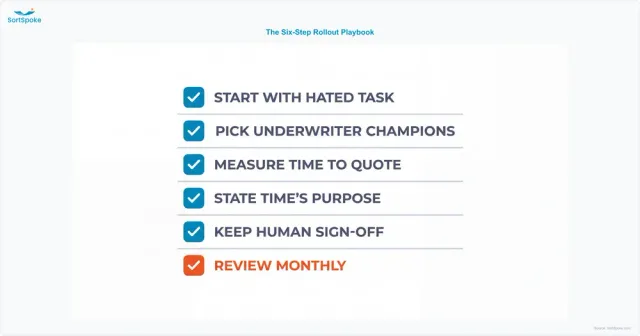
If you're planning an AI rollout in underwriting for 2027, or trying to restart a stalled one, here's the sequence we've seen work:
- Start with the most hated task, not the most impressive demo. Usually that's re-keying loss runs or clearing submissions. Relief builds goodwill faster than novelty.
- Pick underwriter champions early, and let them set the acceptance criteria. If the people doing the work define "good enough," they'll defend the result.
- Measure steps removed and time to quote, not fields extracted. Fields extracted is a vendor metric. Time to quote is a broker metric.
- Say in writing what the time saved is for. More quotes, faster broker responses, better risk selection. Make it a team goal.
- Keep a human sign-off on decisions, and make overrides visible. Visibility builds trust in both directions: leaders see where the AI struggles, and underwriters see that their corrections count.
- Review monthly with the team. What did the AI get wrong? Which step can go next? Treat the rollout as a process you keep improving, not a launch you finish.
Teams that follow this kind of approach see results. RGA saw 50% less manual data entry for underwriters, and a manager in its global digital underwriting team said "Training was quick." A major Canadian P&C carrier cut submission review times by nearly 90%. For staffing the review work itself, see four ways to staff a human-in-the-loop AI operation.
The bottom line
AI in underwriting succeeds or fails on adoption, and adoption is a people problem. Keep underwriters in the driver's seat. Take the admin off their plate. Let their expertise make the system better. Put the AI where they already work.
The technology is the key that unlocks the opportunity. Your people will always be the difference maker.
Free tool
See what intake costs your team.
Benchmark your underwriting team in two minutes and see where the hours go.