6 Best Loss Run Processing Tools (2026)
By SortSpoke

There's a persistent myth in insurance technology: that human-in-the-loop AI is a temporary compromise—a stepping stone on the path to full automation. According to this thinking, we keep humans involved because the AI isn't good enough yet. As AI improves, human oversight will become unnecessary.
That's backwards.
For complex, high-stakes work like insurance, human-in-the-loop isn't the training wheels. It's the architecture that actually works.
First, let's clear up what we're talking about—because "human-in-the-loop" has become a buzzword that means different things to different people.
Human-in-the-Loop AI
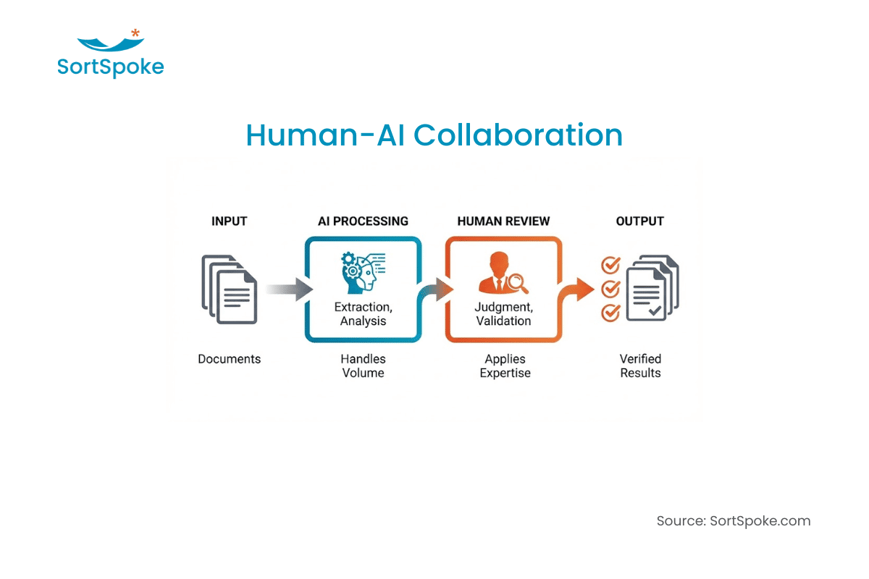
Human-in-the-loop AI refers to systems that integrate human expertise at critical points in the workflow. Instead of running autonomously end-to-end, the AI handles what it handles well while humans verify, correct, and make final decisions where judgment matters.
Here's what that looks like in practice:
AI handles the heavy lifting. The system extracts data from documents, identifies patterns, flags anomalies, and presents structured information for review. This is the work that's repetitive, time-consuming, and prone to human error from fatigue or distraction.
Humans verify what matters. An underwriter reviews the AI's extraction, confirms accuracy, and applies judgment to edge cases. A claims adjuster validates the AI's assessment against their experience. An expert catches the nuances the model wasn't trained on.
The system learns from corrections. When humans adjust AI outputs, those corrections become training data. The AI gets smarter over time, not through abstract model improvements but through direct feedback from the people who know the work best.
This is AI designed for collaboration—where the machine handles volume and the human handles judgment.
One industry analyst put it well: "AI is the autopilot. But in high-stakes environments, the human pilot remains in the cockpit, ensuring the safe landing."
Insurance work has characteristics that make human-in-the-loop particularly valuable.
Documents are messy. An ACORD form might look standardized until you've processed thousands of them and know all the ways people fill them out wrong. Handwritten notes, inconsistent formats, missing fields—this is the reality. AI handles the pattern matching. Humans catch the exceptions.
Judgment calls matter. There's a difference between automating data entry and automating decisions about risk. A 25-year underwriter sees things the AI doesn't—context from previous broker interactions, industry trends outside the training data, red flags that require experience to recognize. That judgment can't be automated; it can only be augmented.
Stakes are high. Insurance decisions affect real people. A denied claim impacts financial security. An underpriced policy creates exposure. A compliance violation triggers regulatory action. Errors aren't just annoying—they're consequential.
Explainability is required. When a regulator asks "why did you make this decision?" you need an answer better than "the model said so." Human-in-the-loop architectures provide that accountability naturally—because a human reviewed and approved the decision.
These characteristics explain why so many AI pilots struggle to scale. The technology works. The architecture needs to match the work.
Here's the statistic that explains why human-in-the-loop succeeds where full automation fails.
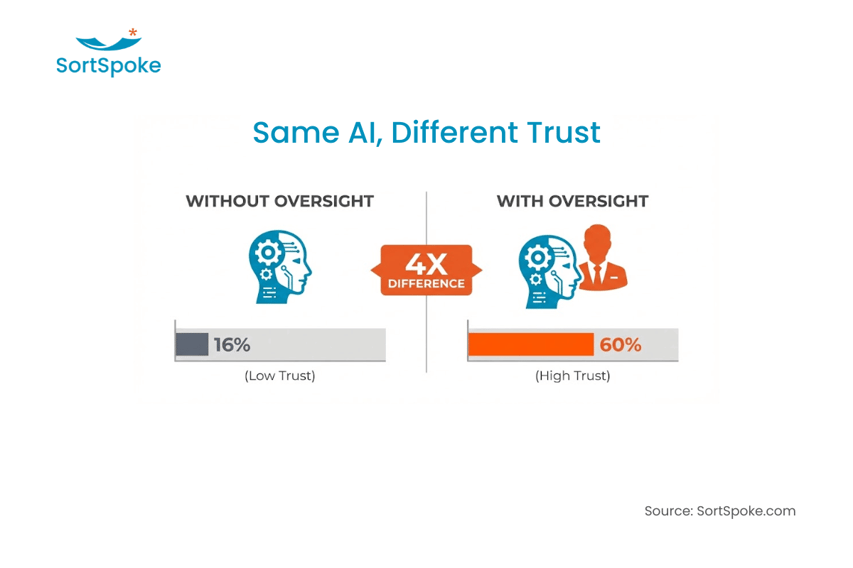
A 2025 survey by Wisedocs and PropertyCasualty360 of insurance claims professionals found that only 16% trusted AI outputs when the AI operated independently. But when human oversight was added to the process, trust jumped to 60%.
Same AI. Same outputs. The only variable: whether a human verified the result.
This 4x trust multiplier isn't about the AI being bad without oversight and good with it. The AI performs the same either way. What changes is how the team relates to the system.
When professionals trust the AI, they use it. When they use it, they provide feedback that improves it. When it improves, trust increases further. This virtuous cycle is how AI adoption actually succeeds.
Without that trust foundation, you get the opposite: teams that route around the AI, check everything manually, or simply stop using the tool. The efficiency gains evaporate. The pilot stalls.
Human oversight isn't a concession to AI limitations. It's the mechanism that enables adoption at scale.
For operations leaders evaluating AI solutions, here's what distinguishes human-in-the-loop architectures from full automation approaches:
Confidence scores that route edge cases. The AI doesn't pretend to be certain about everything. It outputs confidence levels that determine whether a result goes straight through or gets flagged for human review. High-confidence extractions flow automatically. Low-confidence items get expert attention.
Human review integrated into the workflow. Verification isn't a separate step bolted on after the fact—it's built into how the system works. The interface is designed for efficient human review, not as an afterthought.
Feedback loops that improve the system. When a human corrects an AI output, that correction trains the model. Over time, the AI handles more and the human reviews less—but the human never leaves the loop. The trajectory is toward efficiency, not toward removing oversight.
For insurance operations specifically, this means AI that understands your document types—ACORD forms, loss runs, schedules of values—not generic document processing. It means extraction trained on insurance terminology and formatting, not adapted from general-purpose models. The difference shows up in accuracy rates and, more importantly, in whether your team actually trusts and uses the system.
Audit trails that satisfy compliance. Every decision can be traced: what the AI recommended, what the human approved, when, and why. This isn't just good practice; it's increasingly required by regulation. Twenty-four U.S. states have adopted NAIC guidelines for AI governance, and states like California and Colorado now require human review for high-impact decisions.
RGA (Reinsurance Group of America) uses human-in-the-loop AI for life reinsurance underwriting. According to their team, "SortSpoke made one of the messiest and most manual problems in underwriting easy to solve."
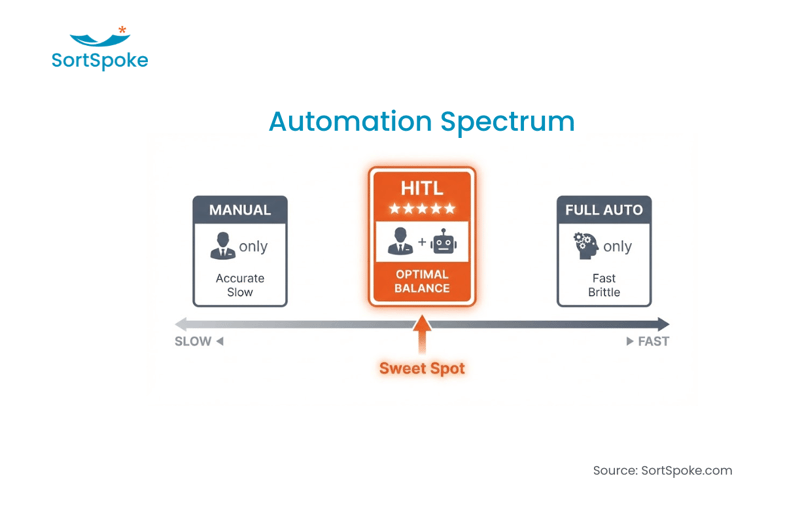
It helps to see human-in-the-loop as a position on a spectrum rather than a category on its own.
Fully manual processes are accurate but slow. Everything runs through human review. This approach doesn't scale, and it concentrates expertise in a bottleneck—the senior people everyone depends on.
Full automation is fast but brittle. AI handles everything end-to-end without human verification. This approach fails in complex environments because errors compound, trust erodes, and teams stop using the system.
Human-in-the-loop captures the advantages of both. AI handles volume and routine tasks. Humans provide judgment and catch exceptions. The result is faster than manual and more reliable than full automation.
The counterintuitive insight: human oversight enables more automation over time, not less. As the system earns trust through transparency and accountability, teams become comfortable expanding what it handles. The human stays in the loop, but their focus shifts from reviewing everything to reviewing what matters. For how this plays out as carriers adopt AI agents, see how agentic AI fits next to human-in-the-loop design.
Some expect that AI capabilities will eventually reach the point where human oversight is unnecessary. That expectation misreads what human-in-the-loop is for.
The value of human oversight isn't compensating for AI limitations. It's providing accountability, building trust, and ensuring decisions can be explained and defended.
Even as AI accuracy improves, the need for human accountability doesn't diminish. If anything, it increases. As AI systems handle more consequential decisions, the stakes of errors rise. The regulatory environment is trending toward more oversight, not less.
The smart money understands this. In January 2026, a startup literally named "Humans&" raised $480 million at a $4.48 billion valuation to build AI that empowers people rather than replaces them. The founding team includes alumni from Anthropic, xAI, and Google—people who helped build the most advanced AI systems in the world. Their bet: human-in-the-loop is the architecture that works.
That's not a contrarian take. It's pattern recognition.
Human-in-the-loop AI isn't a compromise or a limitation. It's how you build AI that your team actually uses, your regulators actually approve, and your customers actually trust.
The myth of full automation is seductive: remove the humans, cut the costs, scale infinitely. The reality is different. For complex insurance work, the human isn't the constraint—the human is the solution. Human oversight is what transforms promising technology into operational results.
The question for insurance operations leaders isn't "when will we be able to remove humans from the loop?" It's "how do we design human-AI collaboration for maximum effectiveness?"
Ready to see what that looks like in practice? Book a demo to see human-in-the-loop AI designed for insurance operations.
Commercial P&C Insurers Guide to Solving the Underwriting Bottleneck