
Automate CSIO Application and eDocs Data Extraction
Automate loss run report data extraction for faster, cleaner underwriting decisions — powered by human-in-the-loop AI
Digitizing a blank application is a form-building problem. Reading the completed one is a data-extraction problem. SortSpoke solves the second.
Those two jobs get talked about as if they were the same job. They are not. Turning a blank CSIO application into a fillable digital form is useful work, and it is a form-design exercise. What lands in an underwriter's queue is different: a completed document — signed, annotated, scanned, sometimes photographed, often attached to an email alongside four other files.
SortSpoke extracts structured data from completed insurance documents: CSIO applications, CSIO eDocs, ACORD forms, loss runs, and statements of values. No templates to build. No per-form model training.
- Completed CSIO applications, including the provincial automobile applications
- CSIO eDocs arriving from insurers through CSIOnet into your brokerage management system
- ACORD forms, loss runs from any prior carrier, and schedules of values in CAD
- Human-in-the-loop — per-field confidence scores, and your people keep authority over every decision
- Canadian data residency is available on request
New to the terminology? Start with CSIO documents explained.
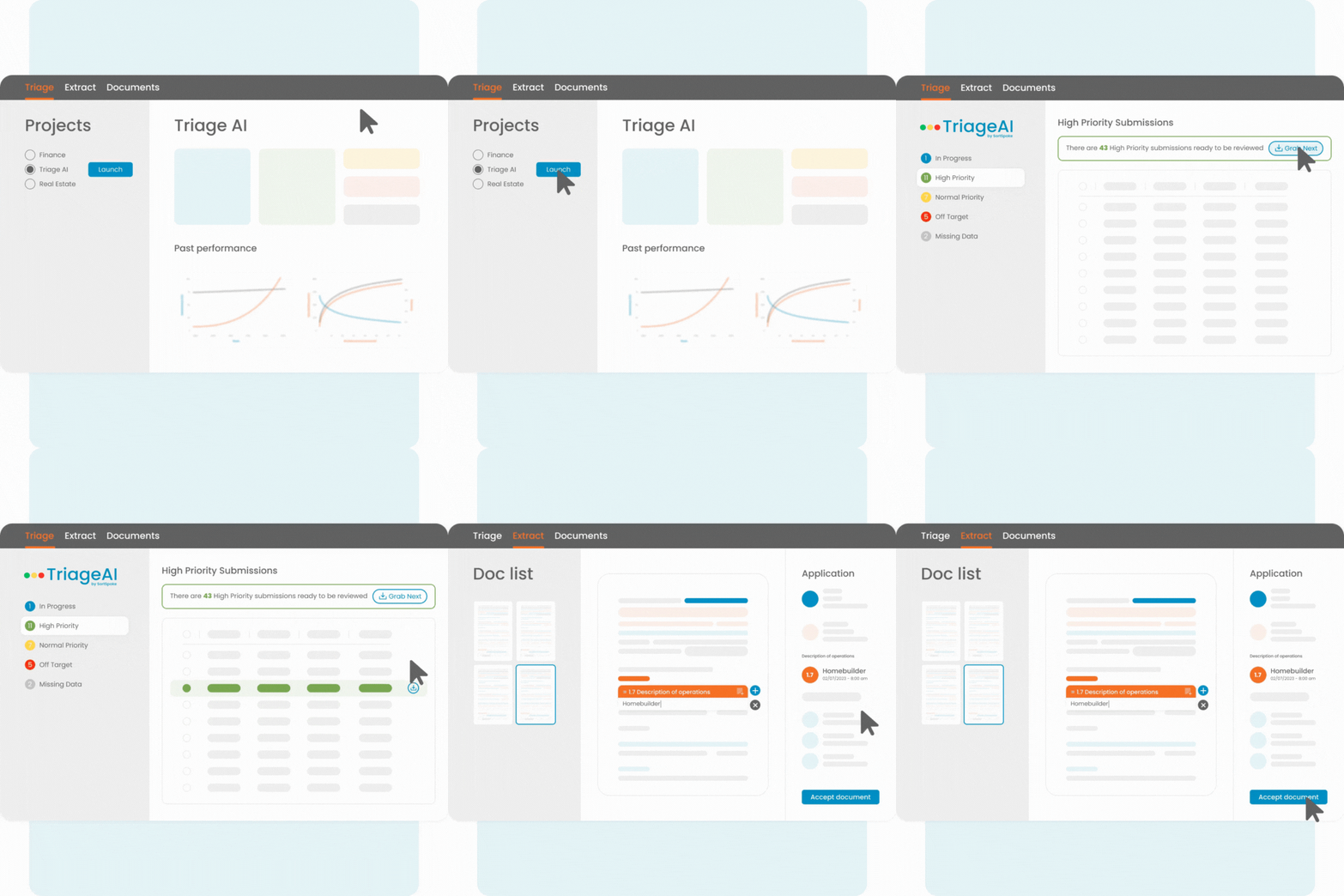





From a Completed CSIO Document to Reviewed Data
Extract Data Quickly
One extraction pass, reviewed once, used everywhere downstream.
- The document arrives — a completed CSIO application from a broker, a CSIO eDoc pulled down through CSIOnet, an ACORD form, a prior-carrier loss run, or an email with all four attached and a scanned page in the middle.
- SortSpoke extracts the fields from the completed document as it actually is, not as a template says it should be. No form-by-form configuration, and no model training per broker or per insurer.
- Your team reviews the exceptions with per-field confidence scores and thresholds you set. Anything below the threshold surfaces for a human; everything above it flows through. Judgement stays with your people.
- Reviewed data flows onward — into your brokerage management system, policy admin, rating engine or data warehouse, with an audit trail recording who approved which field and when.

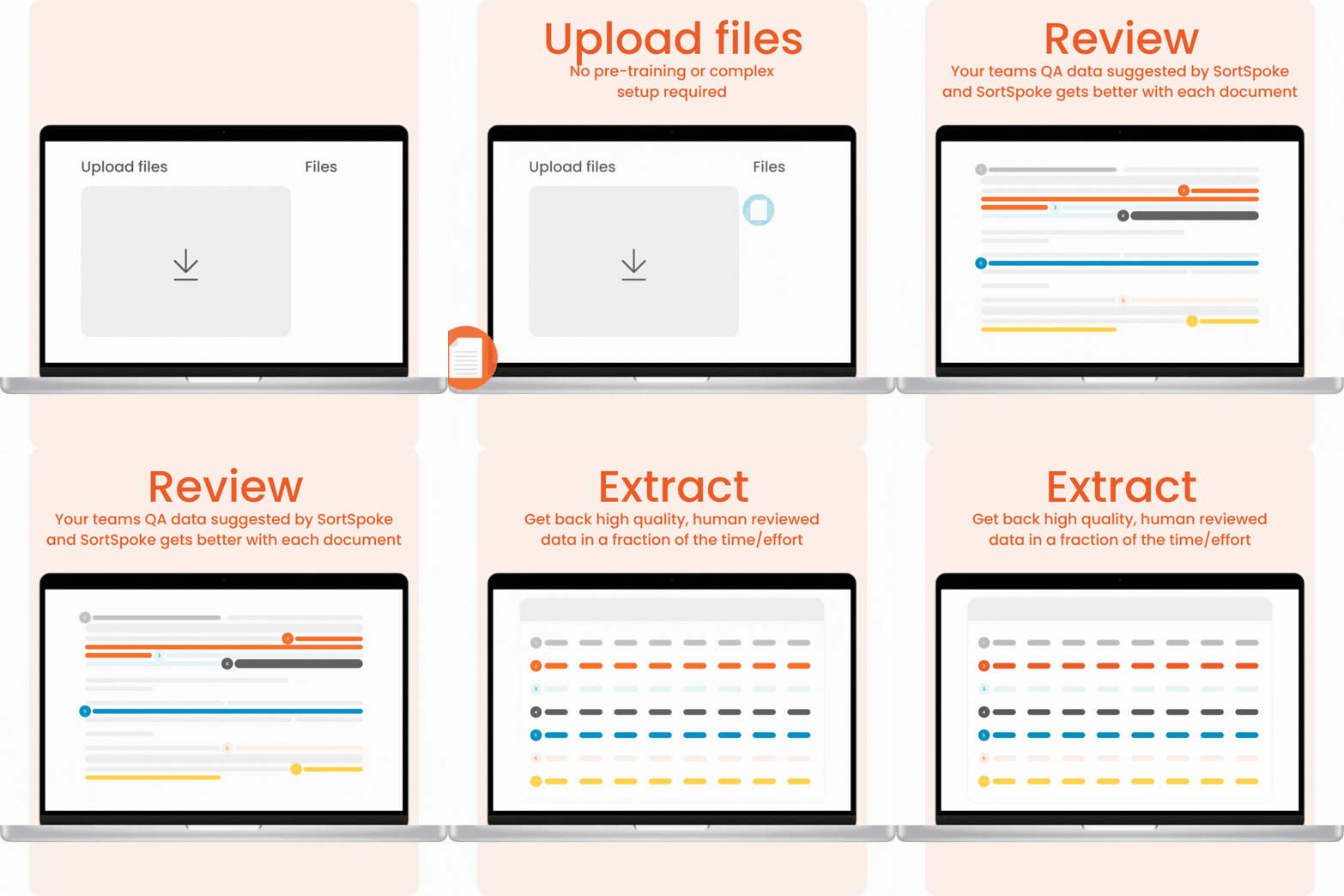
Extract Key Data 90% Faster
Underwriters can quickly and accurately extract data in a fraction of the time with 100% accuracy without the need for manual work, speeding up processes and reducing time spent on tedious work.
Why a Canadian-Market Platform Matters for CSIO Documents
A tool built only for the US market meets a Canadian submission and finds it strange. The forms are unfamiliar, the currency assumptions are wrong, the regulator vocabulary does not appear anywhere in its configuration, and the security questionnaire that follows asks questions it has no answer for.
The documents. CSIO applications and CSIO eDocs are not variants of ACORD paper — they are their own family, with provincial automobile applications underneath them and CSIOnet as the delivery rail. A platform that has never seen AB1001e or ON1001e treats them as generic PDFs and asks you to configure the difference away.
The currency and the schedules. Limits, deductibles, premiums and schedules of values come through in CAD. They should be captured as written, not silently normalized into someone else's assumption.
The oversight map. FSRA in Ontario, the AMF in Quebec, RIBO for Ontario broker licensing, provincial regulators elsewhere including British Columbia, and OSFI reaching federally regulated insurers — plus IBC industry codes running through the commercial data standards. None of that is exotic; it is just absent from a platform that was never built to encounter it.
The privacy questions. PIPEDA applies to the personal information moving through a submission, and Quebec's Law 25 asks an organization to assess privacy implications before information is communicated outside Quebec. Those are obligations that sit with you. What a vendor owes you is straight answers and documentation you can put in front of your own privacy officer — Canadian data residency is available on request, and data does not leave the region your deployment is configured for. SortSpoke is one of the few document-AI vendors that will put that in writing during procurement rather than after it.
More on how SortSpoke works in this market: SortSpoke in Canada.

Powerful, Simple, and Traceable
Underwriters can efficiently extract data with a system that’s easy to use and ensures every piece of data is traceable—without ever compromising on accuracy, even for the most complex submissions.

SportSpoke Platform | Security
Built for Enterprise
At SortSpoke, we understand that document processing in insurance and financial services demands the highest levels of security and compliance. Your sensitive data never leaves your control.
Our Security Foundation:
SOC 2 Type II compliant infrastructure built on AWS
Role-based access controls
Comprehensive audit logging and monitoring
Canadian Insurance Organizations Using SortSpoke
What SortSpoke Customers Say


What a First Conversation Looks Like
Bring one real document, not a roadmap.
Frequently asked questions
What is a CSIO application?
A CSIO application is an insurance application form published by CSIO — the Centre for Study of Insurance Operations, Canada's leading property and casualty insurance technology association. CSIO publishes national forms alongside provincial ones, because there is no single national automobile application in Canada. A brokerage in Ontario, Alberta, Quebec or British Columbia works from a different starting document, and a commercial book adds a national layer on top.
What are CSIO eDocs?
CSIO eDocs enable fast downloads of documents directly from an insurer's or vendor's system into a brokerage management system via CSIOnet — billing, claims, cancellations, policy transactions and underwriting requests across personal, commercial and farm lines. Around 45 million CSIO eDocs are sent annually. Delivery is solved; what the document says still has to be read by someone, or extracted.
Is CSIO the same as ACORD?
No. The published statement about the relationship is narrow and worth quoting exactly: the CSIO XML Standard is licensed to CSIO by ACORD. Beyond that sentence, anything you read about how the two bodies' formats relate is inference. Practically, a Canadian commercial book carries both CSIO documents and ACORD paper, and a submission often contains one of each.
Which CSIO forms can SortSpoke extract data from?
The provincial automobile applications — Alberta's SAF1 (AB1001e_202201, effective 2022-01-01) and SAF4 (AB1002e), Ontario's OAF1 (ON1001e), OAF4 (ON1002e) and OPCF 49 (ON1003e), and Quebec's QC1001e. The commercial applications CA4001e, CA4002e and CA4004e. The national certificate forms CA4301e and CA4302e. And beyond the CSIO families: CSIO eDocs across personal, commercial and farm lines, ACORD forms, loss runs from any prior carrier, statements of values and schedules in CAD, broker-specific supplementals, and email submissions with mixed and scanned attachments.
Is digitizing a blank CSIO application the same as extracting data from a completed one?
No — they are different problems. Turning a blank CSIO application into a fillable digital form is a form-design exercise, and it improves the document going out. Extraction runs the other direction: taking the document that came back in — completed, signed, scanned, sometimes photographed, often attached to an email alongside four other files — and turning it into fields a system can use. SortSpoke works on the return leg.
Where is our data processed, and are our documents used to train models?
Canadian data residency is available on request, and data does not leave the region your deployment is configured for. Your documents are not used to train models for anyone else. SortSpoke is SOC 2 Type 2 certified, and provides documentation to support your own PIPEDA assessment and your Quebec Law 25 privacy impact assessment.

Book a Demo
Pick a time that fits your schedule.

Bring Your Docs
Upload your messiest loss runs to SortSpoke

See Live Results
Watch us extract data from your files in real-time.
By clicking Book Now you're confirming that you agree with our Terms and Conditions.
BOOK A DEMO
See How SortSpoke Can Help You Process 5X More Submissions
After submitting, you'll choose your preferred date and time. Bring a completed CSIO application, a CSIO eDoc, or a messy broker email with attachments — and we'll run it live.

More on Canadian Insurance Documents
Everything you need to know about modernizing your loss run workflows

6 Best Loss Run Processing Tools (2026)

What is a Loss Run Report


