6 Best Loss Run Processing Tools (2026)
By SortSpoke
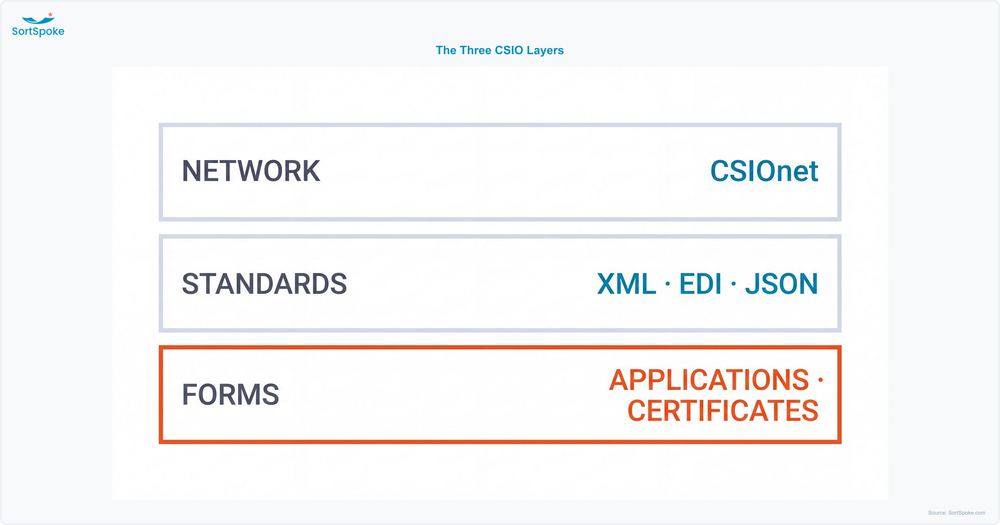
If you work in Canadian property and casualty insurance, CSIO is in your day whether or not you think about it — in the documents that land in your broker management system, in the application a broker sends you, and in the codes on the forms your underwriters read.
Most explanations of CSIO are either a one-line gloss or a login-gated member page. This is the plain version: what the organization is, what eDocs actually means, how the data standards relate to ACORD, which forms matter, and where the manual work still sits.
CSIO is the Centre for Study of Insurance Operations, Canada's property and casualty insurance technology association. It develops and governs the data standards Canadian brokers, insurers and software vendors use to exchange information, and it operates shared infrastructure including CSIOnet, eDocs, and its consumer eDelivery service. CSIO describes its role as bringing brokers, insurers and software providers together.
CSIO
Centre for Study of Insurance Operations — a Canadian industry technology association whose members include property and casualty insurers, technology vendors, and brokers who join through their provincial broker association.
Its stated mission is to “develop, govern, and promote the adoption of industry standards, and deliver secure reliable solutions and education to help streamline Property & Casualty insurance operations for the benefit of members and customers.”
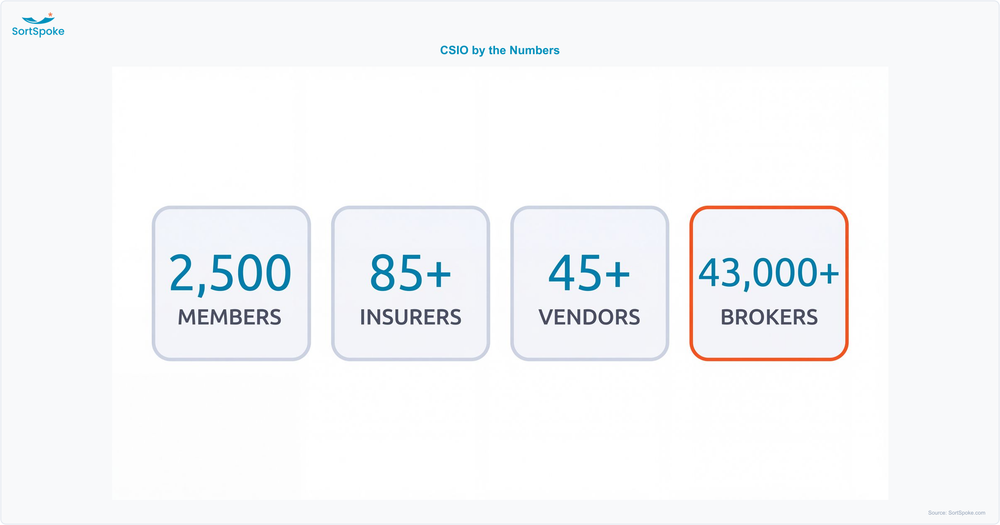
The scale figures CSIO publishes give a sense of how much of the Canadian market sits inside it:
CSIO also runs a Standards Certification Rating Program, which recognises insurers and broker management system vendors for their adoption of the standards. For a broker choosing a vendor, that rating is one of the few public signals of how completely a system implements what CSIO publishes.
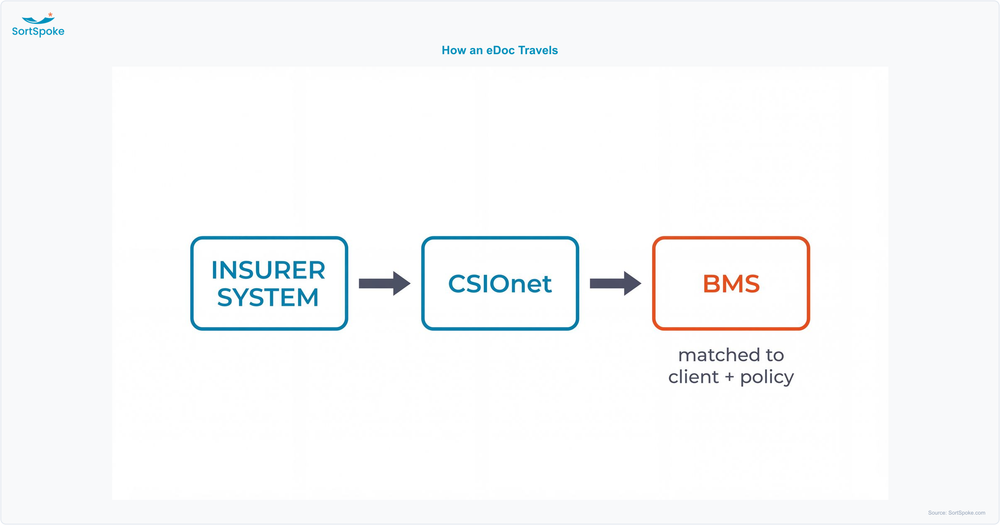
CSIO eDocs is the Canadian property and casualty standard for delivering completed policy documents from an insurer or vendor system into a broker's management system — it is a different thing from OpenText eDocs, the general-purpose document-management product that shares the name. If you searched “eDocs” and landed on enterprise content management, that is the collision.
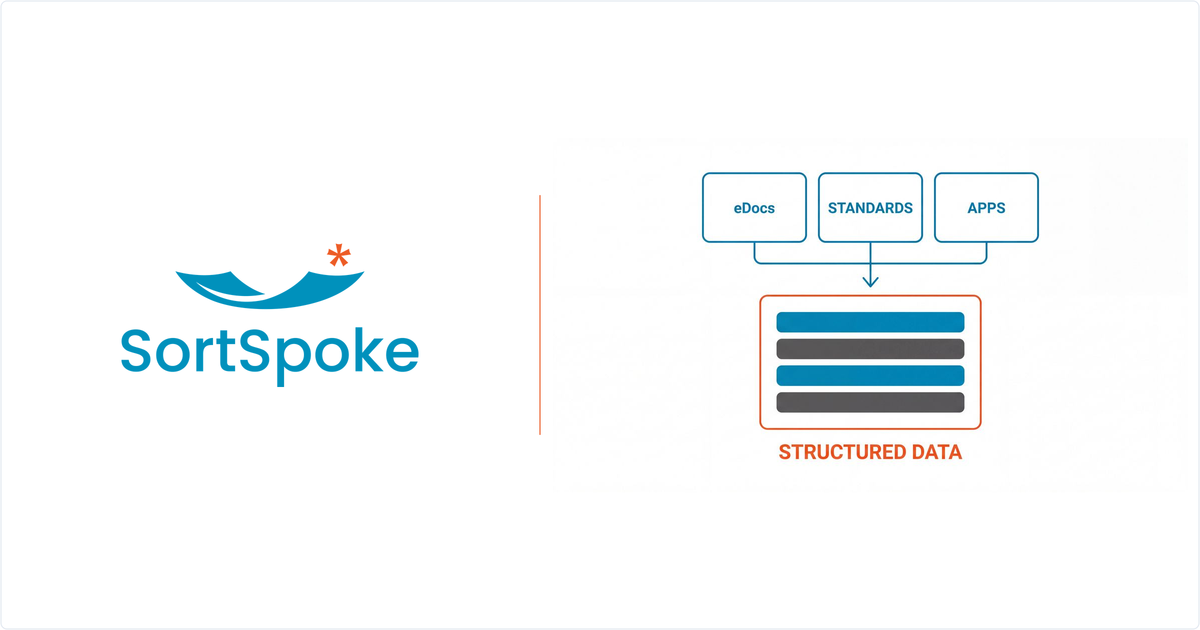
CSIO defines eDocs as enabling “smooth, fast downloads of documents directly from an insurer's or vendor's system to a broker management system (BMS), via CSIOnet.” The document arrives in the broker's system attached to the right client and policy, instead of arriving as an email attachment somebody has to file by hand.
What eDocs covers is broader than most people assume. It supports all lines of business — personal, commercial and farm — and all document types along the policy lifecycle:
CSIO reports that over 85 insurers, 45 vendors and 43,000 brokers use eDocs daily, and eDocs is made possible by the CSIO XML Standard. But what moves is the document, indexed to the right file. The content inside a PDF that arrives by eDocs still has to be read by a person, or by extraction software, before it becomes usable data in a downstream system.
The underlying infrastructure is CSIOnet, which CSIO describes as “the industry leader for fast, secure sharing of policy documents and information between insurance trading partners,” reached over a secure connection via CSIO's VPN or API. The behaviour of eDocs is documented in the eDocs Business Requirements, April 2025, version 1.06.
CSIO Data Standards are the published formats that let Canadian insurance systems exchange information with each other. CSIO puts it as “the language that keeps the industry's ecosystems communicating.” They cover policy documents, claims, billings, CSIOnet and eSlips, and they are refreshed monthly rather than issued as occasional major releases.
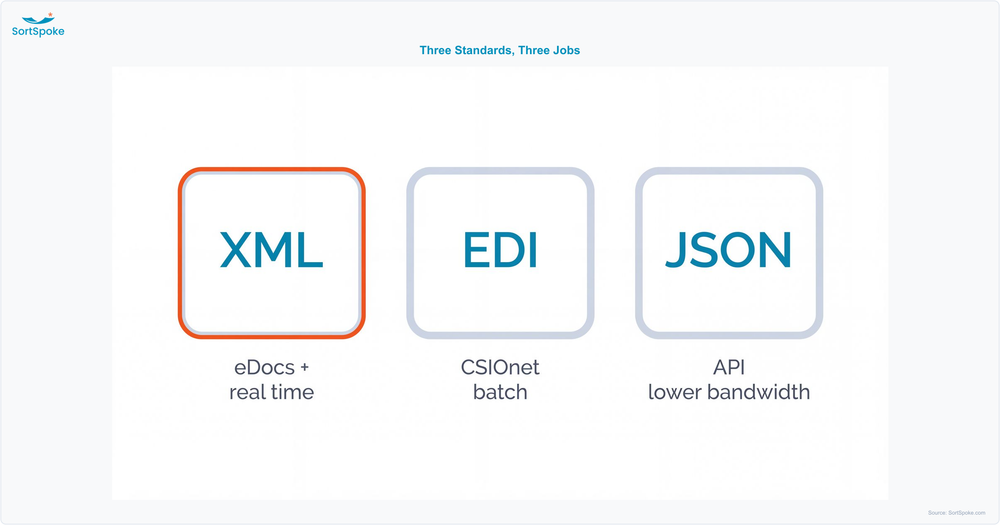
There are three sets, and they are not interchangeable.
| Standard | What it does |
|---|---|
| XML Standard | Enables eDocs and real-time transactions. Licensed to CSIO by ACORD. |
| EDI Standard | Powers CSIOnet batch processing. |
| JSON Standards | API standards, designed for lower bandwidth consumption. |
Alongside those, CSIO publishes API Security Standards and XML Dataset Standards. Named, versioned artefacts include the CSIOnet API Documentation (February 2025, v1.4) and the Commercial Lines Business Requirements (April 2025, v2.0).
The Commercial Lines Data Standards exist to let brokers quote and bind small commercial policies through APIs rather than by document exchange. They map 14 industry segments to 386 IBC codes — Contractors (70 codes), Retail (75), Business & Professional Services (78), Wholesale (40), Real Estate (24), Health Services (23) and Hospitality (21) among them.
That mapping is the quiet enabler of small-commercial digital placement in Canada. Without an agreed segment-to-code map, every carrier API expects a slightly different classification and the broker's system has to translate for each one.
Here is the part where most published explanations overreach, so it is worth being precise about what is documented and what is not.
“The CSIO XML Standard is licensed to CSIO by ACORD (Association for Cooperative Operations Research and Development).”
— CSIO press boilerplate
That single sentence is CSIO's published statement on the relationship. It establishes a licensing arrangement for one specific standard. It does not say CSIO is a Canadian branch of ACORD, a subsidiary, or a national chapter — and this post is not going to say it either.
What follows is inference, not CSIO's published position. For Canadian teams, the practical effect of that licensing arrangement is that CSIO's XML work sits on ACORD-derived foundations while CSIO governs the Canadian implementation, publishes the Canadian forms, and runs the Canadian network. In practice that means an underwriting team in Canada handles both CSIO documents and ACORD forms, and a system that reads one does not necessarily read the other. If you need a firmer statement than that, ask CSIO directly rather than trusting a blog post — including this one.
CSIO creates and maintains the standard forms and insurance applications used across the Canadian property and casualty industry, with fields mapped to the EDI and XML Data Standards. That mapping is what makes a form more than a PDF layout: each field has a defined home in the data standards, so a completed form has a known destination in a policy system.
Automobile applications are provincial, and the codes reflect that.
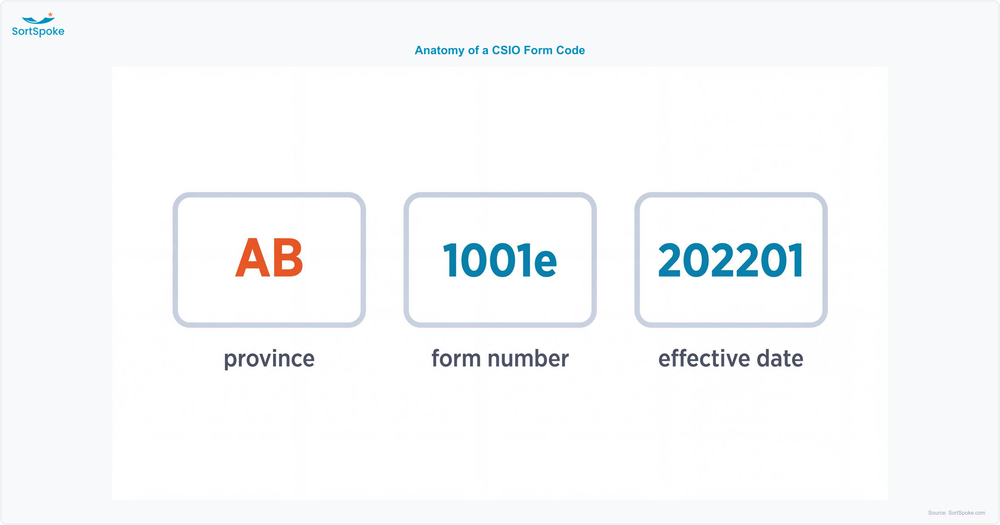
The Alberta Application for Automobile Insurance Owner's Form — SAF1 — carries the CSIO form code AB1001e_202201 and is effective January 1, 2022. Alberta's standard garage automobile application, SAF4, is AB1002e_202201. If someone hands you an Alberta auto application and you need to know which version you are looking at, the date suffix in the code is where to look.
Ontario's auto forms follow the same pattern with an ON prefix: ON1001e is the Ontario Application for Automobile Insurance (OAF1), ON1002e is the garage form (OAF4), and ON1003e corresponds to OPCF 49.
Quebec's application is QC1001e. The same 1001e series continues across New Brunswick, Newfoundland and Labrador, Nova Scotia, Prince Edward Island, Yukon, the Northwest Territories and Nunavut — so a national carrier writing auto is working from a family of related-but-distinct applications rather than one document.
Commercial forms carry a CA prefix rather than a provincial one:
The prefix is the tell: commercial forms carry CA where personal auto carries a provincial code. Read that way, a commercial team writing risks in Ontario, Alberta, Quebec or British Columbia works from a common application set while the personal auto side stays provincial. CSIO marks only the two certificate forms below explicitly as National, so treat the wider pattern as a reading of the numbering convention rather than a published CSIO statement.
CSIO publishes two national standard certificate of insurance forms used in commercial insurance: the Certificate of Liability Insurance (CA4301e), effective March 1, 2026, and the Certificate of Property Insurance (CA4302e), effective October 1, 2025. Both are designated National — one form across the country rather than a provincial series.
These are professional documents, issued by a broker to satisfy a third party's contractual requirement for evidence of coverage. The certificate holder is a general contractor confirming a subcontractor carries liability limits, a landlord confirming a commercial tenant's property coverage, or a municipality confirming a vendor's insurance before work starts. The audience is a risk manager or a contracts department, not a policyholder.
CSIO also operates a consumer-facing eSlip and eDelivery solution for personal lines policyholders. That is a different product for a different audience. The CA4301e and CA4302e certificate forms discussed here are commercial documents exchanged between businesses, and the two should not be handled as the same workflow.
For a commercial lines team, the operational problem with certificates is volume and turnaround: a construction or real estate account can generate hundreds of certificate requests, each needing verification against the underlying policy before issuance. The national standard form removes the layout variation; it does not remove the checking.
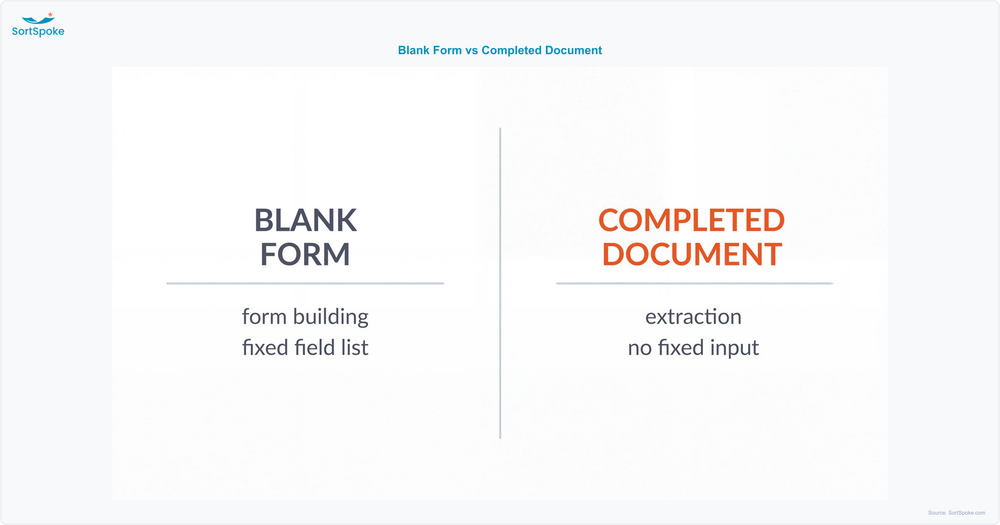
There is a distinction inside document automation that decides which technology you actually need, and it gets blurred constantly in vendor conversations.
| Problem | What it is | What solves it |
|---|---|---|
| Digitizing a blank CSIO application | Turning a PDF layout into a fillable web form so a broker can complete it online | Form-building software — a UI problem with a defined field list |
| Getting data out of a completed document | Reading a filled-in CSIO application, an eDoc, an ACORD form or a loss run and producing structured data | Document extraction — a variability problem with no fixed input |
The second one is where the re-keying lives. A broker sends a completed CSIO application as a PDF; a prior carrier sends a loss run in whatever format its system produced; a certificate request arrives with an attachment that matches nothing. SortSpoke works on that second problem — extracting structured data from completed insurance documents, including CSIO applications and eDocs, ACORD forms, loss runs and statements of values, with human verification on the fields that need it.
Two things worth checking when you evaluate anything in this space:
Canadian insurers and brokers work under layered supervision — OSFI federally, FSRA in Ontario, the AMF in Quebec — and under privacy obligations set by PIPEDA and, in Quebec, Law 25. Those regimes govern how an insurer handles personal information, which makes data residency and processing location fair questions to put to any document-automation vendor. Ask where processing happens, what regional options exist, and get the answer in writing rather than in a slide.
Broker conduct bodies such as RIBO in Ontario add their own record-keeping expectations, which is one reason the audit trail on an automated extraction matters as much as the extraction itself. If a field was changed, someone should be able to see who changed it and when.
Want to see what extraction looks like on your own completed CSIO applications? Book a demo →
CSIO stands for the Centre for Study of Insurance Operations. It is Canada's property and casualty insurance technology association, with roughly 2,500 member organizations including 85+ insurers, 45+ technology vendors and more than 43,000 brokers. CSIO develops and governs the data standards used to exchange insurance information in Canada, and operates CSIOnet and eDocs.
No. CSIO and ACORD are separate organizations. The documented relationship between them is a licensing one: the CSIO XML Standard is licensed to CSIO by ACORD, the Association for Cooperative Operations Research and Development. CSIO publishes its own Canadian forms, operates CSIOnet, and governs Canadian implementation. Descriptions of CSIO as a Canadian branch or chapter of ACORD are not supported by CSIO's published material.
A CSIO eDoc is a policy document delivered directly from an insurer's or vendor's system into a broker management system over CSIOnet, using the CSIO XML Standard. It covers billing, claims, cancellations, policy transactions and underwriting requests across personal, commercial and farm lines. CSIO reports 45 million eDocs sent annually. It is unrelated to OpenText eDocs, a general document-management product with the same name.
Partly. Brokers are members through their provincial broker association rather than joining individually, and CSIO maintains a public member directory. CSIO's forms index is publicly accessible, but featured forms pages and some standards documentation sit behind a member login. Insurers and vendors apply directly, and startup insurtech vendors can request a one-year fee waiver. Membership questions go to membership@csio.com.
Commercial P&C Insurers Guide to Solving the Underwriting Bottleneck