6 Best Loss Run Processing Tools (2026)
By SortSpoke
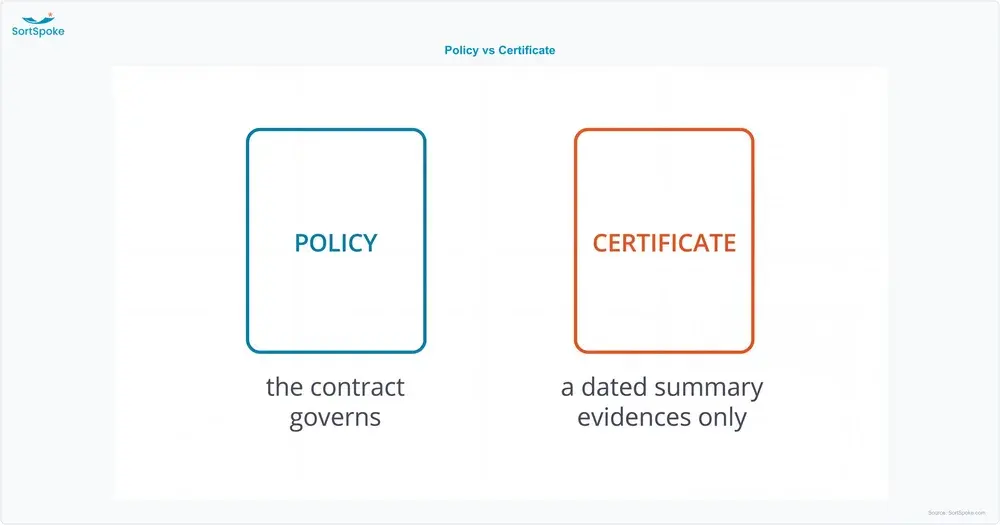
If you run a business in Canada, a COI is the document somebody asks you for shortly before they let you start work. A general contractor wants one before your crew is on site. A landlord wants one before you take possession of the unit. A municipality wants one attached to the procurement file. Nobody explains what it is; they just send an insurance requirements schedule and wait.
This guide covers what a certificate of insurance is, what a Canadian one actually contains, who asks for it and why, and where the terminology gets muddled. It is written for business owners, brokers and insurance professionals — not for personal auto or home policyholders, whose documents work differently.
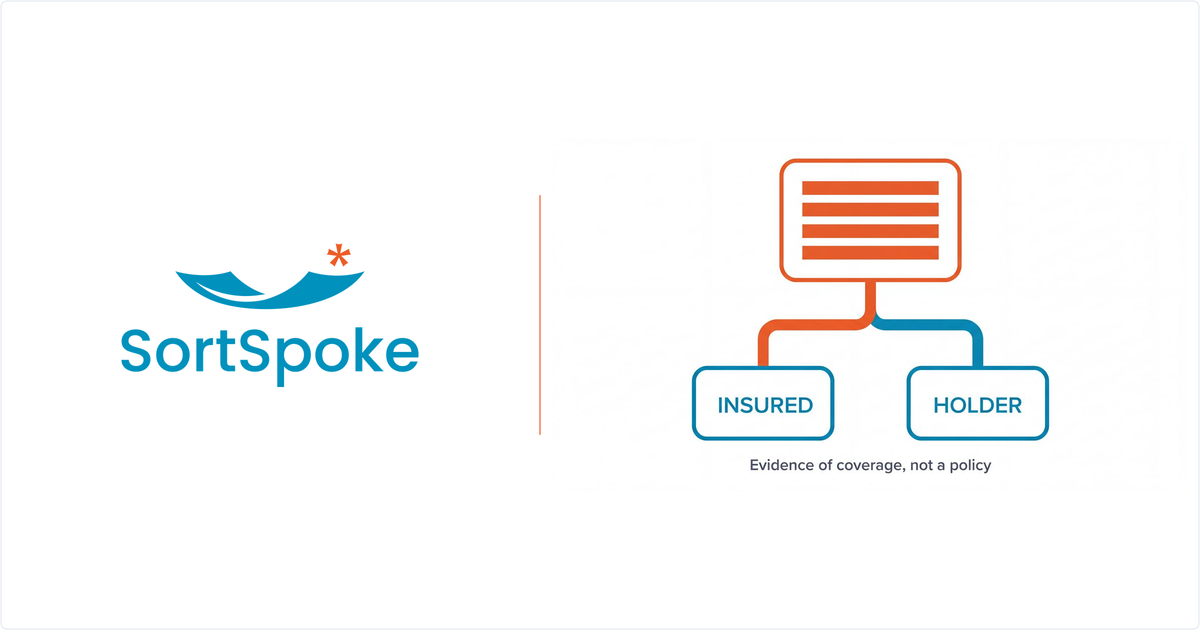
A certificate of insurance (COI) is a short document, usually one or two pages, issued by an insurer or broker to confirm that a named policyholder has specific insurance in force. It lists the insurer, policy numbers, types of coverage, limits and policy dates as at the date of issue. A COI evidences coverage — it does not grant, extend or amend it.
COI (certificate of insurance)
COI — the standard abbreviation for certificate of insurance. The two terms mean the same thing and are used interchangeably in Canadian commercial insurance.
"COI insurance" and "insurance COI" are search-box shorthand for the same document. There is no product called COI insurance. If someone says they need COI insurance, they mean they need a certificate evidencing the insurance they already have.
What it is not: a COI is not the policy, not a binder, and not a substitute for reading the policy wording. It summarises; the policy governs.
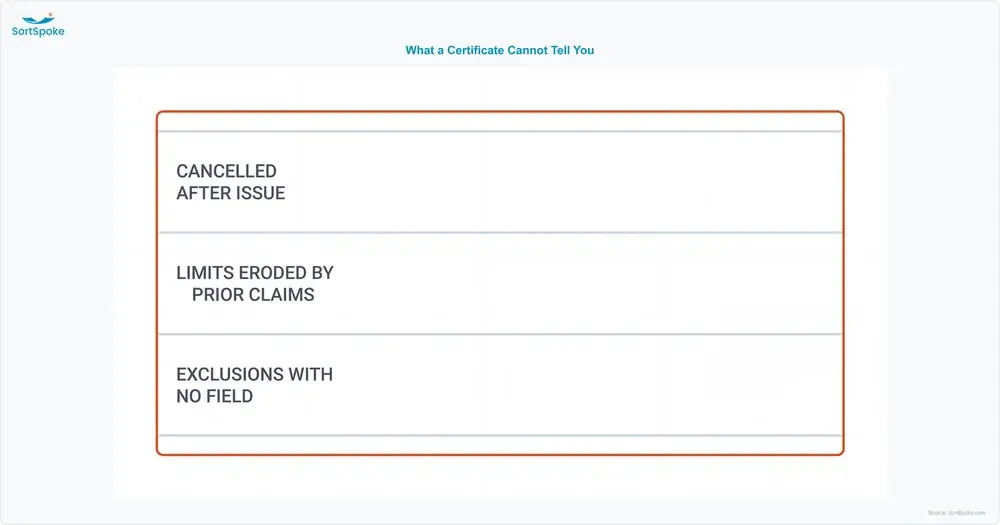
That last distinction is the one that causes commercial disputes. A certificate is a snapshot. Coverage can be cancelled, exhausted by prior claims, or subject to exclusions that the certificate has no field to record. A contracts team that treats a certificate as a warranty of coverage is reading more into the document than it says.
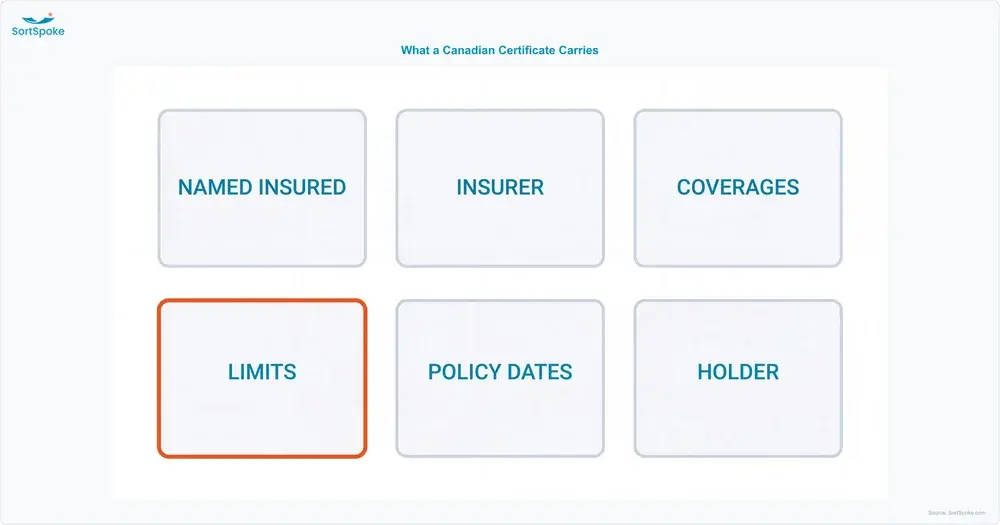
Certificates vary by insurer and by form, but the field set is stable enough to describe. Here is what a Canadian commercial certificate typically carries.
| Field | What it means |
|---|---|
| Named insured | The legal entity the policy covers. It must match the entity named in the contract — an operating company and its numbered holding company are different insureds. |
| Broker / producer | The brokerage that issued the certificate, with contact details for follow-up questions. |
| Insurer(s) | The underwriting company or companies. Layered programs list more than one. |
| Coverage types | Commercial general liability, non-owned automobile, umbrella or excess liability, professional liability, property, equipment breakdown, and so on. |
| Limits | Per-occurrence and aggregate amounts, expressed in CAD on Canadian placements. This is the field requesters check first. |
| Policy numbers and dates | Effective and expiry dates. A certificate expiring mid-project is a renewal-tracking obligation for whoever holds it. |
| Certificate holder | The party the certificate is addressed to — the landlord, contractor or municipality that asked for it. |
| Additional insured / description of operations | Whether a third party has been added to the policy by endorsement, and the project, lease or contract the certificate relates to. |
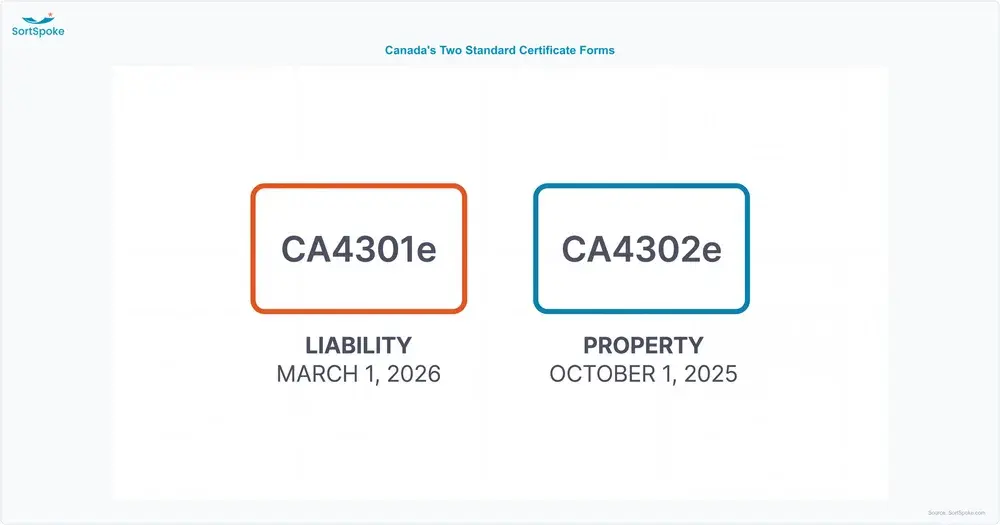
CSIO — the Centre for Study of Insurance Operations, Canada's property and casualty insurance technology association — publishes two national standard certificate forms used across the Canadian market:
Both are designated National — one form for the whole country, rather than the province-by-province series CSIO maintains for automobile applications. The CA prefix marks them as commercial forms, in the same family as CSIO's commercial application forms. If you want the wider picture of how CSIO forms, eDocs and data standards fit together, we cover it in CSIO documents explained.
ACORD certificate forms are widely used in Canadian commercial lines too, particularly on accounts with US parents, US brokers, or cross-border contract requirements. In practice a Canadian commercial team handles both: CSIO's CA4301e and CA4302e, and ACORD's certificate forms arriving from counterparties. The two carry broadly similar information in visibly different layouts, which is exactly the sort of variability that makes certificate handling tedious at volume.
One practical consequence worth knowing: a system built to read one certificate layout does not automatically read the other. That applies to people as much as to software — a reviewer used to reading an ACORD certificate has to hunt for the same fields in an unfamiliar place on a CSIO form.
Certificates get requested wherever one party's insurance failure would become another party's problem. In Canadian commercial practice, that is a short and predictable list.
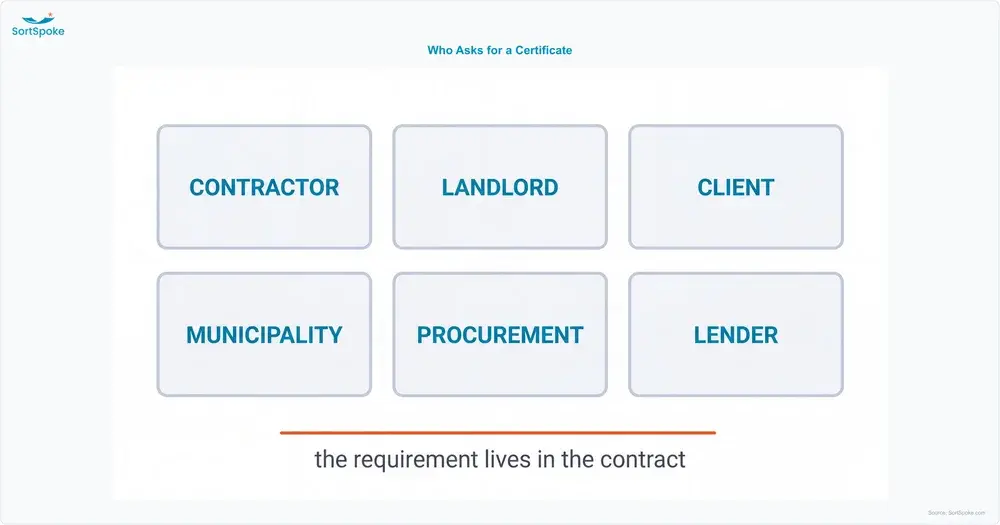
In most of these cases the obligation to produce a certificate is contractual, not statutory. The requirement lives in the subcontract, the lease, the MSA or the tender package. If you are unsure whether a certificate is required by law in your situation, read the contract first and ask your broker second — that is where the answer usually is.
For a business, a certificate is the artefact that clears someone else's insurance requirement. What you are being asked to evidence is set out in a requirements schedule, and it typically names four things: which coverages, at what limits, naming whom, for what period.
These two get used as if they were the same request. They are not, and the difference decides whether the requester has any rights under your policy.
| Aspect | Certificate holder | Additional insured |
|---|---|---|
| What it is | The party the certificate is addressed and sent to. | A party added to the policy itself by endorsement. |
| Rights under the policy | None arise from being listed on a certificate. | Extends certain rights under the policy, as defined by the endorsement wording. |
| Where it lives | A field on the certificate. | An endorsement on the policy, which the certificate then references. |
| Cost to add | Typically none. | May carry a premium charge, depending on the insurer and the endorsement. |
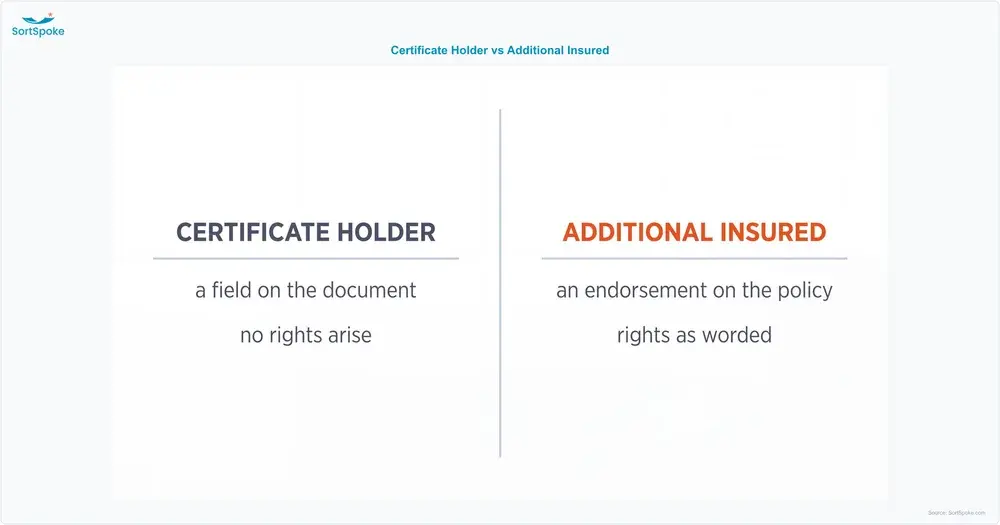
A requester who asks to be "added to your certificate" may mean either. Ask which one the contract requires before your broker issues anything, because adding an additional insured is a policy change and adding a certificate holder is not.
Businesses often search for a certificate of insurance template intending to fill one out themselves. That is not how the document works. A certificate is issued by the insurer, or by the broker acting under the insurer's authority, because it attests to the contents of a policy only they can confirm. Blank CSIO and ACORD certificate forms exist, but a self-completed certificate carries no weight with the party requesting it — and misrepresenting coverage on one is a serious matter. Ask your broker; issuing certificates is routine work for them.
Certificates themselves are largely governed by contract, but the parties issuing them are regulated, and Canada's insurance regulatory landscape is layered — federal for insurer solvency, provincial for market conduct and licensing.
Two more acronyms show up constantly and are worth telling apart. IBAO is the Insurance Brokers Association of Ontario and IBAC is the Insurance Brokers Association of Canada — both are broker associations, representing brokers. The Insurance Bureau of Canada (IBC) is the national industry association of private property and casualty insurers. None of the three is a regulator, and none of them prescribes what goes on your certificate; the standard forms come from CSIO.
The presence of FSRA, the AMF or a provincial insurance council does not mean a statute requires you to hand a certificate to a landlord or a general contractor. Those bodies regulate insurers, brokers and market conduct. The obligation to produce a certificate ordinarily comes from the contract you signed. Where a specific form is required, the contract or procurement document usually names it.
Privacy law is the one regulatory thread that touches the document itself. Certificates carry business and sometimes personal information, and Canadian organisations handle that information under PIPEDA federally and, in Quebec, under Law 25. That matters mostly when certificates are being stored, shared or processed in bulk — which is where the next section starts.
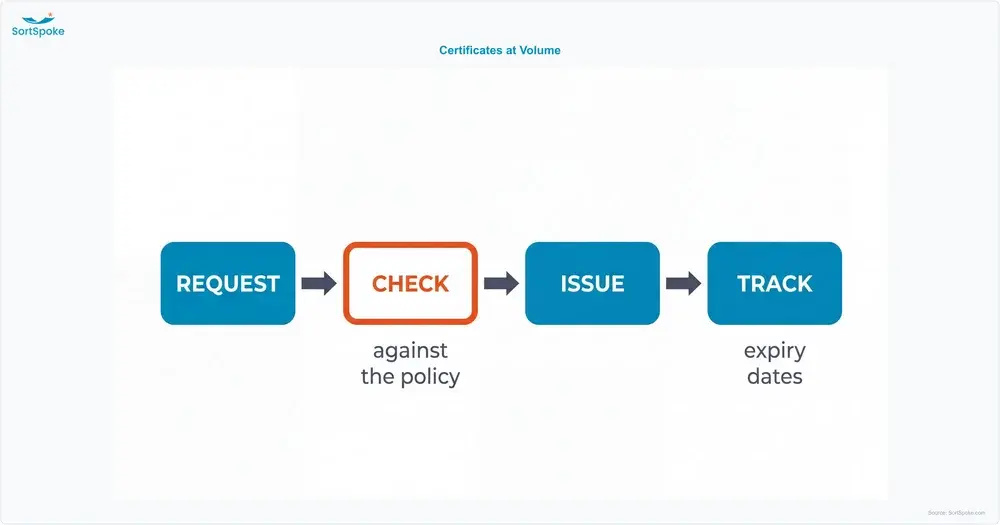
Most people reading a definition of a COI need one certificate, once, and their broker will issue it in an afternoon. This section is for the smaller group with a different problem: brokerages, carriers and large certificate holders processing hundreds or thousands of these a month.
At that scale the work is not the certificate — it is everything around it:
The second item on that list is a document-extraction problem, and it is the one SortSpoke works on. Our software for Canadian insurers and MGAs reads completed insurance documents — CSIO applications and eDocs, ACORD forms, loss runs, statements of values, certificates — and turns them into structured data, with human verification on the fields that warrant it. If that is your problem, you can automate COI data capture alongside the rest of the Canadian document set, and there is a companion page on ACORD forms for the US-origin paperwork that arrives with it.
Two honest caveats. First, if you are a business owner who needs one certificate for one lease, none of this applies to you — call your broker. Second, extraction software is not certificate issuance software; those are different jobs, and a vendor that blurs them is worth a follow-up question.
COI stands for certificate of insurance. It is a short document issued by an insurer or broker confirming that a named policyholder has specific coverage in force, listing the insurer, policy numbers, coverage types, limits and policy dates. In Canadian commercial insurance the abbreviation COI and the full term certificate of insurance are used interchangeably, including in contracts and in insurance requirement schedules.
No. A COI evidences coverage; it does not grant it. The insurance policy is the contract between the insurer and the policyholder, and it defines what is covered, what is excluded and on what terms. A certificate of insurance is a one- or two-page summary of selected policy details as at the date it was issued. Coverage can change after a certificate is issued, and the certificate does not amend the policy.
"COI insurance" is not a type of insurance. It is shorthand for a certificate of insurance — the document that evidences coverage a business already has. A business asked to provide COI insurance is being asked for a certificate confirming its existing policies, most often commercial general liability at a stated limit. The certificate is issued by the insurer or broker, and there is nothing separate to purchase.
A certificate of insurance is issued by the insurer, or by the broker acting under the insurer's authority, for the named insured. A policyholder cannot validly issue one for itself, because the certificate attests to the contents of a policy only the insurer and broker can confirm. In Canada, brokers commonly issue certificates on CSIO's national standard forms, CA4301e for liability and CA4302e for property, or on ACORD certificate forms.
Not exactly. CSIO's CA4301e and CA4302e are the Canadian national standard certificate forms, while ACORD certificate forms originate in the United States and are also widely used in Canadian commercial lines, especially on cross-border accounts. They carry broadly similar information in different layouts. Which one you receive depends on the broker, the insurer and the counterparty, so Canadian commercial teams generally handle both.
Commercial P&C Insurers Guide to Solving the Underwriting Bottleneck