6 Best Loss Run Processing Tools (2026)
By SortSpoke

The conversation has moved again.
A year ago, insurance teams were asking "Should we trust AI with underwriting work?" Six months ago, the question became "Should we add humans to the loop?" Now the question is harder: "We're running human-in-the-loop AI — how do we know it's actually working?"
It's a better question than it sounds. HITL operations can look busy — queues processing, documents flowing, corrections being made — and still be underperforming. The absence of obvious failure isn't the same as success.
Here are five signals that tell you your operation is actually working. And for each one, the red flag that tells you it isn't.
A healthy HITL operation has reviewers who are genuinely engaged with AI output. In the first 90 days, correction rates typically run 10–20% as the model calibrates to your document types and appetite. By the six-month mark, mature operations trend toward 5% or lower.
What that arc tells you: the system is learning, trust is building, and the human review is doing its job.
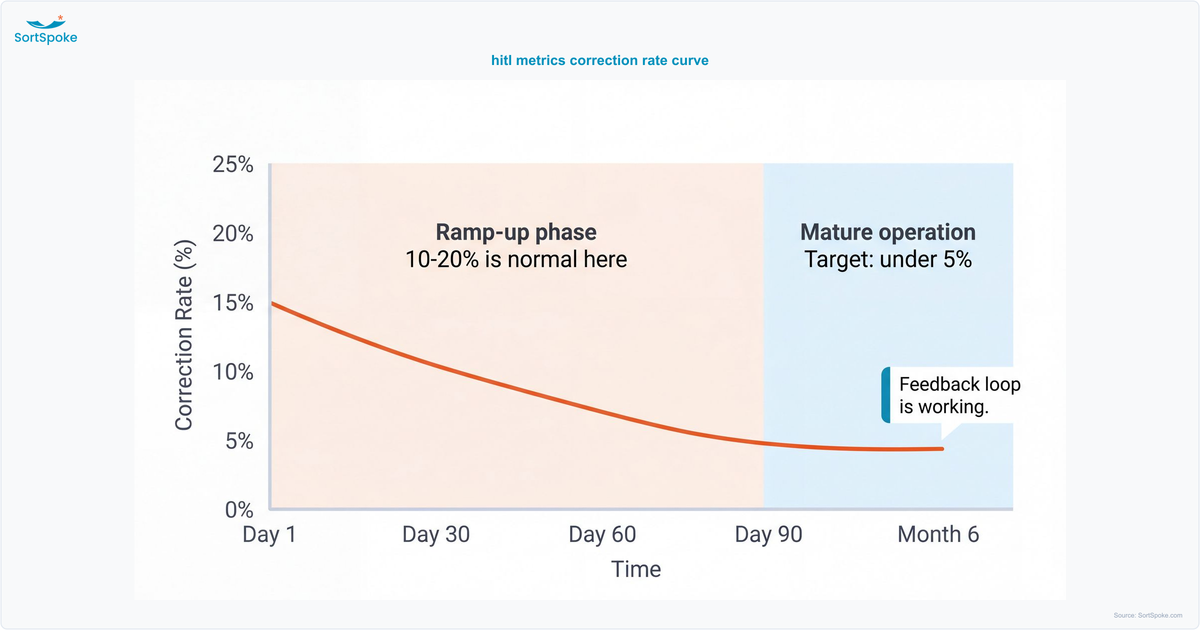
A zero correction rate isn't a success metric — it means one of two things: the AI is perfect (unlikely at 60 days), or your team has stopped looking. Either way, the human part of HITL has broken down. A rubber-stamp isn't oversight. It's theater.
What to watch: Track correction rates by reviewer, not just in aggregate. Wide variance — some reviewers correcting regularly, others never — points to a training and calibration issue, not a technology one.
A HITL operation that's working doesn't just catch errors today — it produces fewer errors tomorrow. Exception rates (the percentage of documents requiring human correction) should decline meaningfully in the first 60–90 days as corrections feed back into the model.
This is the compounding value of human-in-the-loop design. You're not just reviewing outputs; you're building a better system with every correction.
Exception rates that plateau or rise after an initial improvement usually mean corrections are being captured but not fed back into the model — a common integration gap that's easy to miss until you look for it.
What to watch: Track exception rates by document type, not just in aggregate. Loss runs may behave very differently from applications. Flat aggregate numbers can hide improvement in one area and regression in another.
Before HITL, senior underwriters typically spend 60–70% of their time on data extraction — copying fields, reformatting data, reconciling documents. That's the pre-HITL baseline.
A working HITL operation shifts that distribution. Senior staff spend more time evaluating risk, making coverage decisions, and managing broker relationships — the work only they can do. Less time on extraction. More time on judgment.
If senior staff are still doing the same tasks with an AI tool layered on top, that's not delegation — it's duplication. Either the interface isn't working or the trust level hasn't been built. The talent crisis makes this especially costly: your hardest-to-replace people are spending time on work that doesn't require their expertise.
What to watch: Ask senior underwriters directly how their day has changed. Time-allocation surveys are crude but revealing. The goal isn't zero extraction time — some review is correct — but a meaningful shift toward judgment work.
This is the business case made real. If submission volume increases — through growth, soft market competition, or seasonal peaks — and your operation handles it without adding proportional headcount, HITL is delivering. Capacity gains should compound over time, not plateau.
Track submissions processed per FTE. If that ratio isn't improving quarter over quarter in the first year, the efficiency gains haven't materialized yet.
This is usually a staffing model problem, not a technology one. The decentralized model that worked well for a pilot frequently hits a ceiling at scale — the operation needs to evolve its staffing structure, not just its tooling.
What to watch: Submissions per FTE by quarter. Also track reviewer utilization: if your HITL team is consistently at 90%+ capacity, volume growth will start bottlenecking before it appears in your headline numbers.
Every AI output, human correction, and routing decision should be logged. If a regulator, auditor, or broker asks "why was this submission declined?" you should be able to answer in under five minutes — with a trail.
Auditability isn't a compliance checkbox. It's the infrastructure of trust. Teams that can explain their decisions can defend their underwriting, satisfy regulators, and scale confidently. Teams that can't are one audit away from a very uncomfortable conversation.
If institutional knowledge can only be explained by interviewing the underwriter who made the decision, you haven't built a HITL operation — you've added a tool to an undocumented process. The trust gap widens when decisions can't be shown, not just explained.
What to do: Test this quarterly. Pick five decisions from the past 30 days at random and reconstruct the full reasoning trail from system logs alone. If you can't do it in five minutes, the audit infrastructure needs work before the operation scales further.
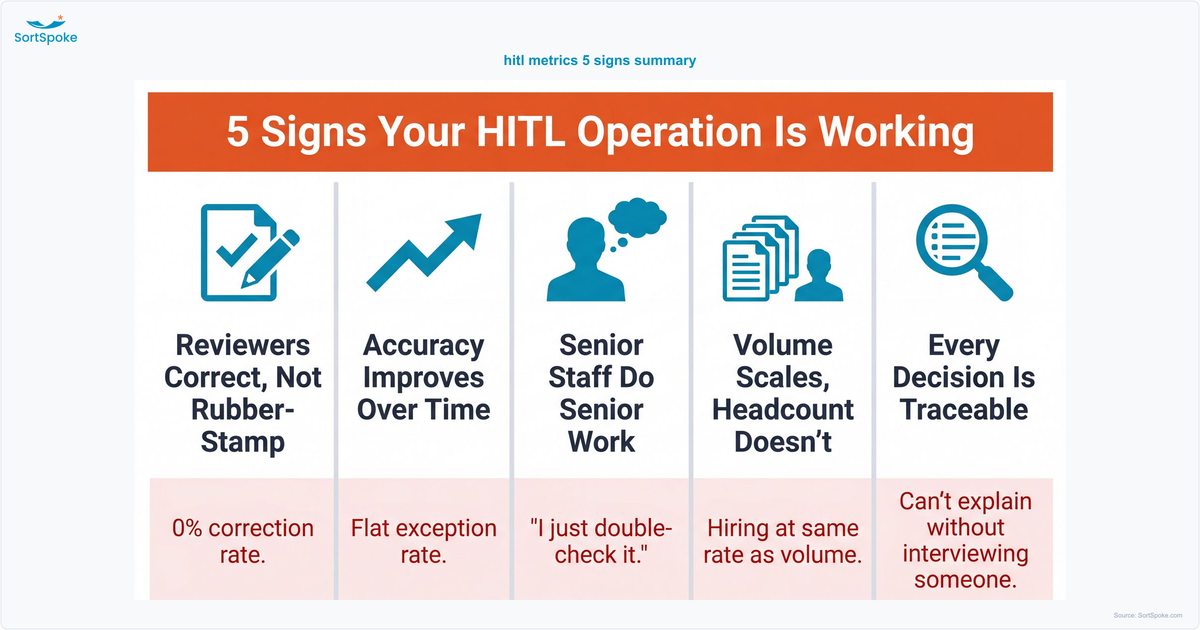
None of these require sophisticated instrumentation on Day 1. Most can be tracked with a simple dashboard and a weekly 15-minute review. But the teams that ask these questions early — before the operation grows complex — are the ones that build HITL operations that scale, satisfy regulators, and earn the lasting trust of underwriting teams.
If you're still in the planning stage, our guide to staffing your HITL operation is a good place to start. If you're already live and these signs are raising questions, let's talk.
Commercial P&C Insurers Guide to Solving the Underwriting Bottleneck