6 Best Loss Run Processing Tools (2026)
By SortSpoke

Published November 21, 2023 | Updated March 4, 2026
Every underwriting leader we talk to is dealing with the same tension: submission volumes are up, but headcount isn't keeping pace. The pipeline is growing, but the team processing it hasn't changed in two years.
The instinct is to hire. But experienced commercial underwriters don't grow on trees—they take 3-5 years to develop, and the talent shortage in insurance means you're competing with every other carrier for the same small pool.
So how are the teams that are winning actually doing it?
They're not hiring their way out. They're eliminating the work that shouldn't require an underwriter in the first place.
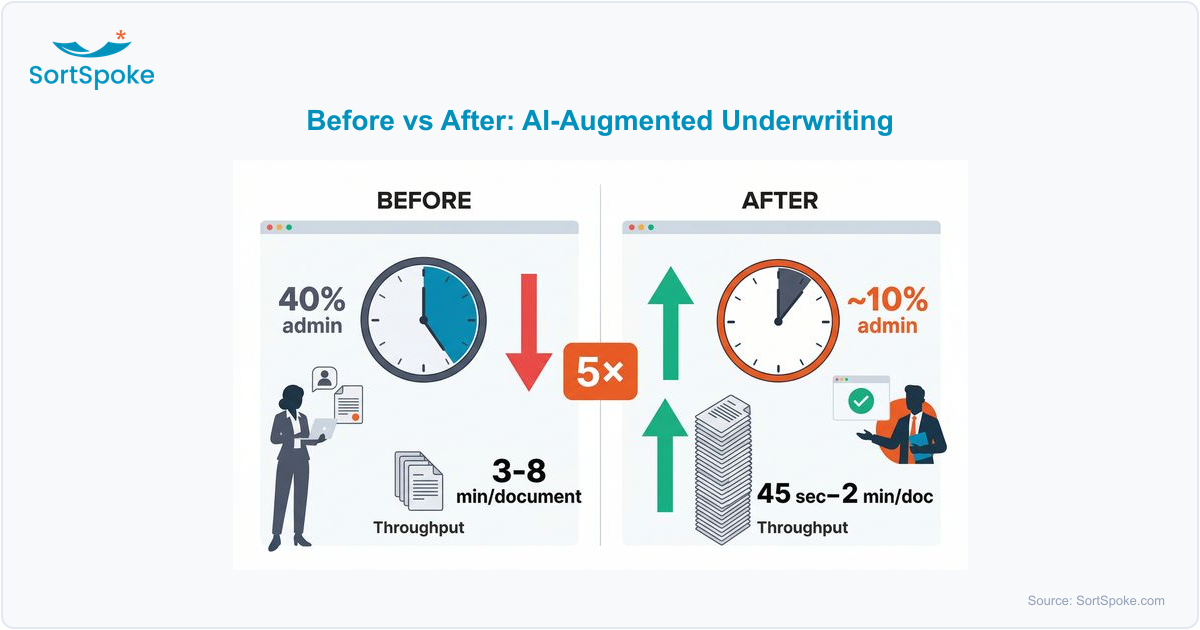
According to McKinsey and Accenture research, commercial P&C underwriters spend 30-40% of their time on administrative tasks—extracting data from PDFs, rekeying information between systems, and chasing down missing documents.
Think about what that means for a team of ten underwriters. Three to four full-time equivalents worth of capacity is going to tasks that don't require underwriting judgment at all:
Every hour spent on data extraction is an hour not spent on risk selection, broker relationships, or responding quickly enough to win the quote.
Research shows the first carrier to respond to a submission wins the business 78% of the time. When your underwriters are buried in data entry, they're not just losing productivity—they're losing revenue to faster competitors.
The obvious answer—hire more underwriters—has three structural problems that make it unsustainable as a primary strategy:
The insurance industry faces a generational talent gap. An estimated 400,000 insurance professionals will leave the workforce by 2026, and the pipeline of experienced replacements isn't keeping up. You can't hire people who don't exist.
Even when you find talent, it takes years to develop commercial underwriting expertise. A new hire doesn't write business on day one—they need mentoring from the same senior underwriters who are already capacity-constrained.
If your process is fundamentally manual, every 20% increase in submission volume requires roughly 20% more staff. That's not a business model—it's a treadmill. The insurers pulling ahead are the ones who've broken that linear relationship between volume and headcount.
The capacity breakthrough doesn't come from replacing underwriters—it comes from keeping humans in the driver's seat while eliminating the manual work that doesn't require their expertise.
Here's the distinction that matters: purely automated AI solutions work well for structured, standardized documents. But commercial P&C underwriting involves highly varied, semi-structured documents where context matters and accuracy can't be compromised.
That's where intelligent document processing with human-in-the-loop oversight changes the equation:
A leading specialty insurer was spending 3-8 minutes per financial statement on manual review and data extraction. After implementing SortSpoke's human-in-the-loop document AI, they extracted the same data with 99%+ accuracy in 45 seconds to 2 minutes—a 4-5x improvement in throughput.
The insurers getting this right aren't making dramatic overnight changes. They're following a deliberate pattern that builds confidence and scales progressively.
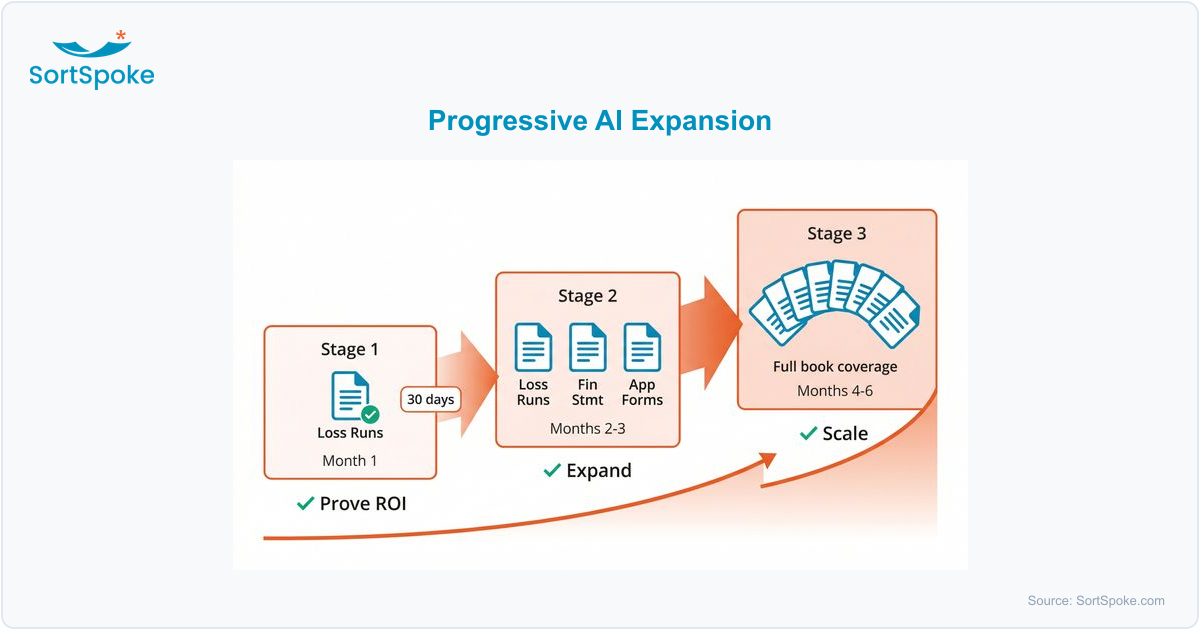
Pick the document that creates the biggest bottleneck—usually loss runs or financial statements—and prove the model works there first. This limits risk while delivering fast, measurable ROI.
The metrics that matter aren't processing speed alone. Track the downstream impact:
Once you've proven results with one document type, expand to others. Most teams see the biggest gains within the first 30 days, which builds internal momentum for broader adoption.
Here's what's often overlooked in the capacity conversation: when senior underwriters train AI systems to read complex documents, they're not just speeding up today's work. They're preserving institutional knowledge that would otherwise disappear when those experts retire.
A human-in-the-loop approach creates a virtuous cycle:
This is the real case for augmentation over automation. You're not just processing documents faster—you're building an organization that gets smarter over time.
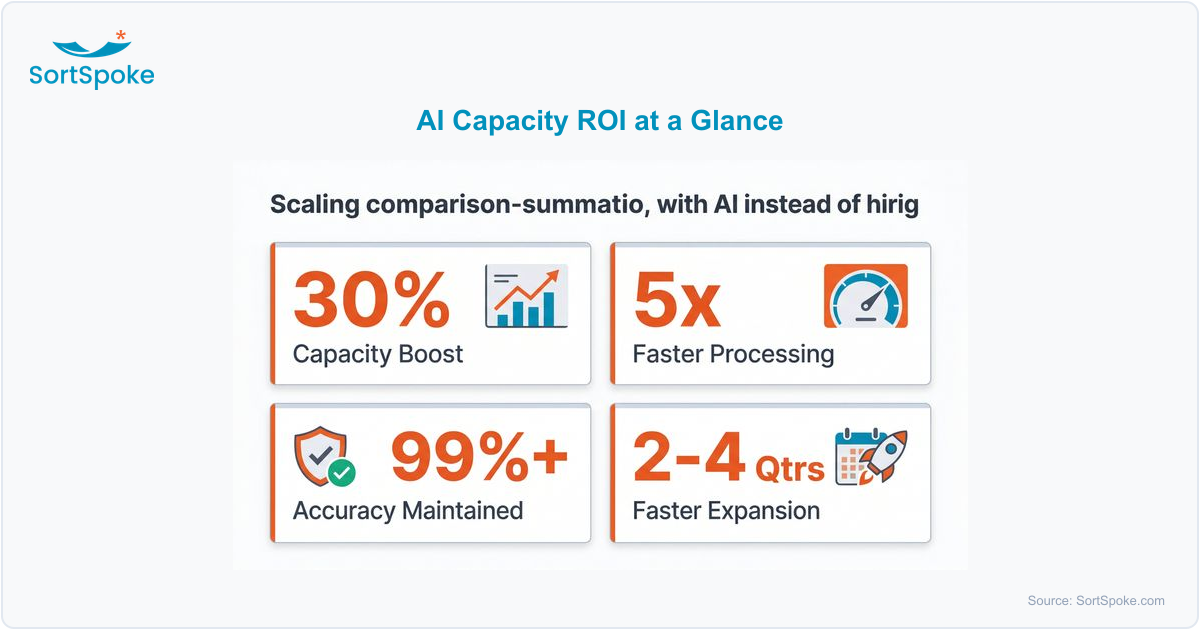
Based on what we're hearing from underwriting leaders who've made this shift, the results follow a consistent pattern:
The teams seeing these results aren't the ones who tried to automate everything overnight. They're the ones who started with a focused proof of concept, proved the model, and scaled deliberately.
Want to see how much capacity your team could unlock? Try the ROI Calculator →
Commercial P&C Insurers Guide to Solving the Underwriting Bottleneck