6 Best Loss Run Processing Tools (2026)
By SortSpoke
Over the last two years, the conversation around submission intake has fundamentally changed.
Three years ago, when we talked to underwriting leaders at conferences or in discovery calls, intake was treated as a back-office concern—something that happened in the background while the "real work" of underwriting got done. The focus was on pricing models, catastrophe exposure, digital distribution, and AI experimentation.
Today? Submission intake is a boardroom topic.
COOs are asking why response times are lagging. Underwriting VPs are building business cases for intake automation. Carriers that used to dismiss intake as "just administrative overhead" are now tracking it as a leading indicator of underwriting performance.
What changed? The bottleneck became impossible to ignore.
As submission volumes climbed—especially in specialty and E&S lines—teams discovered that their intake process, not their underwriting expertise, was the constraint on growth. You can hire the best underwriters in the market, but if they're spending half their day extracting data from PDFs and chasing missing documents, you're not scaling. You're just paying more people to be stuck in the same broken process.
This article breaks down what we've been hearing from underwriting leaders as we enter 2026: where the benchmarks stand, where the biggest gaps are, and why the teams that fix intake first will have a decisive advantage in the next 12-24 months.
Here's a conversation we've had dozens of times over the past 18 months:
Us: "How's your submission intake process?"
Underwriting leader: "Fine. I mean, we're busy, but that's just the nature of the business."
Us: "How long does it take to respond to a new submission?"
Leader: "Depends on the risk. Probably 3-5 days on average."
Us: "What percentage of submissions fall outside your appetite?"
Leader: [long pause] "You know, we don't actually track that."
That hesitation—that moment where leaders realize they don't have visibility into their own intake efficiency—is where the conversation usually shifts.
Because once you start measuring intake, you can't unsee the problem. And what we're hearing from teams that have started measuring is consistent: submission intake is one of the largest hidden constraints on underwriting capacity and growth.
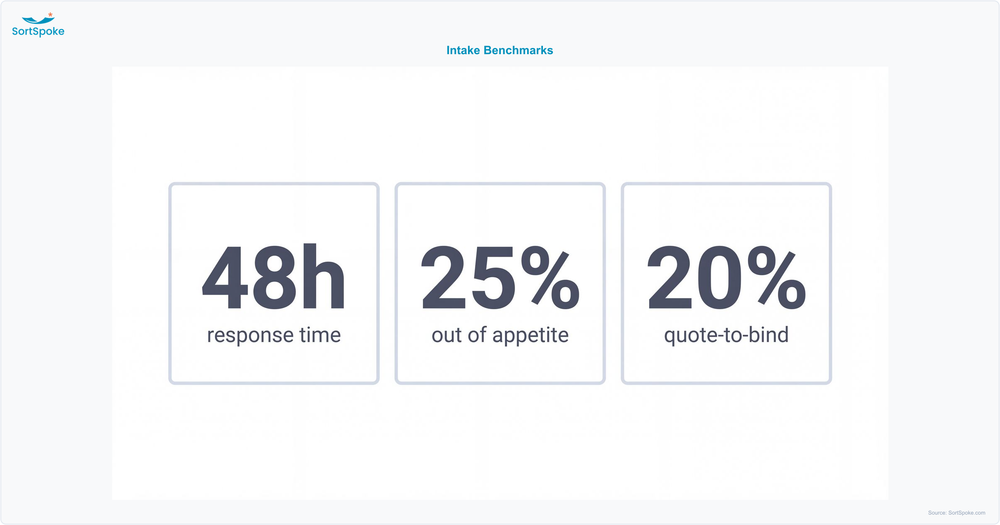
The industry is converging around a set of benchmarks that define what "good" submission intake looks like. These aren't aspirational—they're what leading teams are already hitting, and what average teams are being measured against.
Speed has become table stakes.
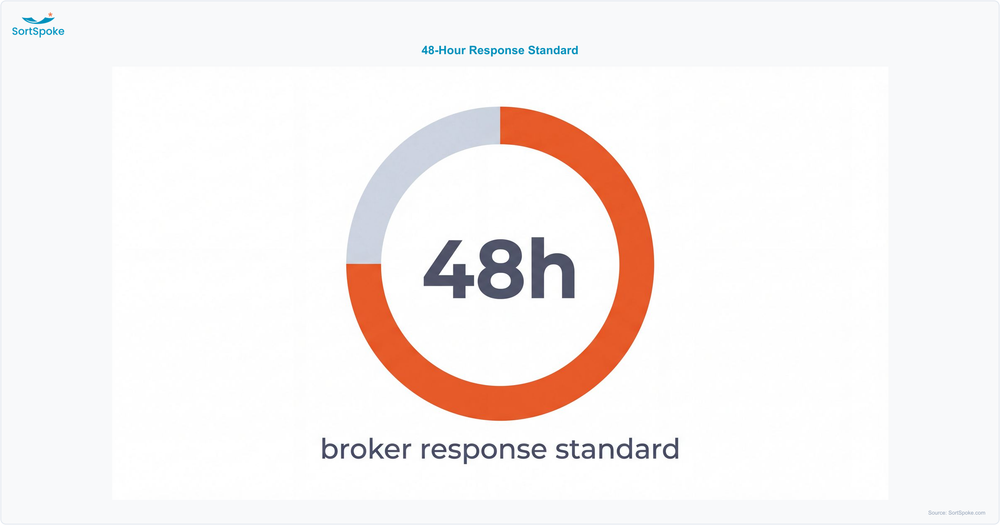
In a 2024 broker survey conducted by Prestige Underwriting, 48% of brokers said industry response times are "too slow." Not "could be better"—too slow. Nearly half of the market is frustrated with how long it takes to get a quote or a decline.
What we're hearing from underwriting leaders is that sub-48-hour first touch has become the competitive baseline. Carriers that consistently respond within two days—with a quote, a decline, or a clear ask for additional information—are winning more submissions. Teams that take 5-7 days are losing deals before they even know they were in the running.
The teams hitting this 48-hour benchmark haven't just hired more people; they've fundamentally changed how they sort work. They treat submission triage as a strategic filter, not just an admin task—using appetite criteria, submission completeness, and deal size to route work intelligently rather than relying on first-in, first-out manual sorting.
As one E&S underwriting VP told us: "Speed is no longer a nice-to-have—it's table stakes for winning submissions."
(Understanding the specific symptoms of broken intake helps you diagnose where response time issues originate and what they cost in lost deals.)
Here's a stat that surprises no one in underwriting but still hasn't been systematically addressed: roughly 25% of submissions fall outside appetite.
That data comes from Federato's 2025 State of Underwriting Report, and it tracks with what we're hearing anecdotally. One in four submissions was never viable—wrong class of business, outside geographic appetite, limits too high, exposures too complex.
The challenge isn't that misfit submissions exist. It's that underwriters are spending meaningful time on risks that will never bind. The same Federato report found that underwriters dedicate about 26% of their time to deals that don't convert—a quarter of underwriting capacity going toward dead-end work.
What's changed in the last year is that leaders are starting to ask: Why are these submissions reaching underwriters in the first place? If appetite is clear and communicated, why is a quarter of the queue out of scope?
Top-performing teams are pushing out-of-appetite rates below 20% through better broker education, clearer appetite signaling, and automated triage. Every percentage point they reduce is underwriting capacity they get back.
Conversion is where the intake process either pays off or reveals its weakness.
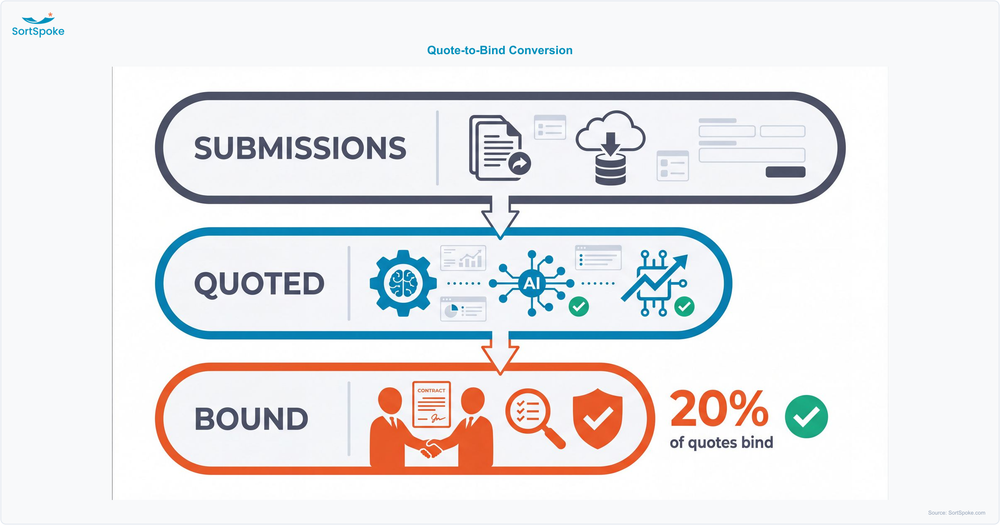
According to PortfolioIQ's insurance KPI database, a 20% quote-to-bind ratio—one in five quotes binding—is considered "typical" in commercial and specialty lines. Some segments run higher (renewals, preferred risks), others lower (new business, high-hazard classes).
But here's what 20% really means: 80% of your quoting effort doesn't result in bound premium.
We've had underwriting leaders push back on this, arguing that quoting is part of the market-making process and not every quote should bind. Fair point. But when we dig into why quotes aren't binding, the answers are revealing:
Those aren't market dynamics—those are process failures.
The teams pushing quote-to-bind above 25% are doing it by fixing intake upstream: declining faster when fit is poor, responding quicker to high-quality opportunities, and ensuring submissions are fully vetted before quoting begins.
Volume is subjective. What counts as "a lot" of submissions depends entirely on risk complexity, underwriting appetite, and team structure.
But we're hearing a consistent baseline from teams in higher-flow segments (small commercial, standard E&S): around 40 submissions per underwriter per week is a typical steady-state workload. That's roughly eight per day.
For complex risks—large accounts, high-hazard classes, heavy manuscript work—the number drops significantly. Some senior underwriters handle 2-3 submissions per week, and that's appropriate given the level of analysis required.
What matters isn't the absolute number—it's how efficiently submissions move through the queue. The difference between a team that's underwater and one that's scaling efficiently often comes down to how they handle capacity without adding headcount—two teams processing the same volume can have wildly different efficiency profiles depending on how well their intake process works.
The teams that are scaling aren't necessarily processing fewer submissions per underwriter—they're processing the right submissions faster by eliminating intake friction.
When we run underwriting teams through the Submission Intake Calculator—which uses these exact benchmarks to score efficiency—most teams fall into what we call the "functional but lagging" category.
They're not broken. Submissions are getting processed. Quotes are going out. Business is binding.
But they're leaking efficiency everywhere:
And here's what we keep hearing: "We assumed this was just normal."
It's not normal—it's just common. There's a difference.
The teams that have started measuring intake are discovering 10-20% efficiency gains simply by standardizing workflows, automating triage, and declining misfit work earlier. Same underwriters. Same volume. Better throughput.
Based on hundreds of conversations with underwriting leaders over the past two years, three gaps show up consistently:
The gap: Most teams respond within 3-5 days. Competitive teams respond within 48 hours.
The cost: Brokers don't wait. When your team is still triaging on day three, the broker has already moved the submission to a carrier that responded on day one. You might log it as "no quote issued," but the real loss is the premium you never had a shot at.
One specialty lines leader told us: "We finally started tracking how many submissions we declined after 72+ hours and realized we were basically auto-declining deals we were too slow to quote. That's not underwriting—that's just losing."
The gap: One in four submissions doesn't match appetite, but they're still consuming underwriting time.
The cost: As we discussed earlier, that's 26% of underwriting capacity spent on non-viable deals. For a 10-person team, that's the equivalent of 2.5 full-time underwriters working exclusively on submissions that will never bind.
What we're hearing from leaders who've addressed this: "Once we made appetite explicit and started declining faster, our underwriters had room to breathe for the first time in years."
The gap: High submission volume feels like success, but it masks whether underwriters are spending time on the right work.
The cost: Underwriters can be "busy" without being productive. When intake is manual and inconsistent, underwriters spend half their day hunting for information instead of evaluating risk.
According to industry research from Brisc, submission triage and intake remain major bottlenecks, with teams still relying heavily on manual processes to organize, route, and prepare submissions for underwriting review.
The teams fixing this aren't working harder—they're eliminating the administrative overhead that keeps underwriters from doing what they do best.
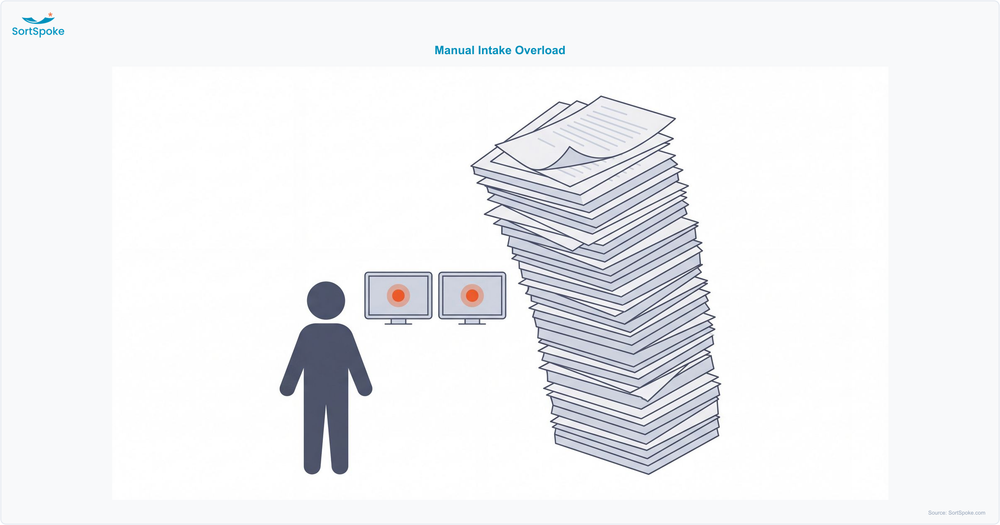
Here's the pattern we see over and over:
Submission volume climbs. Underwriters are underwater. Leadership decides to hire.
Six months later, volume is still climbing, underwriters are still underwater, and now the team is bigger and more expensive.
Why? Because hiring doesn't fix a broken process—it just scales the inefficiency.
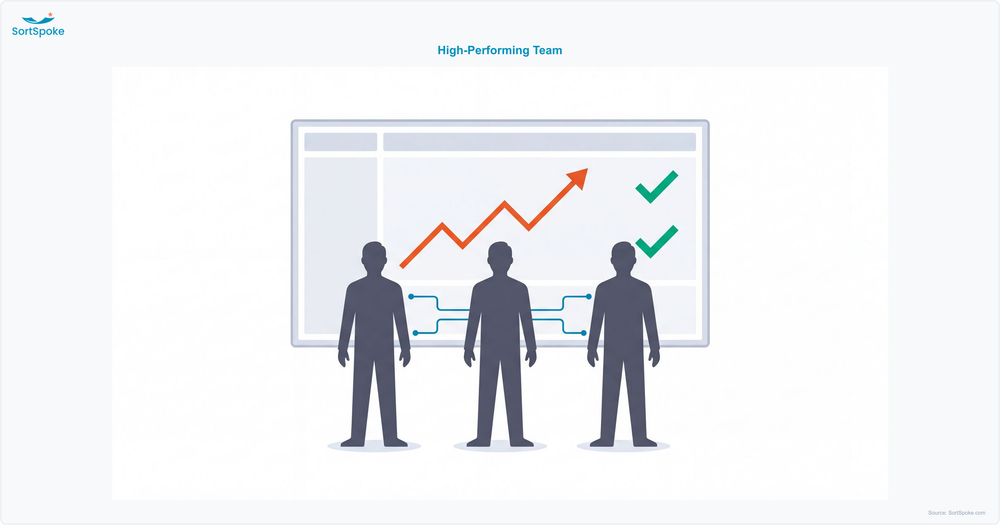
The teams that are handling more submissions without proportional headcount growth have figured out that the constraint isn't underwriting capacity—it's intake friction.
When you eliminate the manual work, the misfit submissions, and the slow handoffs that eat up underwriters' time, you unlock capacity you didn't know you had. Same team. Same expertise. 2-3X the throughput.
The shift we're seeing in 2026 isn't about technology—it's about intentionality.
Leading teams are:
None of this requires massive IT projects or ripping out existing systems. It requires measuring what's broken and fixing the highest-leverage gaps first.
If you don't know where your intake stands, you can't fix it.
The Submission Intake Calculator uses the same benchmarks we've discussed here—response time, out-of-appetite rate, quote-to-bind, and underwriter workload—to show you where your team compares to the market and which gaps are costing you the most capacity.
It takes about 90 seconds to complete, and the output isn't just a score—it's a diagnosis. You'll see:
Two teams with identical submission volumes can have completely different scores depending on where their friction is. The calculator shows you your specific bottleneck so you can prioritize the fix that matters most.
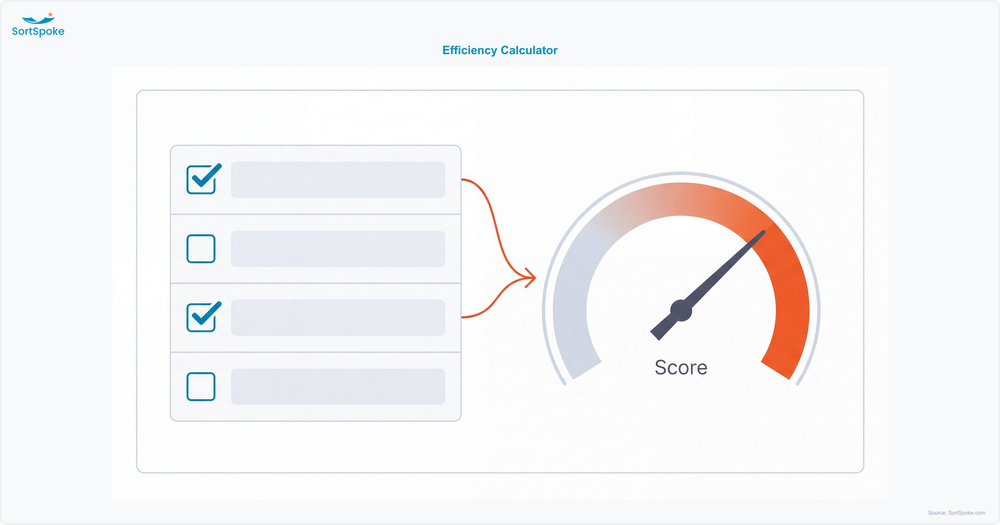
Compare your team against these 2026 benchmarks. Run the Submission Intake Calculator →
Commercial P&C Insurers Guide to Solving the Underwriting Bottleneck