What is a Loss Run Report
By SortSpoke
Published January 21, 2026 | Updated August 19, 2026
Every underwriting leader wants to grow premium. But there's a problem most teams run into long before they hit their growth targets: their best underwriters are maxed out.
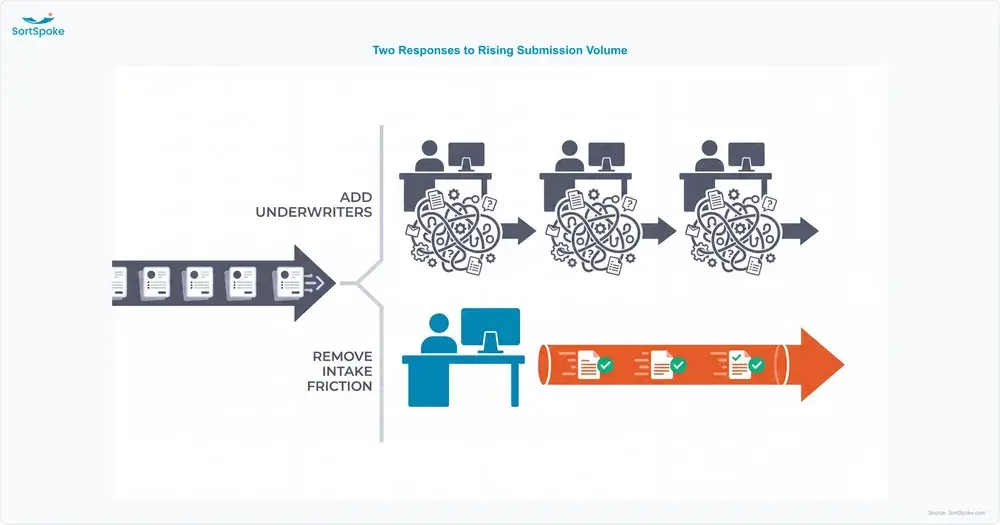
The instinct is to hire. Sometimes that's the right call—new lines of business, geographic expansion, or building specialized expertise all require new people. But when the problem is capacity on existing business, hiring often scales the inefficiency instead of solving it.
Here's the reality: volume doesn't equal capacity. You can throw more submissions at your team and watch throughput stay flat, response times slow down, and conversion rates drop. Or you can fix the friction that's eating up your underwriters' time and handle 2-3X the volume with the same team.
The difference isn't headcount. It's how efficiently submissions move through your intake process before they ever reach an underwriter.
This article breaks down where underwriting capacity is actually lost, what high-throughput teams do differently, and how to scale submission handling without proportional headcount growth.
Most underwriting teams equate submission volume with growth potential. If you're getting 500 submissions a month, you must be doing better than when you were getting 300, right?
Not necessarily.
If those 500 submissions include:
Then you're not growing—you're just busy. And busy without efficiency is a treadmill, not a growth engine.
Volume is a strain indicator, not a success metric. The question isn't "how many submissions are we getting?" It's "how many of those submissions are we converting into bound premium with the capacity we have?"
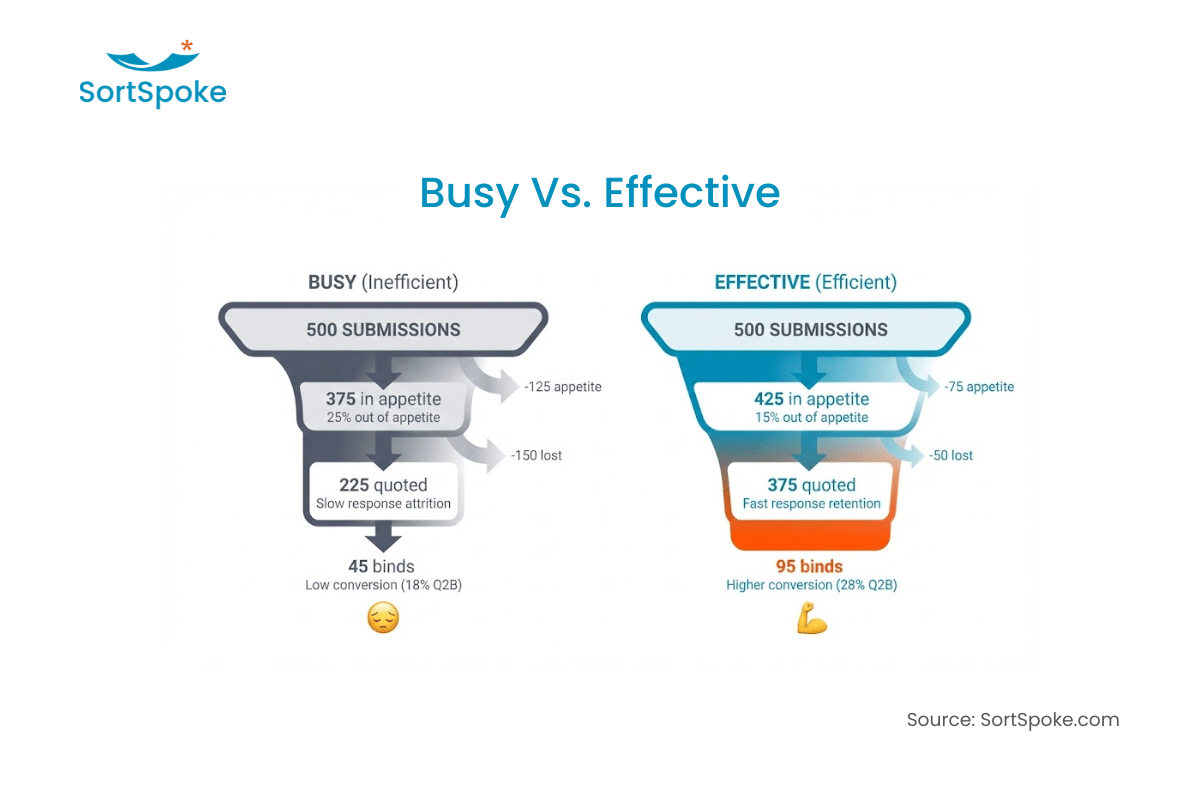
The Submission Intake Calculator measures submissions per underwriter per week as one of its key inputs—not because high volume is inherently bad, but because it shows where teams are operating under strain.
Industry data shows that in higher-flow contexts, teams are handling around 40 submissions per underwriter per week. That's roughly eight per day. For complex specialty risks, the number may be far lower—two or three submissions might represent a full week of work depending on account complexity.
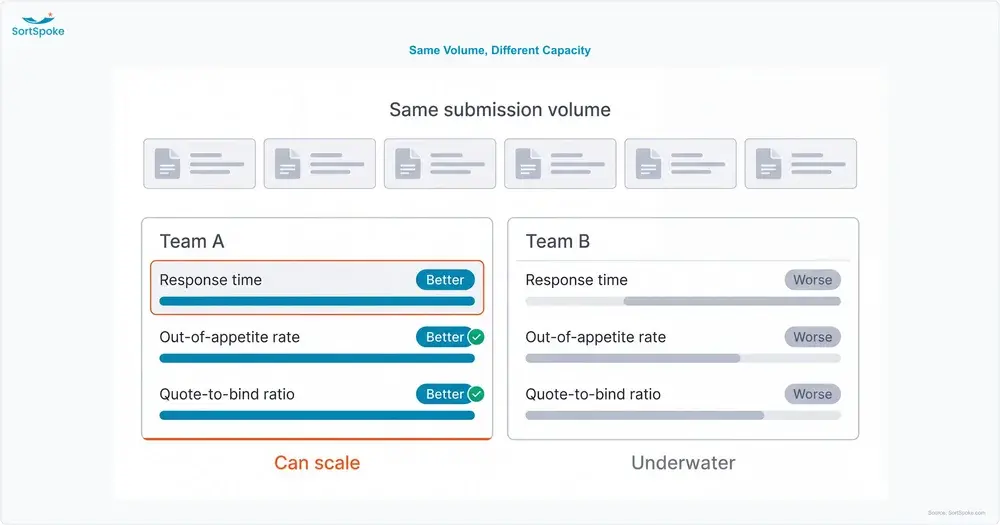
But here's what matters: two teams processing the same volume can have wildly different efficiency profiles.
One team might process 40 submissions per week per underwriter with:
Another team processes the same 40 with:
Same volume. Completely different capacity utilization.
The first team is operating efficiently and can scale. The second team is underwater, and adding more submissions will only make it worse.
When underwriting leaders talk about being "at capacity," they usually mean underwriters are too busy to take on more work. But the real constraint isn't underwriting—it's everything that happens before underwriting.
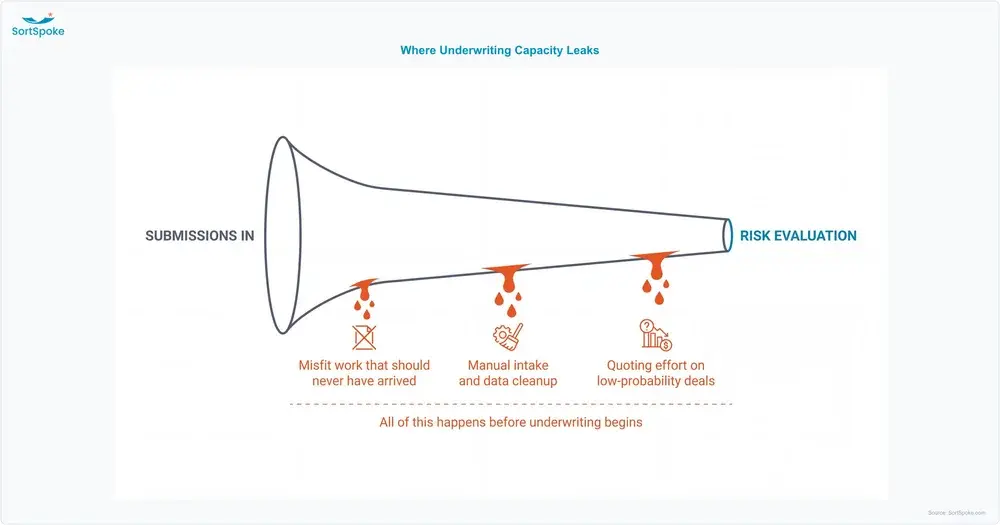
Understanding the real cost of broken intake reveals that most underwriting time isn't lost during risk evaluation. It's lost upstream, during intake, triage, and data cleanup.
Here's where capacity actually disappears:
Research shows that roughly 25% of submissions fall outside appetite—and underwriters spend about 26% of their time on deals that will never bind.
Let's convert that to real dollars and FTE hours:
For a 10-person underwriting team:
If you could redirect even half of that capacity toward submissions that actually match your appetite, you'd unlock $187,500 in underwriting value annually without hiring anyone. That's enough to handle 25-30% more viable submissions with your existing team.
Underwriters don't lose time analyzing risk—they lose time hunting for information.
This isn't anecdotal. Research from Accenture found that underwriters spend up to 70% of their time on non-underwriting activities—data gathering, document processing, chasing information, and administrative tasks. Only 30% goes toward the risk analysis and pricing work that actually requires their expertise.
Most submissions arrive as a messy bundle: emails with scattered attachments, incomplete ACORD forms, outdated loss runs, missing schedules. Before underwriting begins, someone has to:
Industry research from Brisc highlights that intake and triage remain major bottlenecks, with many teams still relying on manual processes to organize and route submissions.
The result? Underwriters spend hours on administrative work that has nothing to do with their expertise. That's not a capacity problem—it's a process problem.
According to PortfolioIQ's insurance KPI benchmarks, a 20% quote-to-bind ratio is considered "average" in commercial and specialty lines. That means one in five quotes binds—and four out of five don't.
Quoting isn't cheap. Every quote requires:
If 80% of that effort goes toward deals that don't close, you're burning capacity on low-probability work. Top-performing teams push conversion above 25% by focusing underwriting time on higher-quality opportunities and declining misfit submissions earlier.
Every percentage point improvement in quote-to-bind is premium growth without adding quoting volume.
Bottom line: Capacity isn't lost in underwriting—it's lost upstream. And until you fix upstream, hiring more underwriters just means more people stuck in the same broken process.
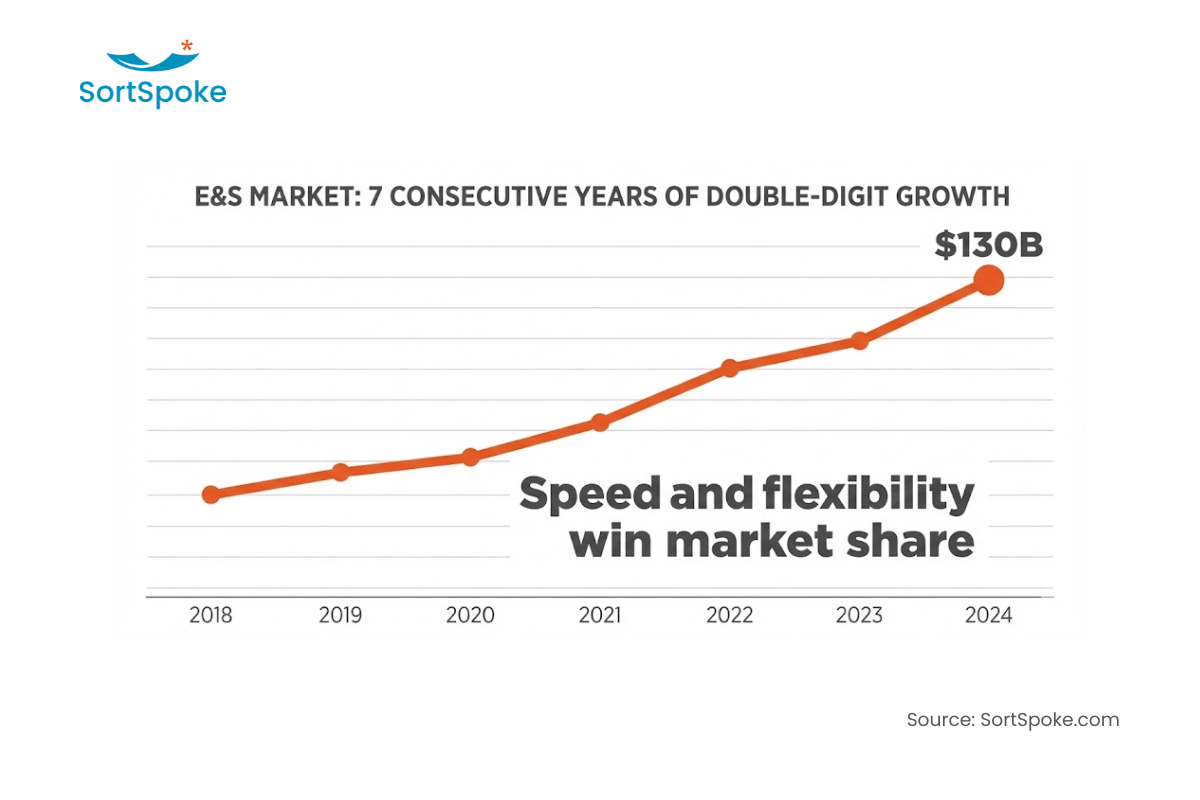
Want proof that operational efficiency drives growth? Look at the E&S market.
According to Insurance Journal, the excess and surplus lines market grew 12.3% in 2024 to just under $130 billion in premium (AM Best Market Segment Report), marking seven consecutive years of double-digit growth. E&S carriers are winning business that admitted markets can't serve fast enough or flexibly enough.
The lesson isn't that you should become an E&S carrier. It's that speed and operational flexibility are competitive advantages in every segment. The carriers capturing market share are the ones who can respond faster, quote more efficiently, and avoid the bottlenecks that slow down their competitors.
The teams that handle 2-3X more submissions without proportional headcount growth aren't working harder—they're working smarter. Here's what they've figured out:
Average teams agonize over borderline submissions, spending days evaluating deals that were never a strong fit. High-throughput teams decline fast when appetite match is weak—and they use technology to make that call before it ever reaches a human.
How they do it:
One specialty E&S carrier we spoke with reduced out-of-appetite work from 28% to 14% by implementing automated appetite checks at the front door. That freed up the equivalent of 1.4 underwriters on a team of 10—without hiring or firing anyone. Their underwriters went from spending Tuesday mornings explaining appetite to brokers to spending that time pricing complex risks.
This isn't about replacing underwriter judgment—it's about protecting underwriter time by handling the administrative filtering upstream. Every hour spent on a marginal submission is an hour you're not spending on a high-probability opportunity that actually needs expertise.
A common concern: "If we automate intake, what happens to our underwriters?"
The best underwriters don't want to spend their time on data entry and appetite education. They want to underwrite. Automation shifts their work from administrative to analytical:
Before: 70% admin, 30% underwriting
After: 30% admin, 70% underwriting (the ratio flips)
The underwriters who thrive are the ones who can focus on complex risks, broker relationships, and judgment calls that AI can't make. Position it internally as: "We're freeing you from the work you hate so you can do more of the work you're great at."
Speed is a competitive advantage—and research shows it's also a revenue driver. 78% of buyers purchase from the first responder, which means response time directly determines who competes for the deal, not just how efficiently you operate.
Nearly half of brokers say underwriting response times are too slow. High-throughput teams hit sub-48-hour first touch consistently—not because their underwriters work faster, but because they've eliminated the manual work that delays first contact.
How they do it:
Instead of spending 30-45 minutes hunting for information and copying data into systems, underwriters receive submissions that are already organized, summarized, and ready for evaluation. That compression in prep time is what enables sub-48-hour response without burning out your team.
The relationship between response time and premium attrition is steeper than most leaders realize—same-day response sees roughly 5% attrition while 72+ hours can hit 60% or more. For a team handling $100M in quoted premium, moving from 3-day to same-day response could represent $35M+ in retained opportunity.
For the full revenue math by response time tier, see Speed Wins: The First-Responder Advantage.
Too many teams operate with vague appetite guidelines that leave brokers guessing. The result? Submissions that were never viable flooding the underwriting queue.
Top teams make appetite explicit, public, and enforceable—and they give brokers tools to self-screen before submitting.
How they do it:
This isn't about rejecting business—it's about attracting better-fit submissions and reducing the noise. Brokers appreciate clarity. When you tell them upfront what you will and won't write, they send you better opportunities.
Automating intake can backfire if not done carefully. Here are the failure modes we see most often:
Over-aggressive auto-declines
Broker backlash from robotic responses
Data quality undermining triage accuracy
Underwriter resistance
Fixing intake friction isn't just a technology project—it's a change management challenge. Here's what we hear from teams who've done this:
"The technology was the easy part. Getting underwriters to trust the triage decisions took longer."
"We started with a pilot on one LOB before rolling out broadly."
"IT integration took 3 months, not 3 weeks. Plan accordingly."
Common implementation patterns that work:
So how do you actually handle more submissions without hiring proportionally? You eliminate the friction that's eating up underwriting time.
Manual, inconsistent intake processes are capacity killers. When every submission is handled differently—emails routed to different people, data extracted inconsistently, information scattered across systems—you waste hours on administrative overhead.
Standardized intake means:
This starts with a standardized submission triage process that ensures every submission follows the same logic—appetite screening, completeness checks, and prioritization—before it ever hits an underwriter's desk. The goal isn't to eliminate underwriter judgment; it's to eliminate the administrative work that delays it.
Not all submissions are created equal. A $500K workers' comp renewal shouldn't sit in the same queue as a $5M high-hazard new business opportunity.
Automated routing ensures:
Teams that implement intelligent routing report 20-30% faster response times simply by getting the right submissions to the right people at the right time.
First-in, first-out feels fair, but it's inefficient. High-probability deals deserve underwriting attention before low-probability ones.
Leading teams prioritize by:
This approach maximizes throughput and improves conversion, because underwriters spend more time on deals they're likely to win.
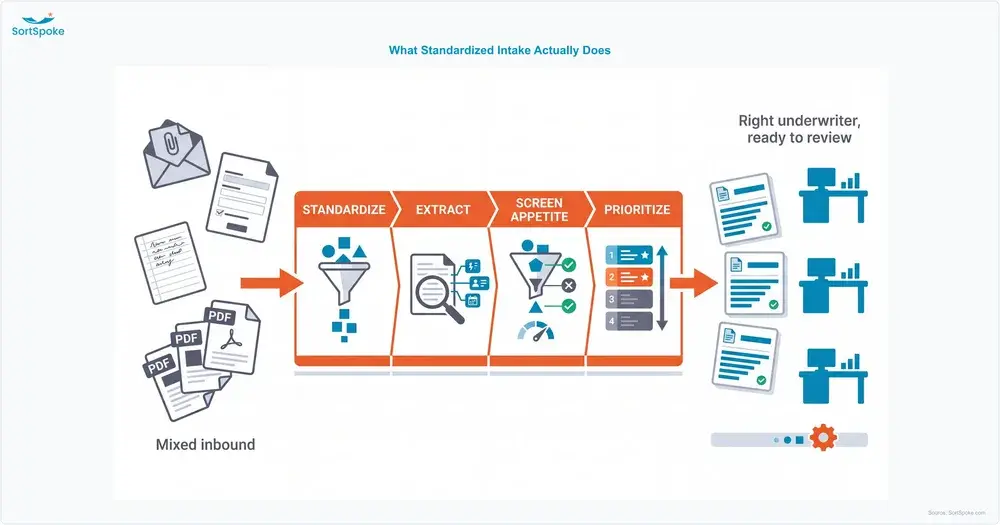
Here's the challenge: most teams don't know where their capacity is being wasted because the signals are scattered across different systems.
The Submission Intake Calculator solves this by showing you which bottleneck is costing you the most capacity:
Two teams with identical submission volumes can have completely different efficiency scores depending on where their friction is. The calculator shows you your specific bottleneck so you can fix the constraint that matters most.
For a practical implementation guide that starts Monday morning, see Your First 30 Days: A Playbook for Fixing Submission Intake—week-by-week steps to measure your baseline, capture quick wins, and build the business case.
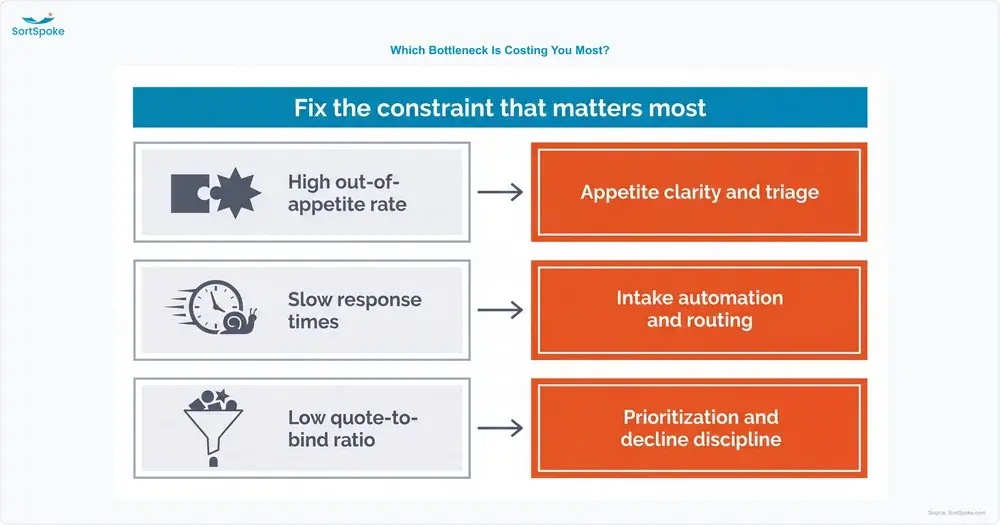
Calculate how much underwriting capacity you're losing to intake friction. Run the Submission Intake Calculator →
Commercial P&C Insurers Guide to Solving the Underwriting Bottleneck