
ACORD 125
Form Guide
ACORD 125: Commercial Insurance Application
Download the blank fillable ACORD 125 and a filled sample, see what each field means, and extract data from the commercial applications you receive.
Open the ACORD 125 guideSortSpoke for ACORD Forms
Extract data from ACORD forms — ACORD 125, 126, 130, 140 and more — into structured, source-traceable fields your underwriters verify before anything reaches your systems.
Parser or Filler
An ACORD form is a standardised insurance form published by ACORD, the industry's global standards body. Carriers, MGAs, and brokers use them so the same submission data is captured the same way everywhere — the ACORD 125 for the commercial applicant, the ACORD 126 for general liability, the ACORD 140 for property.
The commercial set carries one more alongside those three: ACORD 130 — Workers compensation application — class codes, payroll, experience modifier.
ACORD stands for the Association for Cooperative Operations Research and Development. Standardising the form is not the same as standardising the submission: brokers fill the same form differently, carriers modify it, revisions accumulate, and much of it arrives scanned or photographed. That gap between a standard form and non-standard data is the problem this page is about.
"Parser and filler" gets used for two different jobs.
Two Different Jobs
SortSpoke does one of them, and it is worth being exact about which — because picking the wrong tool for the other one wastes a quarter.
Start from the fields your rating or policy system requires. Teams that start from the form end up extracting hundreds of fields nobody consumes.
A commercial submission is usually an ACORD 125 with a 126 for liability and a 140 for property, and the same field appears in different places across them. Map once per field, across the set.
Every extracted value should be traceable to the place it came from in the source PDF, so the reviewer verifies rather than re-reads. This is the step that decides whether downstream teams trust the data.
The saving only materializes if the verified record lands in the policy or underwriting system without a second keying step.
Eliminating manual ACORD data entry takes four steps: define the fields your systems actually need, map them to the ACORD forms brokers really send, route the extracted values through a reviewer who checks each one against the source document, and push the verified record into the policy or underwriting system through an API. SortSpoke covers all four in one project.
Automated ACORD form processing scales with program count, not just document count: a larger MGA runs several programs, each with its own required fields and its own carrier reporting format, so the mapping is per program rather than one-size-fits-all. See submission intake for MGAs for how that plays out across a book.
SortSpoke's form guides carry blank fillable copies of the most common commercial forms, each with its edition date: the ACORD 125, ACORD 126 and ACORD 140. To confirm the edition your carrier accepts, use one of three sources:
The bottleneck is rarely the blank form. Underwriting teams do not lose their week finding an ACORD 125 — they lose it turning hundreds of completed ones, in a dozen formats, into data they can price against. That is the job on this page.
Certificates
An ACORD 25 is the standard Certificate of Liability Insurance form: one page summarising the liability coverage a business already has, issued by the insured's agent or broker as evidence of that coverage, as of the date the certificate was issued, for a third party such as a client, a landlord or a general contractor.
That makes it a different document from the application forms above — a certificate arrives from a vendor or subcontractor and gets checked against a requirement, while an ACORD 125, 126 or 140 arrives from a broker and gets underwritten. To see one read field by field, the free certificate extractor returns every field on a certificate you already have. For a section-by-section walk through the document, read what an ACORD certificate of insurance does and does not prove.
A commercial submission is usually an ACORD 125 with a 126 for liability and a 140 for property, and the same field can appear in different places across them — see how the ACORD 125, 126 and 140 differ. The ACORD 25 is the outlier in this set: it reports coverage already bound rather than requesting new coverage.
| Form | What it is | When you see it | Who fills it | What SortSpoke does |
|---|---|---|---|---|
| ACORD 25 | Certificate of Liability Insurance — a one-page summary of the coverage already in force. | When a vendor, subcontractor or tenant has to prove coverage to whoever required it. | The insured's agent or broker, who issues it to the certificate holder. | The free extractor on this site returns every field on a certificate you upload. |
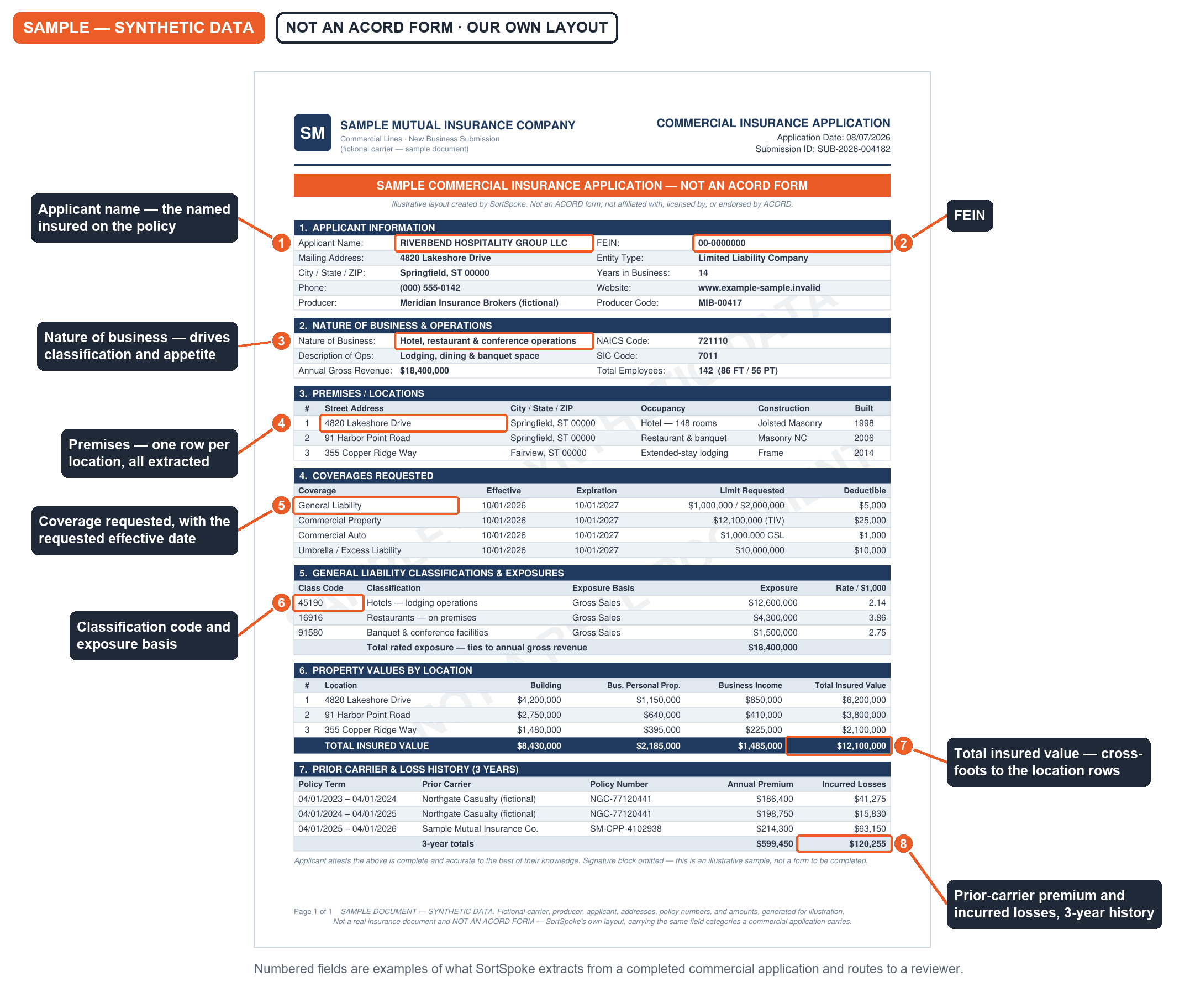
| ACORD 125 | Commercial insurance application — applicant, FEIN, locations, nature of business, prior carriers. | At the front of almost every commercial submission. | The agent or broker, from information the applicant provides; the applicant signs it. | Reads completed applications and returns each field with a confidence score and a link back to where it sat on the page. |
| ACORD 126 | Commercial general liability section — exposures, limits, classification codes. | Attached to an ACORD 125 whenever general liability is requested. | The agent or broker, alongside the application. | Extracts limits, classification codes and exposures for a reviewer to check before they reach rating. |
| ACORD 140 | Property section — building values, construction, protection, occupancy. | Attached to an ACORD 125 whenever property coverage is requested. | The agent or broker, alongside the application. | Extracts building values, construction and protection details location by location. |
An ACORD form is a standardised insurance form published by ACORD, the industry’s global standards body, so that submission data is captured the same way across carriers, MGAs, and brokers. The most common commercial ones are the ACORD 125 (applicant), ACORD 126 (general liability), ACORD 140 (property), and ACORD 130 (workers compensation).
From ACORD directly, from your agency or policy management system, or from the carrier or MGA you are submitting to. SortSpoke’s ACORD 125, ACORD 126 and ACORD 140 guides also include a blank fillable PDF and a filled sample, with the edition date shown — ask the carrier which edition it accepts.
SortSpoke processes the commercial ACORD forms covered on this page — the ACORD 25, 125, 126, 130 and 140 — along with other standard ACORD forms. The system also handles the custom versions and variations of these forms that carriers or agencies use, adapting to format differences.
No — SortSpoke can run straight through on high-confidence fields if you configure it that way. However, we always recommend keeping a human in the loop for critical underwriting data to ensure maximum accuracy and compliance, especially for complex submissions or high-value policies.
Unlike black-box AI or traditional OCR, SortSpoke puts underwriters in control of the extraction process. AI handles the initial data extraction from ACORD forms, but underwriters validate results and provide feedback that improves the system in real-time. This approach delivers speed without giving up verifiability: every field is checkable against the source form, and accuracy is governed by thresholds you set rather than promised by us.
Yes, we provide structured data outputs via API that can be consumed and ingested into any downstream system, eliminating manual data re-entry and ensuring consistency across your tech stack.
Most customers are up and running with SortSpoke's ACORD forms processing within 2-4 weeks. Unlike traditional solutions that require extensive setup and configuration, SortSpoke works with ACORD forms out of the box and learns from your team's feedback to continuously improve accuracy.
Go Deeper