What is a Loss Run Report
By SortSpoke
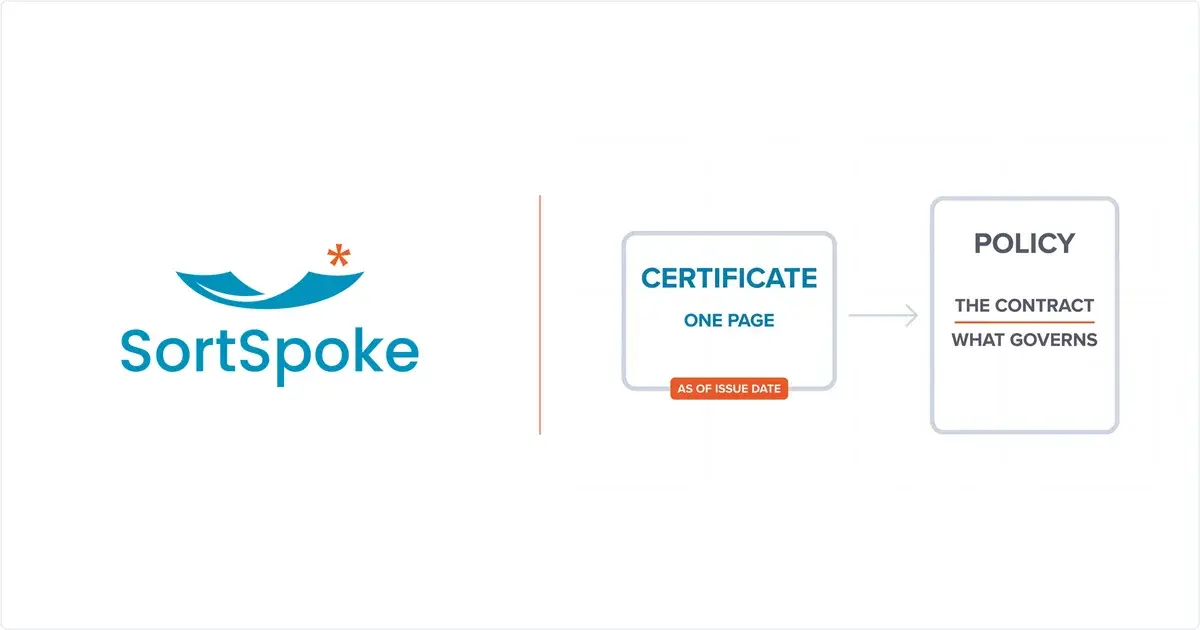
An ACORD certificate of insurance shows up in an inbox and, within a minute or two, somebody has to decide whether it satisfies a contract. An underwriter checking a submission, a general contractor clearing a subcontractor for a site, a property manager filing a tenant's annual renewal — all of them are reading the same one-page form and asking the same question: does this say what it needs to say?
The frustrating part is that the form is standardized and the answer still is not obvious. The grid never moves. What goes inside it is typed by a person at a different agency every time, and the most consequential box on the page is free text. This guide walks the certificate the way somebody who receives them actually reads it: what each section means, what the document does not establish no matter what it shows, and a repeatable order of operations for getting through one quickly.
Most of the time, the phrase means one specific document.
ACORD Certificate of Insurance (ACORD 25)
An ACORD certificate of insurance is a one-page summary of a business's liability coverage, issued on a standard form published by ACORD. It names the insured, the carriers, the policies, the limits and the dates, and is sent to a third party as evidence that coverage was in force on the day it was issued.
ACORD is the standards body that publishes and copyrights the forms. The standardization is the whole point: a certificate issued in Tampa puts its fields in the same places as one issued in Seattle, so whoever receives it knows where to look.
Two clarifications save a lot of confusion. First, "certificate of insurance" is the generic term for the document type; "ACORD certificate of insurance" almost always refers to the ACORD 25 in particular, because that is the form nearly every US agency issues. Second, the certificate is issued by the producer — the agency or brokerage — not by the carrier. Questions about the certificate itself go back to the producer; questions about what the policy actually covers go to the insurer named on the row.
One thing this guide deliberately does not do is name an edition date. ACORD revises its forms periodically and publishes the current edition itself, so the certificate in front of you may well be an older printing than the one your counterparty issued last month. If the edition matters for a compliance file, read it off the footer of the document you are holding rather than trusting a number from an article.
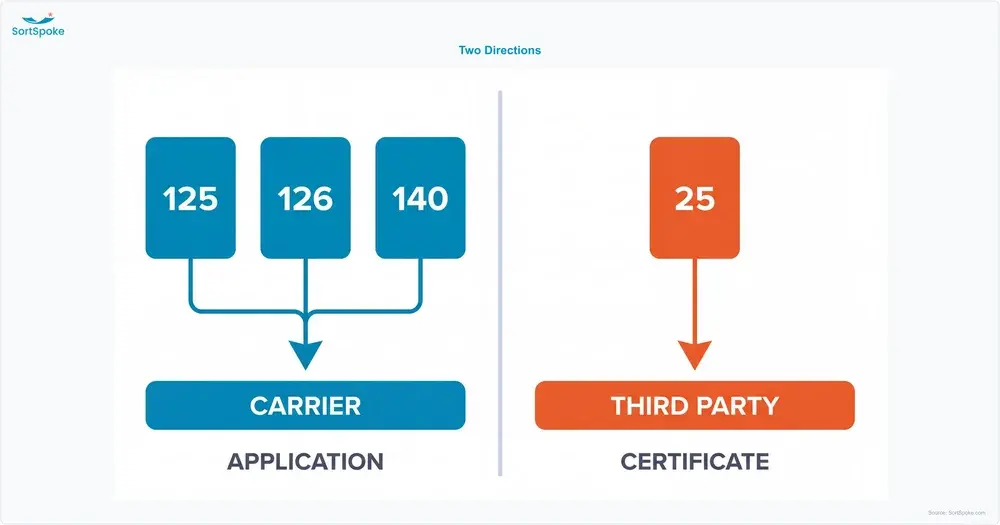
The ACORD 25 gets confused with the application forms, which do a completely different job. The application forms collect information so a carrier can decide whether and at what price to write the risk. The certificate summarizes the result afterwards, for somebody outside that transaction.
| Form | What it is | Who it is for |
|---|---|---|
| ACORD 25 | Certificate of Liability Insurance — a summary of liability coverage already in force | A third party asking for proof: a client, a landlord, a general contractor, an underwriter reviewing a submission |
| ACORD 125 | Commercial Insurance Application — the base application that identifies the account and the coverages requested | The carrier or MGA being asked to quote |
| ACORD 126 | Commercial General Liability Section — the exposure, classification and limit detail GL is rated from | The general liability underwriter |
| ACORD 140 | Property Section — buildings, values, construction, protection and occupancy | The property underwriter |
| ACORD 101 | Additional Remarks Schedule — an overflow sheet for text that will not fit on the parent form | Whoever is reading the parent form, including the certificate |
If the distinction between the application forms is the part that trips you up, we have a longer piece on how the ACORD 125, 126 and 140 stack inside a single submission. The full set of form guides lives on the ACORD forms hub.
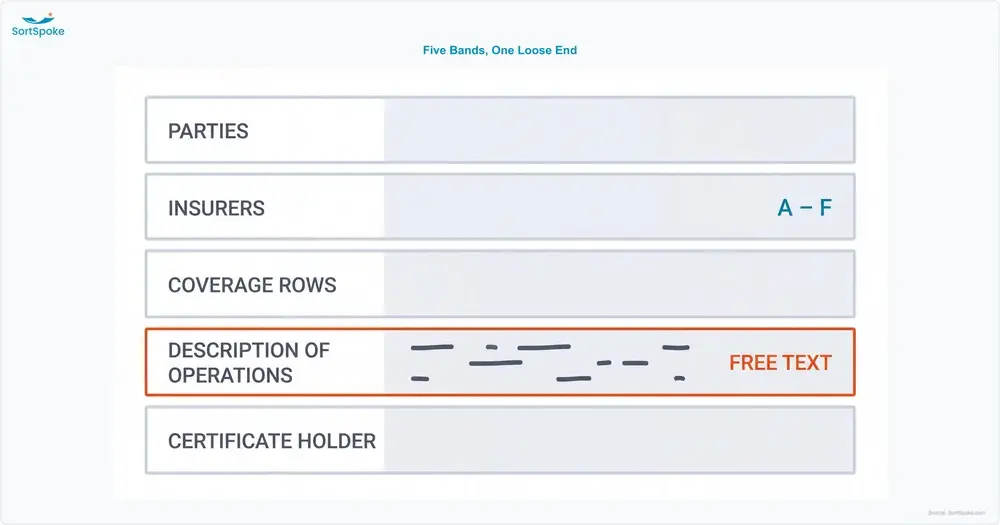
Reading top to bottom, the ACORD 25 carries roughly sixty fields in a fixed arrangement:
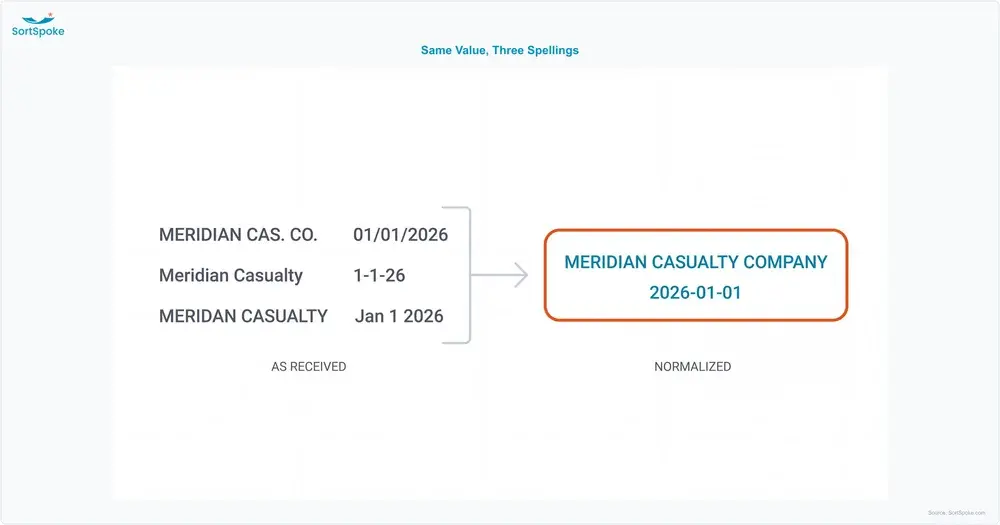
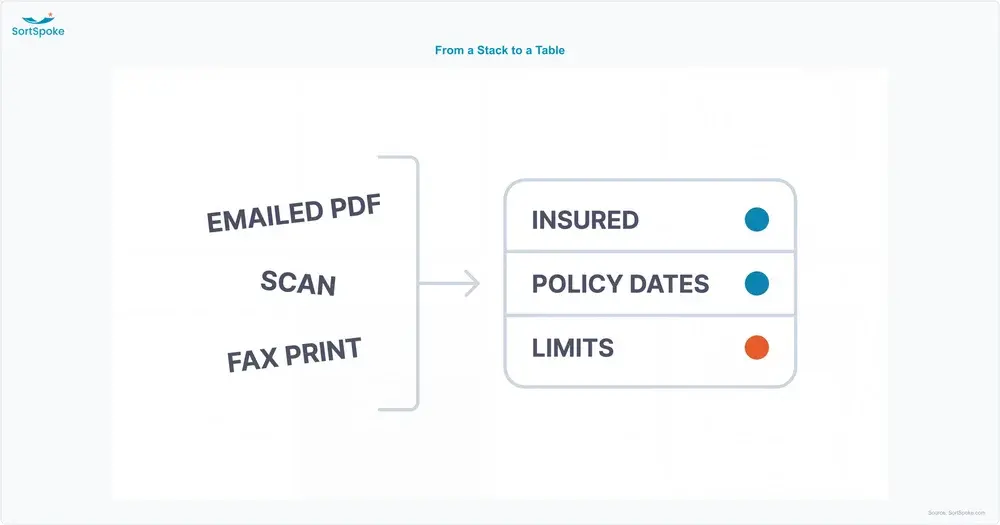
That is a lot of fields for a document that arrives in volume, in inconsistent condition, and often as a scan of a print of a fax. If you want to see the whole set pulled off a real certificate rather than described in prose, the free ACORD 25 extractor takes a certificate you already have and hands every field back structured, with a confidence score on each one.
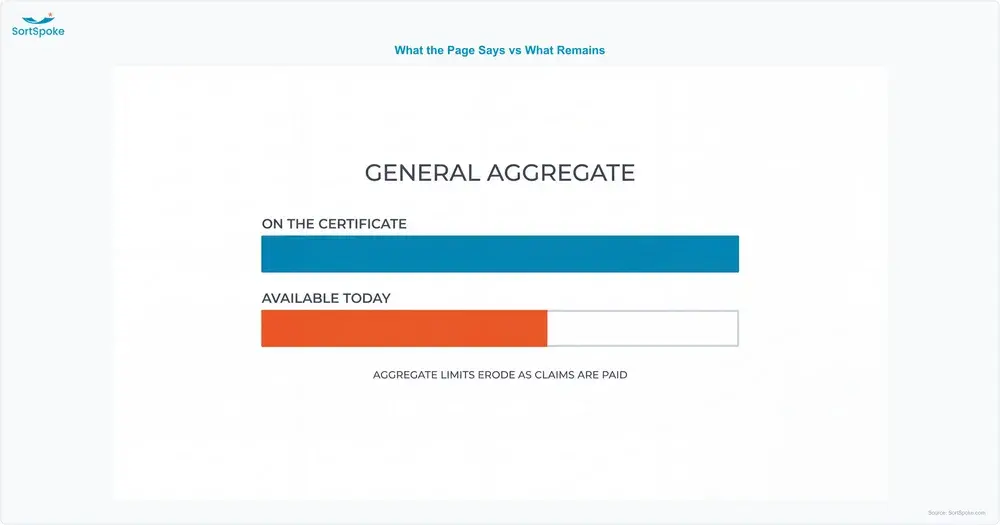
This is where certificates cause real trouble. The document is evidence that coverage existed on the day it was issued. It is not the policy, and it is not a guarantee about today.
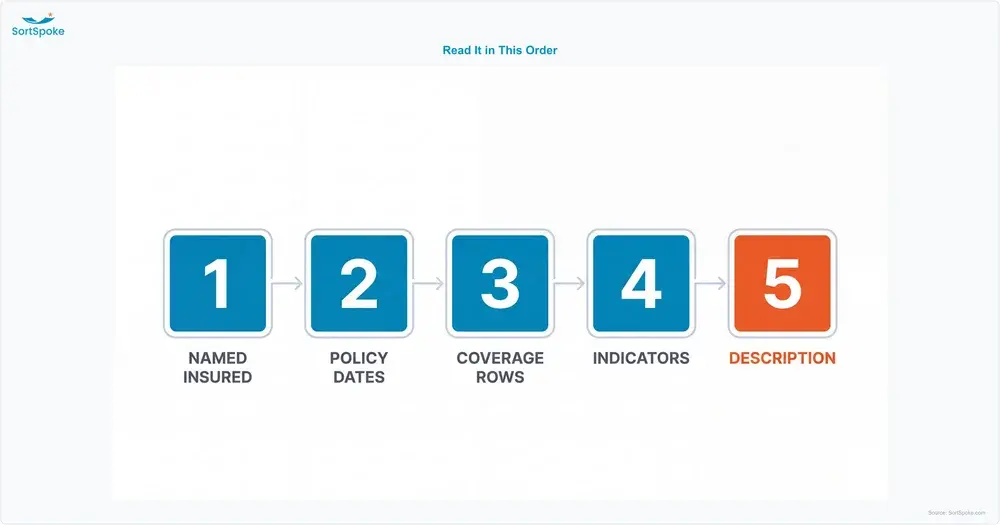
Certificates reward a fixed order of operations. Running the same five passes every time is what keeps a hundred-document morning from turning into a hundred separate judgement calls.
Before anything else, confirm the entity on the certificate is the entity you are doing business with. Everything downstream is wasted effort if the name is wrong, and a mismatched subsidiary is the single easiest defect to miss.
Find the effective and expiration dates on every coverage row. An expired row makes the rest of that row irrelevant, and the expiration dates are the reason certificates get tracked at all.
Work from your requirement list to the certificate, not the other way around. Take each coverage and limit your contract demands and locate it on the page. Absence is the failure mode — hired and non-owned auto, for instance, is frequently required and quietly missing.
Note which rows carry ADDL INSD or SUBR WVD, then decide whether you need the endorsement behind them. On a low-value vendor you may accept the checkbox; on a construction contract you almost certainly should not.
The free-text block is where project numbers, job-site addresses and additional-insured wording live, and it is the one section you cannot skim. If it references an ACORD 101, the certificate is incomplete without that attachment.
It is a standardized one-page document, the ACORD 25, that summarizes a business's liability insurance. An agent or broker issues it to a third party who has asked for proof of coverage. It lists the named insured, the carriers, the policy numbers, the effective and expiration dates, and the limits for each line of liability coverage, and it is evidence of what was in force on the date it was issued.
In US commercial insurance, effectively yes. "Certificate of insurance" is the generic name for the document; the ACORD 25 is the standard form nearly every agency uses to produce one. Outside that context the terms can diverge — Canadian brokers often issue CSIO-standard certificates, and some carriers use their own proprietary layout — so it is worth confirming which form a contract actually requires.
The producer: the insured's agent or broker, generally out of their agency management system. The carrier is named on the certificate but does not usually issue it. That distinction matters when something on the document is wrong, because corrections come from the producer, while questions about what the policy actually covers go to the insurer on that coverage row.
The certificate itself has no expiry. What expires is the coverage it describes, row by row, on the policy expiration dates printed on the page — and coverage can end before those dates if a policy is cancelled, which is why the certificate is a snapshot rather than a standing guarantee. Compliance teams typically request a fresh certificate at each policy renewal and track the earliest expiration date on the document.
Reading one certificate carefully takes a minute. Reading four hundred of them a month, off scans and forwarded PDFs, is a staffing question. Our free ACORD 25 extractor pulls every field off a certificate you already have so you can see what structured output looks like, and if certificates are one document type among many arriving on your desk, book a SortSpoke demo and we will walk through the rest of the stack.
Commercial P&C Insurers Guide to Solving the Underwriting Bottleneck