TL;DR
- The ACORD 125 is the base. It is the commercial insurance application — who the applicant is, where they operate, what they do, and what they are asking to insure. Almost every commercial submission starts here.
- The ACORD 126 is the general liability section. It attaches to the 125 when the account needs commercial general liability, and carries the exposure and limit detail a GL underwriter prices from.
- The ACORD 140 is the property section. It attaches when there is property to insure, and describes each building — values, construction, protection, occupancy.
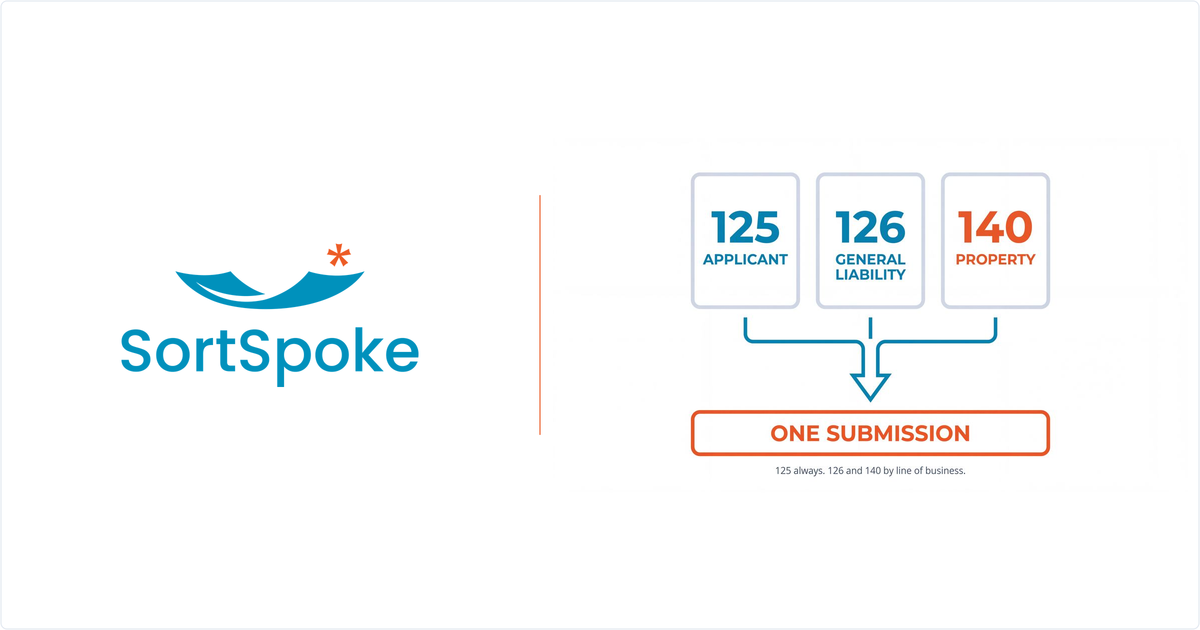
- They stack, they do not compete. A commercial package submission is usually a 125 plus whichever line-of-business sections apply, and the underwriting problem is rarely the forms themselves — it is turning a stack of filled, scanned, and modified forms back into data.
Ask three people in a commercial lines operation what the difference between the ACORD 125, 126 and 140 is and you will often get three partial answers. Everyone recognises the forms. Fewer people can say cleanly which one carries which data, which are mandatory, and which attach only when a particular line of business is in play. That matters, because an incomplete submission is the most common reason a quote stalls before an underwriter has even looked at the risk.
This is a plain explanation of what each of the three forms covers, how they fit together in a single submission, where the ACORD 127 and 130 sit alongside them, and what happens to all of that paper once it reaches an underwriting desk.
ACORD 125 vs 126 vs 140 at a glance
The shortest version: one application form, plus a section per line of business.
ACORD 125 — Commercial Insurance Application
What it is — the common application that identifies the account. It covers the applicant, the business, the locations, and the coverages being requested.
When it is used — on essentially every commercial submission, regardless of line of business. It is the form the others attach to.
ACORD 126 — Commercial General Liability Section
What it is — the liability supplement. It carries the exposure detail, classifications, limits, and coverage-form choices that general liability is rated on.
When it is used — whenever commercial general liability is part of the request. It is not a standalone application; it is meaningless without the 125 in front of it.
ACORD 140 — Property Section
What it is — the property supplement. It describes the physical risk building by building: values, construction, protection, occupancy, and how the coverage is written.
When it is used — whenever there is property to insure. On larger schedules it is frequently supplemented or replaced in practice by a statement of values, because the form is not built for hundreds of locations.
ACORD 125: the commercial insurance application
The ACORD 125 answers the underwriter's first question: who is this, and what are they asking for? It is the identity and scope layer of the submission. Nothing on it prices the risk on its own — it establishes the account so that the line-specific sections mean something.
Commercial Insurance Application (ACORD 125)
The ACORD 125 is the standard commercial application form: the applicant's identity and legal structure, the premises they operate from, the nature of the business, the lines of coverage requested, and the general background questions every carrier asks before it looks at exposure detail.
The field categories underwriters and clearance teams tend to read first:
- Applicant identity — legal name, any DBA, entity type, and the federal tax identifier used to clear the account against existing business.
- Premises and locations — where the business physically operates, which drives everything the property and liability sections then describe.
- Nature of the business — the description and classification that determine appetite before anything else is considered.
- Coverages requested — which lines the submission is actually asking for, and therefore which supplementary sections should be attached.
- Prior carrier and loss history summary — the short version on the form, which the carrier will then want backed by actual loss runs.
- General background questions — prior cancellations, bankruptcies, and similar disclosures that can end a submission early.
Because the 125 governs appetite and clearance, a gap here is expensive in a way a gap elsewhere is not. A missing tax identifier or a vague business description stops the submission before triage.
ACORD 126: the commercial general liability section
The ACORD 126 is where general liability actually gets priced. Where the 125 says what the business is, the 126 says how much of it there is and on what terms — the exposure basis, the classifications, and the limits.
Commercial General Liability Section (ACORD 126)
The ACORD 126 is the general liability supplement to the commercial application. It captures GL classifications and their exposure bases, the requested limits and deductibles, the coverage trigger, and the liability-specific questions a GL underwriter needs answered.
The field categories that carry the most underwriting weight:
- Classifications and exposure basis — the class descriptions and the measure each is rated on, such as sales, payroll, or area.
- Requested limits and deductibles — per-occurrence and aggregate structures, plus any sublimits being asked for.
- Coverage trigger — whether the coverage is written on an occurrence or claims-made basis, and any retroactive date that comes with the latter.
- Operations detail — subcontracting, products and completed operations exposure, and the liability questions specific to the class of business.
- Additional interests — parties who need to appear on the resulting policy or certificate.
The 126 is the single most common source of "we cannot quote this yet" on a liability account, because a class description without its exposure basis is not a rateable exposure — it is a note.
ACORD 140: the property section
The ACORD 140 describes the physical risk. It is the section a property underwriter and, downstream, a catastrophe model care about, because it is where a location stops being an address and becomes a set of characteristics.
Property Section (ACORD 140)
The ACORD 140 is the property supplement to the commercial application. It describes each building or location being insured: the values at risk, how the building is constructed and protected, how it is occupied, and the basis on which the coverage is written.
The field categories that matter most on a property account:
- Values at risk — building value, business personal property, and business income or extra expense, which together give total insured value.
- Construction and year built — the construction class and age of the structure, both of which move the rate directly.
- Protection — sprinklers and alarms, the public protection class, and proximity to fire response.
- Occupancy — what actually happens inside the building, which can matter more than the construction does.
- Coverage basis and terms — replacement cost versus actual cash value, causes-of-loss form, coinsurance, and deductibles.
One practical limitation worth naming: the 140 is designed around a modest number of locations. Once a schedule runs to dozens or hundreds of buildings, brokers stop expanding the form and send a spreadsheet instead — which is why property submissions so often arrive as a 125, a 140, and a statement of values that disagree with each other in places.
How the three fit together in one submission
The relationship is a base form plus attachments, not three alternatives. In practice the packet assembles like this:
- Start with the ACORD 125. It identifies the applicant and declares which coverages are being requested. It is present on essentially every commercial submission.
- Attach the ACORD 126 if general liability is requested. No GL in the request, no 126.
- Attach the ACORD 140 if there is property to insure. A tenant with no building of their own may still need one for contents and improvements.
- Attach the other line-specific sections as they apply — auto, workers compensation, crime, inland marine, and so on. A commercial package can carry several at once.
- Add the supporting documents. Loss runs, a statement of values on larger property schedules, supplemental applications for particular classes, and whatever the carrier's own appetite requires.
So a general-liability-only account is typically a 125 and a 126. A property-only account is typically a 125 and a 140. A commercial package is a 125 with both, plus whatever else the account needs. The forms never substitute for one another.
Where ACORD 127 and ACORD 130 fit
Two more numbers come up constantly in the same conversation, and they follow exactly the same logic — a section attaching to the 125 for one line of business.
- ACORD 127 — Business Auto Section. The commercial auto supplement: the vehicles, their use and radius of operation, drivers, and the auto liability and physical damage coverages requested.
- ACORD 130 — Workers Compensation Application. The workers compensation supplement: class codes and payroll by code and state, the experience modifier, prior coverage, and the safety and operations questions a comp underwriter asks.
The ACORD 25 is the odd one out and worth separating explicitly, because it is regularly confused with this family. If you want to see the difference for yourself, you can extract an ACORD 25 free and compare the output. It is a Certificate of Liability Insurance — evidence that coverage already exists, issued after a policy is bound. It is not part of a submission at all. If someone hands you an ACORD 25 when you asked for an application, you have been given proof of someone else's policy.
How do you fill out an ACORD 125?
You fill out an ACORD 125 by working through it in the order the form is laid out — applicant identity first, then locations and the nature of the business, then the coverages requested, then the background questions — and you do it in a fillable copy obtained from a legitimate source. Most agencies never touch a blank form directly: their agency or policy management system pre-populates the applicant data it already holds and produces the completed form for review.
The practical advice from the underwriting side is narrower than "fill in every box". Three things cause most of the back-and-forth:
- Do not leave the business description generic. "Contractor" is not a description; it is a category. Appetite decisions are made on this field.
- Make sure the requested coverages match the attached sections. A 125 requesting general liability with no 126 behind it is an incomplete submission, and it will come back.
- Answer the background questions rather than leaving them blank. A blank disclosure question reads as an unanswered one, and it will be asked again.
Where to get fillable ACORD forms
Blank fillable copies of all three forms, each with its edition date and a filled sample, are on SortSpoke's form guides: the ACORD 125, ACORD 126 and ACORD 140. To confirm the edition your carrier accepts, use one of three sources:
- ACORD directly, through its own forms programme and membership.
- Your agency or policy management system, which will normally carry a licensed forms library and pre-populate it for you.
- The carrier or MGA you are submitting to, who can supply the version of the form they want to receive.
Whatever the source, check the edition date in the form's footer — ACORD revises forms, and carriers reject stale revisions.
What underwriters do with the data once it arrives
Here is the part the form numbers obscure. Standardising the form is not the same as standardising the data. Every submission that lands has been through a broker's hands, and by the time it reaches an underwriting desk the packet is usually some combination of scanned pages, forms with handwriting in the margins, carrier-modified versions of the standard layout, and revisions from several different years — all in one PDF, in no particular order.
So the work between "the submission arrived" and "the underwriter can price it" is data entry. Someone identifies which document is which, keys the 125's applicant data into the clearance system, keys the 126's classifications and limits into the rater, keys the 140's building characteristics into the property model, and then reconciles the loss summary on the 125 against the actual loss runs. On a busy desk that is the bottleneck, and it is why submission triage stalls long before underwriting judgement is ever applied.
This is the problem SortSpoke's ACORD forms processing exists to remove. The relevant capabilities map directly onto the mess described above:
- Splitting and classification. A single bundled PDF is separated into its component documents and each one is identified — an ACORD 125 from an ACORD 130, an application from a loss run — so the right extraction runs on the right document.
- Pretrained ACORD models. Models trained on the 125, 126, 130, 140 and related commercial-lines forms extract into their standard fields without a template being configured first, so a carrier-modified version does not require setup before it works.
- Checkboxes and handwriting. Checkbox states are captured as structured data, and handwritten entries and margin notes are read rather than dropped — the two things generic OCR most reliably loses on a filled ACORD.
- Cross-document checks. The loss summary on the 125 can be compared against the loss runs in the same submission, and discrepancies flagged rather than left for someone to catch by eye.
- Governed accuracy, not promised accuracy. Every extracted field carries a confidence score. Fields above the thresholds you set flow through; anything below routes to your own reviewers, who see each value beside the exact place on the source document it came from. Accuracy is governed by your thresholds, not asserted by us.
SortSpoke is one of the few insurance document platforms built around that review step rather than around a hands-off promise — which matters more on ACORD forms than almost anywhere else, because a misread limit or class code does not announce itself downstream.
"5x efficiency boost."
— Great American Custom Insurance
One boundary worth stating plainly, since "ACORD parser and filler" is often used for two different jobs: SortSpoke reads completed ACORD forms and turns them into structured data. It does not generate blank or pre-filled ACORD PDFs for you to send onward — that is a licensed-forms function, and it belongs in your agency or policy management system. The distinction is set out in more detail on the ACORD forms page.
FAQ
What is an ACORD form?
An ACORD form is a standardised insurance form published by ACORD, the industry's global standards body, so that submission data is captured the same way across carriers, MGAs, and brokers. The most common commercial ones are the ACORD 125 (the commercial application), the ACORD 126 (general liability), the ACORD 140 (property), and the ACORD 130 (workers compensation).
What is the difference between the ACORD 125 and the ACORD 126?
The ACORD 125 is the commercial insurance application — it identifies the applicant, their locations, the nature of the business, and the coverages being requested. The ACORD 126 is the general liability section that attaches to it, carrying the classifications, exposure bases, limits, and coverage-trigger detail that general liability is actually rated on. The 125 establishes the account; the 126 prices one line of business on it. A general liability submission normally needs both.
Do you always need an ACORD 140?
No. The ACORD 140 is the property section and it is only needed when there is property to insure, which includes a tenant's contents and improvements as well as an owned building. A general-liability-only account needs the ACORD 125 and the ACORD 126 and no 140 at all. On large property schedules the form is often supplemented by a statement of values, because it was not designed to describe hundreds of locations.
Where can I get fillable ACORD 125, 126 and 140 forms?
From ACORD directly, from your agency or policy management system, or from the carrier or MGA you are submitting to. SortSpoke's ACORD 125, ACORD 126 and ACORD 140 guides also include a blank fillable PDF and a filled sample, with the edition date shown — ask the carrier which edition it accepts, because out-of-date revisions get rejected.
Key Takeaways
1
The ACORD 125 is the base commercial application; the 126 is the general liability section and the 140 is the property section. They stack onto the 125 by line of business rather than competing with each other.
2
The ACORD 127 (business auto) and ACORD 130 (workers compensation) follow the same pattern. The ACORD 25 is not part of this family at all — it is
an ACORD certificate of insurance, evidence that coverage already exists.
3
A standardised form does not produce standardised data. Scanned pages, handwriting, carrier-modified layouts, and mixed revisions are what actually reach the underwriting desk — and turning that back into structured, reviewable data is where the time goes.
Want to see a real ACORD packet turned into structured data under your own team's review? See a demo →