6 Best Loss Run Processing Tools (2026)
By SortSpoke
Insurance underwriters spend only 30% of their time actually underwriting—the rest disappears into administrative tasks and manual data entry. The documents that drive insurance operations—ACORD forms, loss runs, statements of value—consume hours of skilled professional time that could be spent assessing risk and growing premium.
Automated document processing (ADP) uses artificial intelligence, machine learning, and optical character recognition to automatically extract, classify, and process data from documents. It eliminates manual data entry by intelligently reading PDFs, scanned documents, emails, images, and other file formats, then routing structured data to downstream systems without human intervention.
According to Gartner, "Intelligent document processing solutions are specialized data integration tools that enable automated extraction of data from multiple formats and various layouts of document content."
The terms Automated Document Processing (ADP) and Intelligent Document Processing (IDP) are often used interchangeably in the industry. IDP is the more technical term preferred by analysts and vendors, while ADP is more accessible and descriptive. Both refer to the same category of AI-powered document automation technology. For a detailed look at how these technologies apply to insurance-specific documents like ACORD forms, loss runs, and SOVs, see our guide to intelligent document processing for insurance.
The productivity crisis in insurance underwriting has reached a breaking point. According to research from Insurance Thought Leadership, Accenture, and The Institutes, underwriters spend just 30% of their time on actual underwriting activities. The remaining 70% is consumed by administrative tasks, data entry, and negotiation support—work that doesn't leverage their expertise or judgment.
McKinsey research reveals that 40% of underwriter time goes to administrative tasks alone. The capacity impact is severe: most underwriting teams can thoroughly review only 30-40% of submissions received, leaving premium opportunities on the table simply because there aren't enough hours in the day.
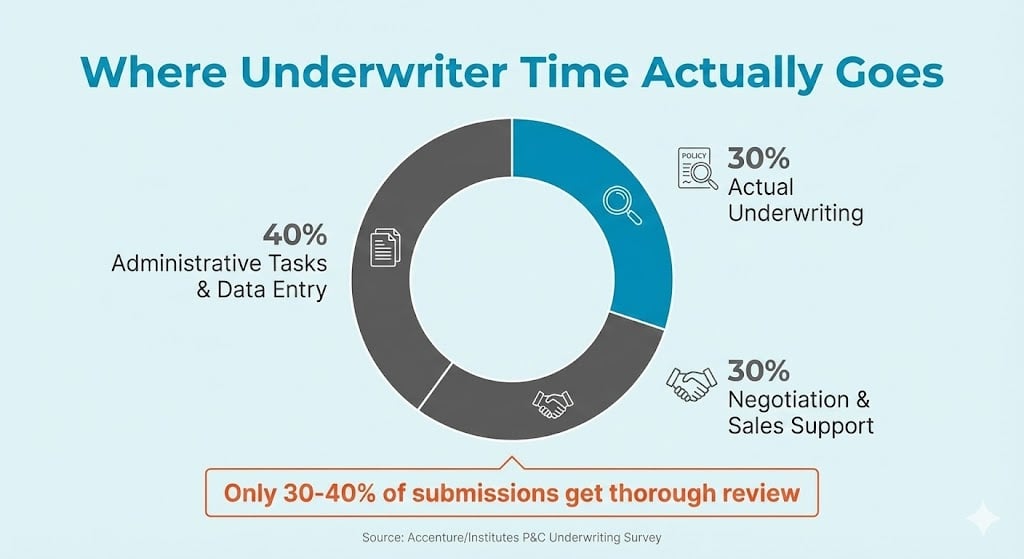
Underwriters spend only 30% of time on actual underwriting. The remaining 70% goes to administrative work, data entry, and document handling—creating a severe capacity bottleneck that limits growth.
The talent market compounds the challenge. With approximately 127,000 insurance underwriters in the United States according to the Bureau of Labor Statistics, and underwriting now the highest-demand position in insurance for the first time in 15 years, carriers can't simply hire their way out of the problem. The Jacobson Group and Aon report unprecedented demand for underwriting talent, making automation essential for scaling operations.
The root cause? Data trapped in documents. According to AutomationEdge, 97% of insurance data is unstructured—locked in PDFs, emails, scanned loss runs, and handwritten application forms. This unstructured data can't flow into rating engines, policy administration systems, or underwriting workbenches without human intervention to extract and re-key it.
The math is brutal: while competitors respond to broker submissions in hours, organizations stuck with manual processing take days. In a broker-driven market where speed determines who gets the submission, this processing bottleneck directly impacts bound premium. Automated document processing—combined with intelligent submission triage—fundamentally changes this equation.
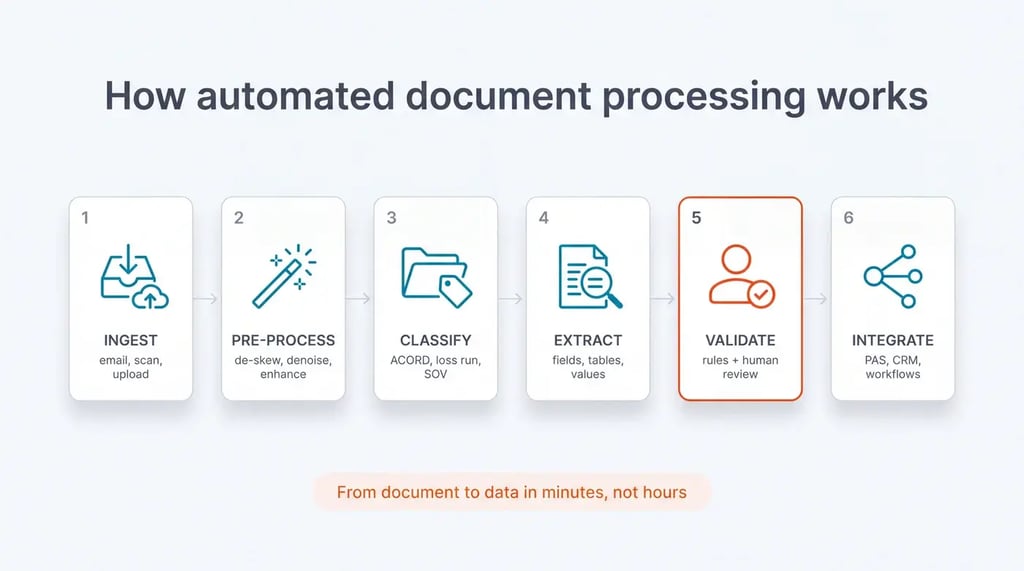
Automated document processing combines multiple AI technologies to replicate—and exceed—human document processing capabilities. While humans read documents linearly and extract information manually, ADP systems process documents in parallel, applying specialized algorithms for different extraction challenges.
Modern ADP platforms integrate six core technologies:
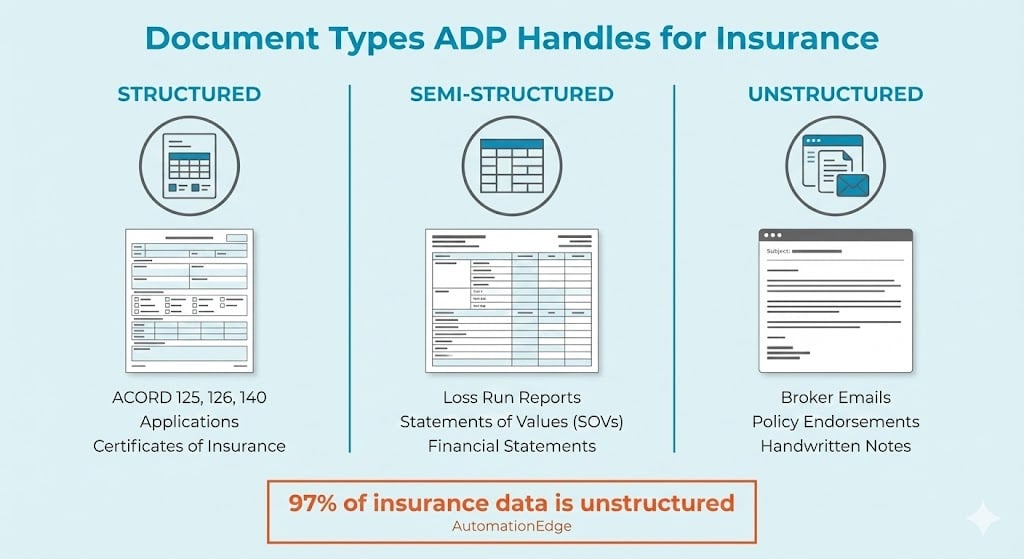
Document Types ADP Handles
ADP platforms handle three categories of documents, and insurance workflows include all three:
Traditional OCR struggles with semi-structured and unstructured documents—precisely where insurance documents are most challenging. According to DocuWare, "OCR merely reads text, but IDP understands it. For example, OCR might capture '$500' from an invoice, but IDP identifies it as the total amount and associates it with the correct supplier."
While ADP works across industries, insurance presents unique document challenges. The variety, complexity, and volume of insurance documents—combined with regulatory requirements for accuracy and auditability—make automation particularly valuable for carriers, MGAs, and BPOs.
ACORD (Association for Cooperative Operations Research and Development) forms are the industry standard for commercial insurance data exchange. According to Embroker, approximately 90% of U.S. property and casualty insurers use ACORD standards, with 36,000+ participating organizations globally.
The challenge with ACORD forms lies in their complexity and variation. The ACORD 125 Commercial Insurance Application alone contains 60-70 data fields per form according to Infrrd.ai. More daunting: ACORD Solutions Group reports over 4,700 versions of 800+ different ACORD forms in circulation. Forms arrive with handwritten sections, variable-quality scans, and attachments that reference the main form.
Traditional manual processing of a single ACORD 125 can take 20-30 minutes for an experienced processor. Automated processing handles the same form in under 2 minutes while achieving higher accuracy. Infrrd.ai reports that 80% of ACORD data can be auto-captured before requiring human review, dramatically accelerating intake.
Learn more about ACORD form extraction →
Loss run reports document claims history and are essential for underwriting renewals and assessing risk for new business. These reports come from multiple carriers, each with inconsistent formats and varying levels of detail. One carrier might provide a simple summary table; another delivers 50 pages of claim-by-claim detail.
Processing complexity aside, speed matters. According to Sentry Insurance, standard turnaround for loss run requests is 7-10 business days, with most states mandating 10 days for delivery. The Hartford notes that underwriters typically require 3-5 years of claims history, meaning a single commercial submission might include loss runs from multiple prior carriers.
Automated document processing enables same-day loss run processing. Systems extract claim dates, descriptions, paid amounts, reserved amounts, claim status, and claimant information regardless of carrier format. What once took hours of manual review and data entry now happens in minutes.
Statements of Values list property values, locations, and coverage details—often in complex spreadsheet formats with hundreds or thousands of rows. According to V7 Labs, AI-powered SOV processing delivers 80-90% time reduction compared to manual methods.
Beyond these core documents, insurance submissions include financial statements, ISO applications, certificates of insurance, broker emails, and policy endorsements. Indico Data reports that submission emails alone can contain 20-30 extractable data fields (insured name, requested coverage, effective date, broker contact information, and more). Capturing this data automatically ensures nothing falls through the cracks during intake.
The business case for ADP is clear and measurable. Organizations implementing automated document processing see improvements across speed, accuracy, cost, and compliance—with quantified returns that justify investment.
Processing time reductions of 85%+ are common across implementations. The transformation is dramatic: Nanonets reports submission turnaround dropping from 3.8 days to 10 minutes. OIP Insurtech and Bound AI document ACORD 125 processing falling from 3 hours to 4 minutes. Instabase cites 85% reduction in document processing times as the industry benchmark.
Speed improvements translate directly to competitive advantage. Insurance Journal reports one carrier reduced quote turnaround by 50%, leading to a 35% increase in bind rates. In a broker-driven market, responding first often means winning the submission.
The impact extends beyond new business. McKinsey research from July 2025 reveals that Aviva cut liability assessment time by 23 days through document automation—a transformation in operational efficiency that enables the same team to handle significantly higher volume.
Speed Benchmark: Leading insurers report 85% reduction in document processing time—from 3.8 days to under 10 minutes per submission.
Manual data entry carries a 4-5% error rate according to industry research. Automated document processing drops error rates to under 1%, with many implementations achieving 99%+ accuracy through validation workflows.
OIP Insurtech and Bound AI document error rate reductions from 4% to under 1%. Academic research published in IJSRA shows 90% error reduction versus manual methods. The same research reveals that manual claims processing results in 22% rejection rates from data errors—a costly problem ADP eliminates.
Accuracy improvements extend beyond data entry. McKinsey reports that Aviva improved routing accuracy by 30% with AI-powered classification, ensuring submissions reach the right underwriting team faster. Hyperscience notes that human-in-the-loop validation workflows enable 99%+ accuracy even for complex, edge-case documents.
Per-document processing costs drop significantly with automation. Manual claim processing costs $40-60 per claim according to Deloitte; automated processing brings this under $20. Enterprise-level savings reach tens of millions: McKinsey reports that Aviva saved £60 million ($82 million) in 2024 from AI-powered document transformation alone.
McKinsey projects 30-50% processing cost reduction as the standard outcome from document automation. Symtrax documents 240% average ROI with payback periods of 6-12 months. Digital Insurance reports that Intact Financial realizes $150 million in annualized AI value across operations, with document processing as a key component.
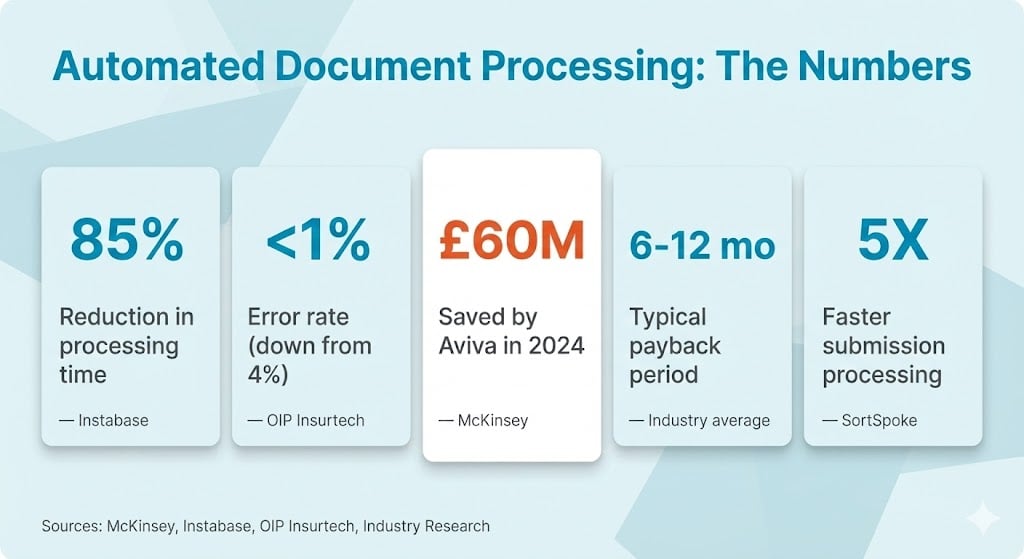
Aviva saved £60 million ($82M) in 2024 from AI-powered document transformation alone. Most implementations pay back within 6-12 months.
ADP platforms automatically identify and mask personally identifiable information (PII), ensuring compliance with data privacy regulations. Complete audit trails satisfy regulatory requirements, particularly important given state-level insurance regulations and data privacy laws.
Every extraction is traceable from source document to downstream system. When regulators or auditors ask "Where did this data point originate?", modern ADP platforms provide the exact document, page, and location—along with the confidence score, any human review notes, and the date/time of extraction. This explainability is critical for insurance operations where decisions must be defensible.
Understanding the differences between processing methods helps organizations choose the right approach. Here's how automated document processing compares to traditional alternatives:
| Factor | Manual Processing | Traditional OCR | Automated Document Processing |
|---|---|---|---|
| Processing Time | 3-6 hours per submission | 30-60 minutes | 4-10 minutes |
| Error Rate | 4-5% | 2-3% | Under 1% |
| Cost per Document | $40-60 | $15-25 | Under $20 |
| Handles Unstructured Documents | Yes (slowly) | Limited | Yes |
| Handles Handwritten Text | Yes (slowly) | Poor | Yes (ICR technology) |
| Learns Over Time | No | No | Yes (ML) |
| Insurance-Specific Training | Depends on staff | No | Pretrained for insurance, then learns your documents |
| Scalability | Linear (add staff) | Limited | High |
| Audit Trail | Manual logging | Basic | Automatic, complete |
As DocuWare explains: "OCR merely reads text, but IDP understands it. For example, OCR might capture '$500' from an invoice, but IDP identifies it as the total amount, associates it with the correct supplier, and cross-checks it with purchase orders."
This distinction matters in insurance where context is everything. Extracting "100,000" is meaningless without understanding whether it's a coverage limit, a deductible, a building value, or annual revenue. Automated document processing understands and categorizes this context automatically.
AI adoption in insurance is nearly universal, but the gap between experimentation and scaled deployment remains wide. According to Market.us, 91% of insurance companies adopted AI by 2025. The Deloitte 2026 Global Insurance Outlook confirms that AI-powered automation is now a strategic imperative, and Sollers Consulting reports that 69% of insurers specifically use AI for data extraction and document processing.
However, adoption doesn't equal mastery. Boston Consulting Group's 2025 research reveals that only 7% of insurers have successfully scaled AI implementations beyond pilot stage. Approximately two-thirds remain in piloting, struggling to move from proof-of-concept to production at scale. Our guide to digital transformation for insurance companies covers what separates the programs that scale from the ones that stall.
Sollers Consulting research shows that while 97% of insurers have some AI implementation, only half have embedded AI strategically across operations. More concerning: 26% have no formal AI governance framework, creating risks around model accuracy, bias, and regulatory compliance.
The gap between adoption (91%) and successful scaling (7%) represents both a challenge and an opportunity. Organizations that move from pilot to production now will build competitive moats that late adopters will struggle to overcome. The carriers winning broker business today are those responding fastest to submissions—a capability that document automation enables. For a detailed look at why the document layer is where so many transformation programs break down before they ever reach scale, see The Document Layer: Why Insurance Transformation Stalls at Intake.
Successful ADP implementation requires evaluating platforms against insurance-specific criteria, not generic document processing capabilities. The technology matters, but so does the vendor's understanding of insurance workflows, compliance requirements, and integration complexity.
When evaluating ADP platforms for insurance, prioritize:
| Benchmark | Timeline |
|---|---|
| Enterprise IDP deployment | 6-12 weeks |
| Typical payback period | Under 12 months |
When evaluating ADP vendors, ask:
OCR (Optical Character Recognition) reads text from images and converts it to digital format. Automated document processing goes further—it understands context, classifies documents, extracts specific data fields, validates accuracy, and integrates with business systems. As DocuWare explains: "OCR might capture '$500' from an invoice, but IDP identifies it as the total amount and associates it with the correct supplier." For insurance, this means ADP understands that "100,000" in one field is a coverage limit while the same number in another field is annual revenue.
Enterprise implementations typically take 6-12 weeks depending on complexity and integration requirements. This includes discovery, configuration, integration testing, and user training. Most organizations see ROI within 6-12 months, with some reporting payback in under 6 months. The fastest implementations focus on high-volume, standardized documents first, then expand to more complex document types.
Leading platforms achieve 99%+ accuracy with validation workflows. Organizations typically see error rates drop from 4% (manual processing) to under 1% with automation. Human-in-the-loop validation ensures edge cases are handled correctly while maintaining throughput. Accuracy improves over time as machine learning models train on more examples from your specific document mix.
Per-document costs typically drop from $40-60 (manual) to under $20 (automated). Enterprise savings can be substantial—Aviva reported saving £60 million ($82M) in 2024 from AI-powered document transformation. Most implementations achieve payback within 6-12 months. Pricing models vary by vendor, ranging from per-document fees to annual platform subscriptions based on document volume.
SortSpoke's intelligent document processing platform is built specifically for insurance—handling ACORD forms, loss runs, and complex submissions with human-in-the-loop accuracy that maintains underwriter control while eliminating data entry.
Commercial P&C Insurers Guide to Solving the Underwriting Bottleneck