What is a Loss Run Report
By SortSpoke
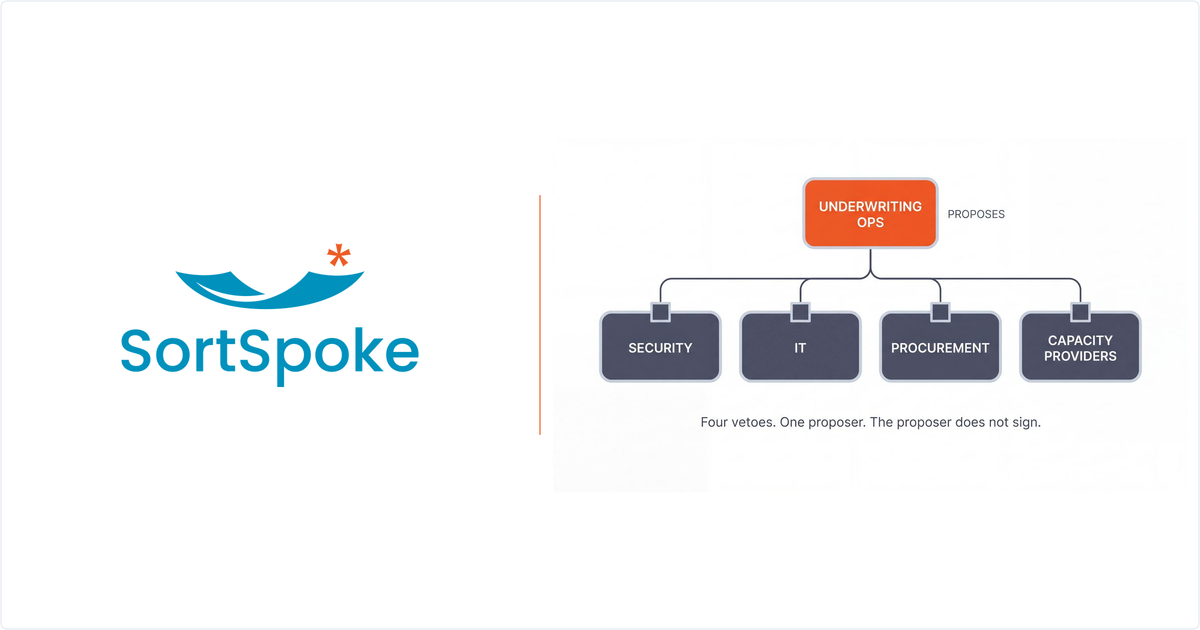
Ask an underwriting-operations leader at a large MGA what stands between them and automated submission intake, and the answer is almost never the technology. It is the eleven weeks the vendor questionnaire will sit in a security queue, the procurement template that has to be redlined, and the carrier partner who wants to understand how data will be handled before the first program moves.
That is a different purchase from the one a smaller MGA makes, run by different people against different evidence. Knowing the shape of it in advance is most of the battle, because nearly all of the delay is sequencing rather than substance.
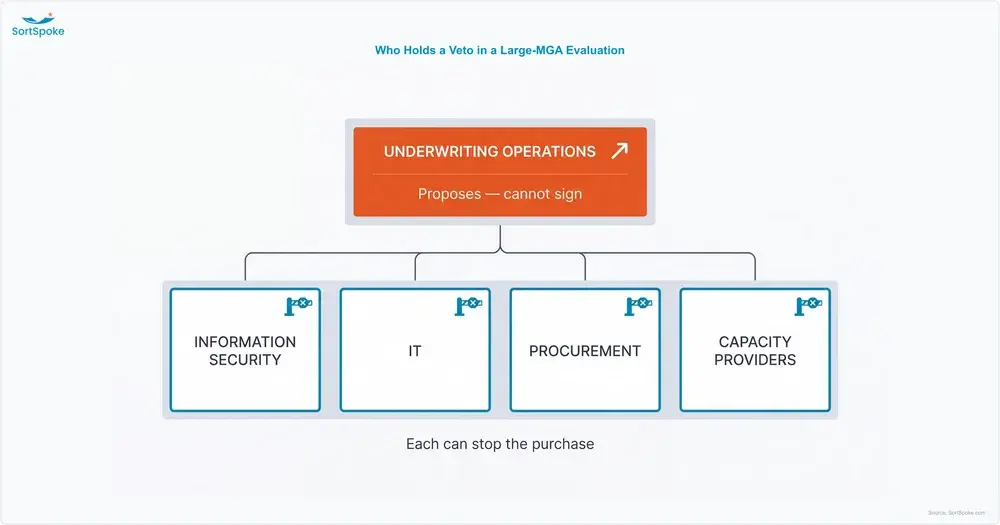
A large MGA evaluates SortSpoke the way a carrier does: a committee assesses it, IT and information security must clear the vendor, procurement owns the contract, and capacity providers may hold audit rights over how the MGA handles their business. SortSpoke is built to be examined that way, with SOC 2 Type II and HIPAA compliance, customer-set per-field confidence thresholds, and a retained record of who reviewed which field and when.
The mistake worth avoiding is treating that machinery as friction to be routed around. It exists because a large MGA is trusted with someone else's pen, and everyone in the chain knows it. The vendor conversation that works is the one that arrives with the artefacts the machinery consumes, rather than the one that asks for an exception.
The rest of this piece is the map: who holds a veto, what each of them actually asks for, why rollout is sequenced program by program, and the one question a large MGA has to answer that a carrier never does. If your evaluation runs with two or three people rather than a committee, read how small and mid-size MGAs buy submission automation instead — the sequencing is genuinely different.
The evaluator and the signer are different people, and the people who can stop the purchase are not the people who wanted it. Five constituencies, each with a distinct test:
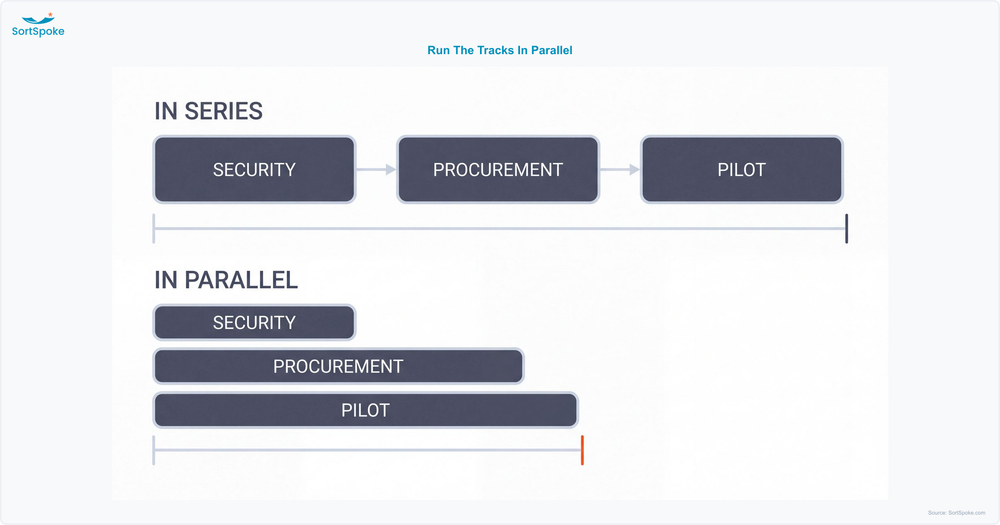
Almost every avoidable month in a large-MGA evaluation comes from running these in series. Security review, procurement redlines and the pilot can run in parallel from week one. Nothing about a pilot on non-production documents requires the contract to be signed first.
Security review is a document exchange before it is a conversation, and the questionnaire is largely predictable. What it wants:
One question comes up often enough to answer directly: who, other than your own staff, ever looks at the documents? Processing runs in software, and the only people reviewing your data are your own. Cost scales with document volume rather than with vendor headcount, which also means throughput does not depend on somebody else's shift coverage. That distinction matters to a security reviewer, because a human-powered service dressed up as SaaS has an access surface that software does not.
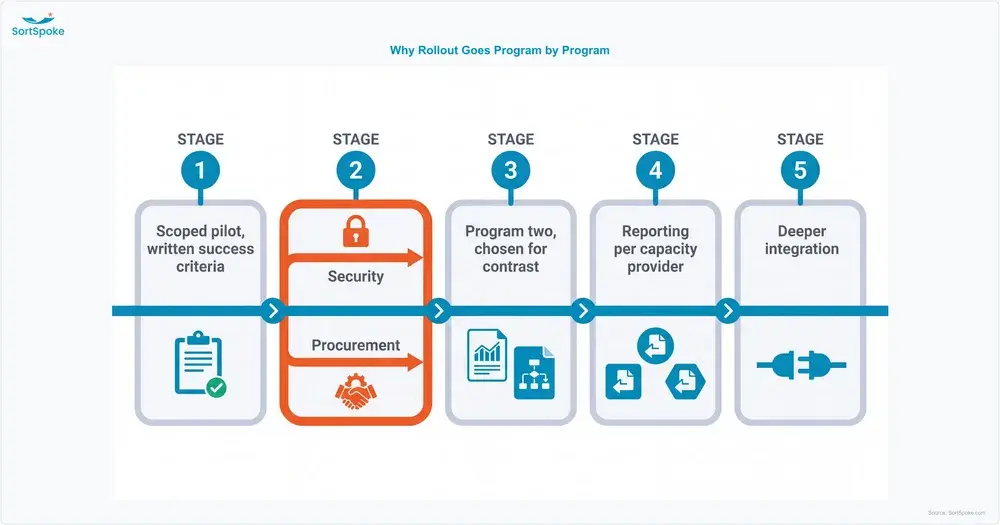
Large MGAs manage complex submission workflows because they run several books at once, each under a different binding authority. That is the structural reason rollout is phased rather than switched on: program A's broker panel sends ACORD 125s and 126s with a property schedule attached, program B lives on a bespoke supplemental questionnaire, and program C's capacity provider wants a monthly bordereau in its own layout.
A sensible sequence:
Standardised forms do not produce standardised data — the ACORD forms arriving from dozens of brokers come scanned, annotated, partially completed and in mixed revisions. Program-by-program rollout is how an MGA absorbs that variation without betting the whole book on one configuration.
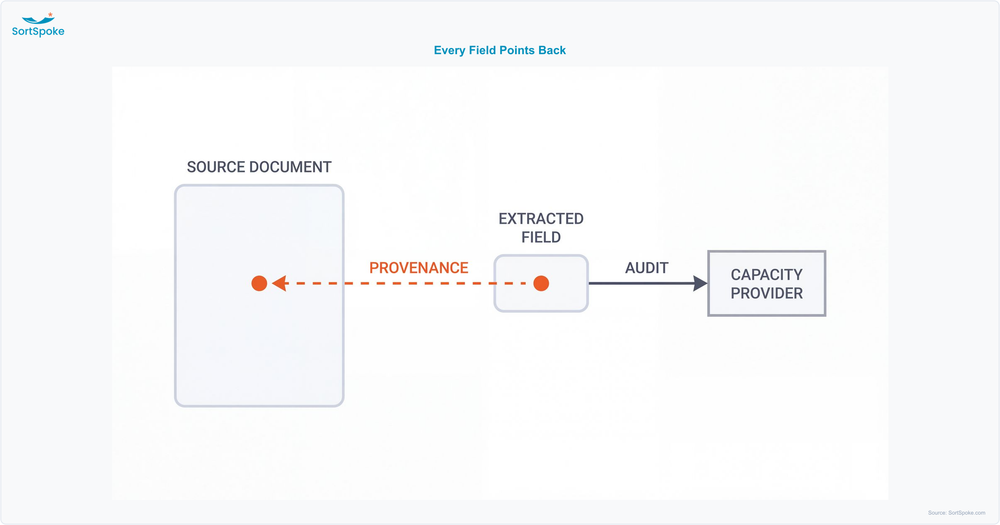
Here is where a large MGA's evaluation stops resembling a carrier's. A carrier automating its own intake answers to itself. An MGA writing under delegated authority answers to somebody else for the same work: the capacity provider whose pen it holds, who is entitled to ask how the data it receives was produced.
That changes what "good" means. Raw processing speed is not the thing being audited. Consistency and traceability are.
SortSpoke is one of the few insurance document platforms designed around that review step rather than around a hands-off promise, which is what makes the record producible in the first place. Great American Custom, a specialty carrier operating under the same kind of scrutiny, reports a 5x efficiency boost with SortSpoke — a carrier reference rather than an MGA one, and worth reading as evidence about governed environments rather than about your own book.
"Great accuracy levels achieved. Training was quick. SortSpoke stood out among competitors evaluated."
— Manager, Global Digital Underwriting, RGA
At this size, integration stops being optional. "Deep" is a concrete list rather than an adjective:
Integration depth is also the honest reason a large MGA's timeline is longer than a smaller one's. None of that list is hard; all of it needs an owner, a test window and a change process. Budget for the process, not for the difficulty. This is the same platform smaller MGAs run shallow — see submission automation for MGAs for the shared foundation underneath both.
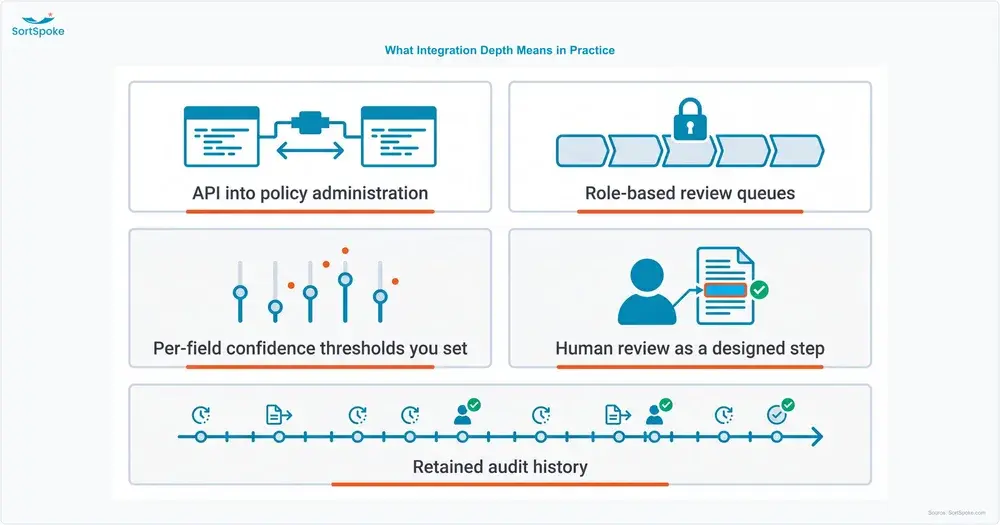
Governance artefacts and integration depth. SortSpoke supports large-MGA evaluations with SOC 2 Type II and HIPAA compliance, single sign-on, role-based review queues, customer-set per-field confidence thresholds and a retained audit trail of who reviewed which field and when — the evidence a security review and a capacity provider's audit both ask for.
Longer than a small MGA's, and usually for reasons that have nothing to do with the software. A scoped pilot with written success criteria runs first, then rollout proceeds program by program. The security and procurement queue is typically the longest single item, which is why it should start in parallel with the pilot rather than after it.
Often, yes. Under delegated authority you are accountable to your capacity providers for the consistency of the data you return, and some agreements give them audit rights over your process. That is why field-level traceability — being able to show where each extracted value came from in the source document — matters more than raw processing speed.
No. Processing runs in software, and the only people reviewing your data are your own. Cost scales with document volume rather than with vendor headcount, so throughput does not depend on someone else's shift coverage.
Send us the security questionnaire — we answer it before the demo. Start the review →
Commercial P&C Insurers Guide to Solving the Underwriting Bottleneck