What is a Loss Run Report
By SortSpoke
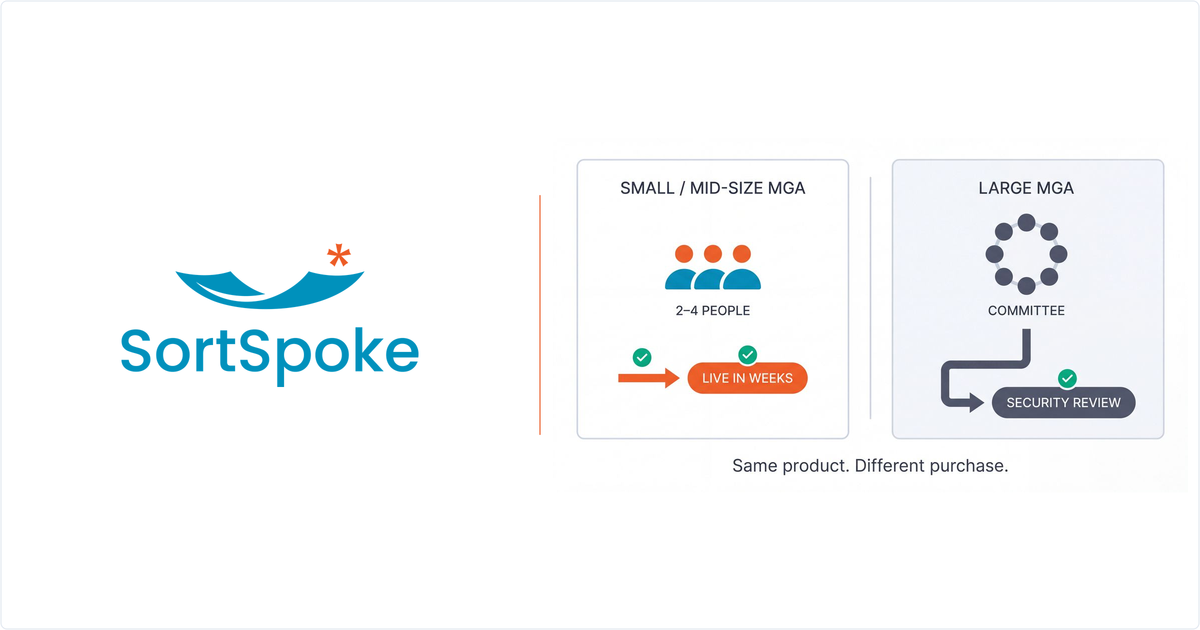
A small MGA can be live on one program before a large MGA has finished scheduling its security review.
That is not a claim about which one is smarter. It is a claim about how differently the two organisations buy. The software is identical; the purchase is not. A large MGA runs a committee evaluation with security, procurement and carrier-partner oversight, because that is what its size obliges it to do. A small or mid-size MGA has the person who feels the backlog sitting in the same room as the person who signs, and can move at the speed that allows.
Most vendor content aimed at MGAs ignores this and writes for one imaginary buyer. If you run a program at a smaller shop, the result is content that describes an implementation you cannot staff. So here is the other version: what submission automation for MGAs actually looks like to buy when your whole evaluation team fits around one table.
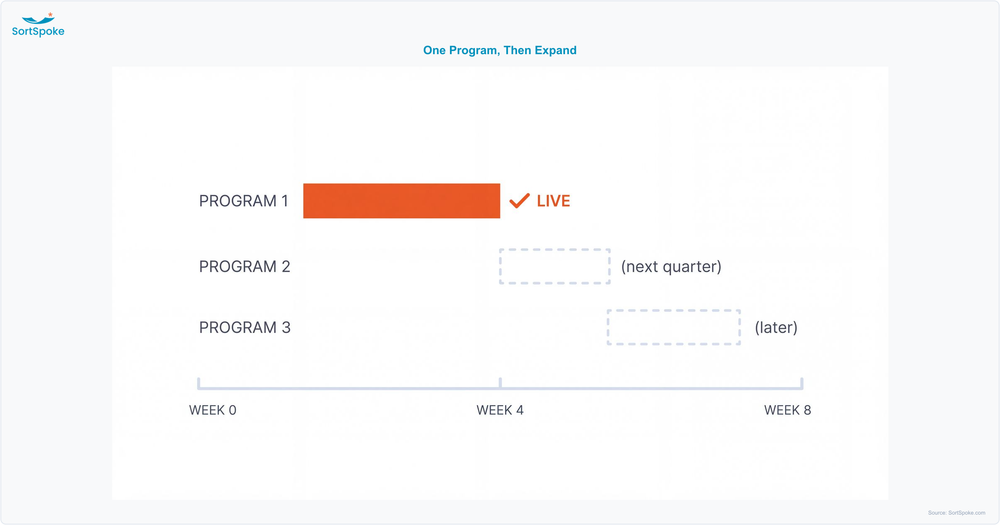
Quick deployment, for a small or mid-size MGA, means SortSpoke is reading one program's submissions within weeks rather than quarters. There is no template library to build and no core-system project to schedule. Documents arrive by email or upload, structured data leaves by CSV or API, and your own reviewers handle whatever the extraction is unsure about.
The word "deployment" carries a lot of freight in insurance software, most of it earned by policy administration projects. It is worth separating the two ideas. A policy admin replacement is a multi-year programme with a business case, a steering group and a migration plan. Turning one inbox of broker submissions into structured data is not that. It is configuration work on a system that already knows what an application looks like.
Quick deployment (submission intake)
Quick deployment — getting a single, real submission workflow producing usable structured data without first replacing, rebuilding or deeply integrating with a system of record. The scope is one program or one document type; everything else is deferred on purpose.
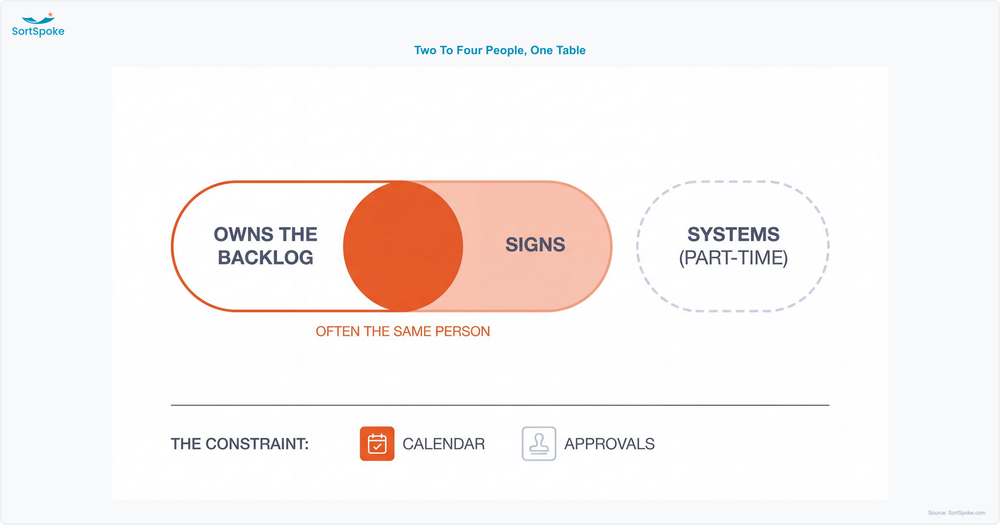
Two to four people, usually. A program lead or underwriting-operations lead who owns the backlog, a COO or principal who signs, and often somebody part-time on systems who will want to know where the data lands. In many evaluations the person doing the evaluating and the person signing the contract are the same person — which is precisely the thing that cannot happen at a large MGA, where the evaluator never signs.
That compression changes what a vendor conversation should contain. Three practical consequences:
Ask the vendor to process ten of your submissions — the messy ones, not the clean sample — and to show which fields their system was unsure about. A demo on a vendor's own tidy document proves nothing about your broker panel.
The single most useful decision a smaller MGA makes is to narrow the first deployment to one program or one document type. Not because the software cannot do more, but because a narrow first scope is what makes the timeline honest.
There is real time to recover. SortSpoke's internal benchmarks put manual ACORD 125 processing at roughly 20–30 minutes per form against under two minutes when the extraction runs first and a reviewer confirms it. Applied to one program's weekly intake, that is a measurable change in submission processing time without touching anything else in the business.
A workable first scope looks like this:
This is also how the economics stay sane. You are not funding a platform on the promise of eventual coverage; you are funding one workflow that either pays for itself in the first quarter or does not.
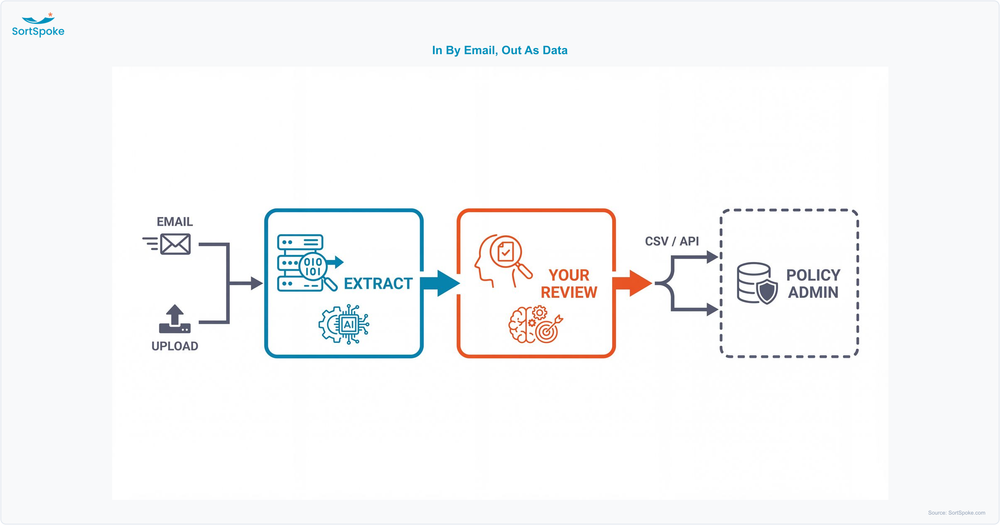
Shallow integration means documents come in the way they already arrive — forwarded email, drag-and-drop upload — and structured data leaves as a CSV your team can import or through an API when someone has time to wire it up. The workflow sits alongside your policy administration system rather than inside it.
People sometimes hear that as a downgrade. It is a sequencing choice. Deep integration is not free: it needs an owner on your side, a test environment, a change window and somebody to maintain it when the vendor on the other end ships an update. Buying that on day one, before anyone has confirmed the extraction is good enough on your documents, is how automation projects end up shelved with the integration half-built.
This is the objection that ends most smaller-MGA evaluations, and it is almost never really about features. It is about deployment shape. The reader has watched a peer spend eight months building a rules library for a document-capture tool and has correctly concluded they cannot afford that.
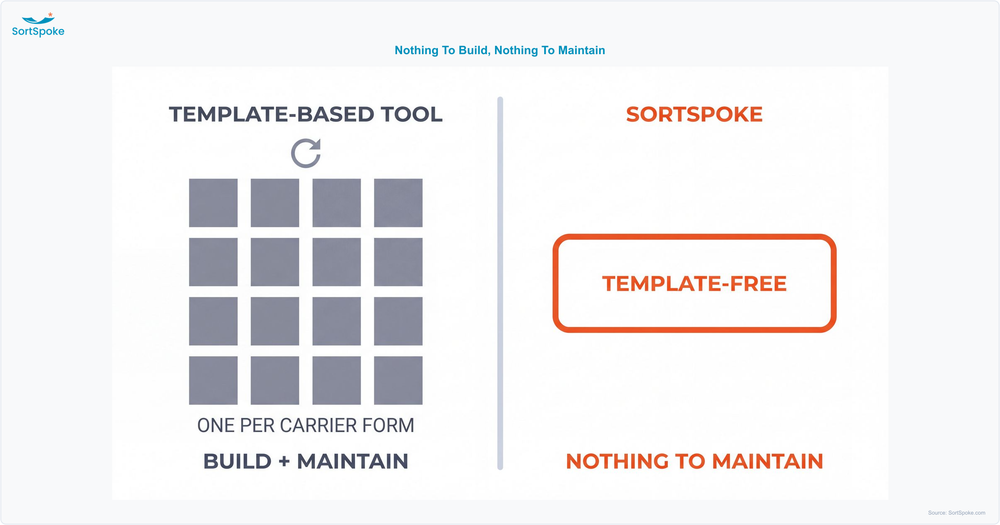
The answer is mechanical rather than rhetorical. SortSpoke is template-free: it does not require you to define a layout per carrier form, so there is no template library to build and none to maintain the next time a carrier reissues a form with the fields moved. That single property is what removes the IT project from the critical path, because the maintenance burden that normally needs an owner does not exist.
Being honest about the other side: you do need a named person to define the fields that matter, to review low-confidence extractions in the first weeks, and to decide what "good enough to pass through" means. That is a few hours a week from someone who understands underwriting — not a developer, and not a project.
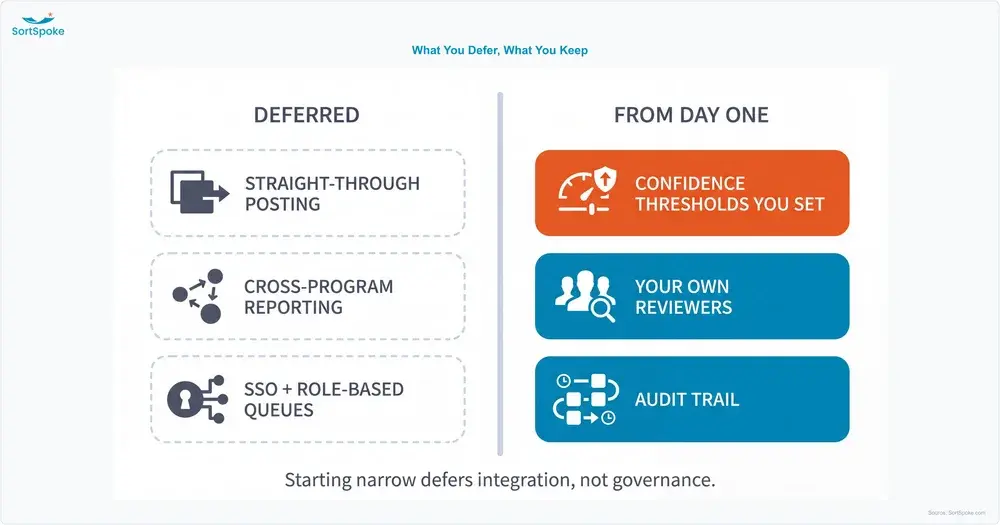
Starting narrow has genuine costs, and a vendor that pretends otherwise is not worth trusting. What you defer:
What you do not give up, and should refuse to:
Speed of deployment is not the same as speed of judgement. The setup is fast because the configuration burden is small, not because the checking has been skipped.
If your organisation is large enough that security, IT and procurement all hold a veto, the sequencing above will not survive contact with your own process — read what a large MGA's committee will ask instead.
On a single program or document type, weeks rather than quarters. SortSpoke requires no document templates and no model training, so the work is configuration and review-workflow setup rather than a development project. Deep integration into a policy administration system can follow later; it is not required to process the first submissions.
Not for the first program. Documents arrive by email or upload and extracted data leaves as CSV or through an API, so the initial workflow sits alongside your existing systems rather than inside them. IT involvement scales with how deeply you eventually integrate, not with getting started.
The product is the same; the purchase is not. A small or mid-size MGA typically evaluates with two to four people and the person who owns the problem often signs. A large MGA runs a committee evaluation with security, IT and procurement approvals, deeper integration requirements and a phased rollout — closer to how a carrier buys.
Yes, and that is the usual pattern. Prove the workflow on your messiest document type or your highest-volume program, then extend to others once your team trusts the review process.
See SortSpoke read one of your carriers' ACORD 125s live — bring the messiest one you have. Book a working session →
Commercial P&C Insurers Guide to Solving the Underwriting Bottleneck