What is a Loss Run Report
By SortSpoke
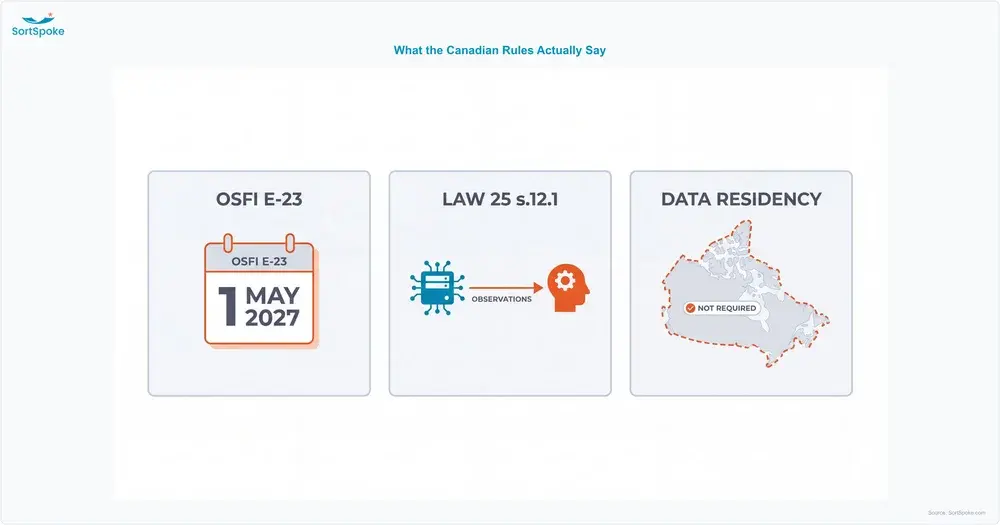
Canadian insurance AI content has a sourcing problem. A great deal of it asserts that OSFI already obliges federally regulated insurers to run a model risk management framework under Guideline E-23, that Quebec's Law 25 gives consumers a right to a human decision, and that Canadian customer data has to be held in Canada. None of those three statements is accurate as of August 2026.
This piece is an attempt to state the Canadian position precisely, with dates and section numbers, and then to turn it into something operationally useful: a vendor evaluation checklist a compliance or underwriting-operations team can run without needing a law firm on retainer for the first pass.
One scoping note before anything else. OSFI supervises federally regulated financial institutions. A substantial share of Canadian property and casualty capacity is written by provincially incorporated insurers, reciprocals and mutuals that fall outside OSFI's remit entirely and answer instead to FSRA in Ontario, the AMF in Quebec, or their provincial equivalent. Brokerages sit outside all of it, with conduct oversight through bodies such as RIBO and association work through IBAO and IBAC. Before applying any of the below, confirm which supervisor actually has you.
Guideline E-23 is OSFI's model risk management guideline. Two versions of it exist, and conflating them is the single most common error in Canadian insurance AI writing.
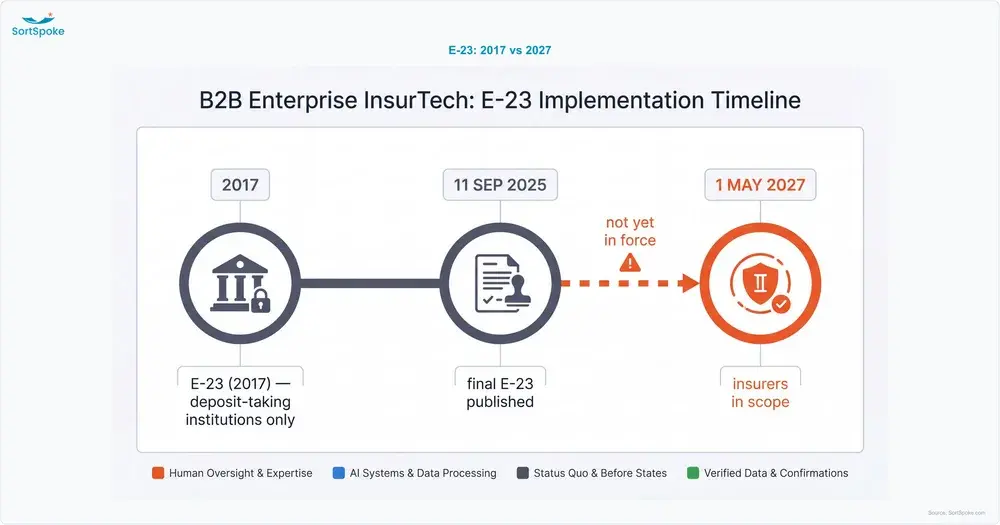
E-23 (2017) is the version in force today. Its scope is deposit-taking institutions only. It does not apply to insurers.
E-23 (2027) was published in final form on 11 September 2025 and takes effect on 1 May 2027. Its scope adds life insurance and fraternal companies, and property and casualty companies, alongside banks, foreign bank branches, and trust and loan companies. Federally regulated pension plans were in the draft and were removed from the final.
The practical consequence: federally regulated insurers are not currently subject to E-23. They come into scope on 1 May 2027. The correct framing is "will require, from 1 May 2027" — not the present tense. Insurers have until May 2027, which is roughly two budget cycles, not two quarters.
The final guideline is built around three Outcomes and twelve Principles (1.1–1.3, 2.1–2.3 and 3.1–3.6). It is principles-based and proportional, which means the depth of the framework OSFI expects scales with the risk a model carries rather than arriving as a fixed checklist.
Two things make E-23 (2027) unusually relevant to document AI and underwriting automation.
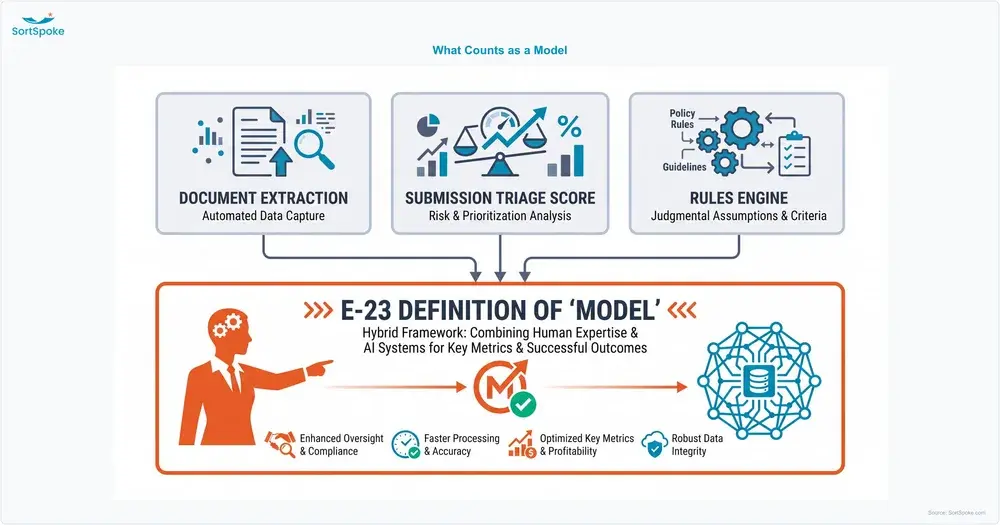
The first is the breadth of the definition of a model. E-23 (2027) defines it as:
"Model", per OSFI Guideline E-23 (2027)
"An application of theoretical, empirical, judgmental assumptions or statistical techniques, including AI/ML methods, which processes input data to generate results."
On that wording, a document extraction system that reads a loss run or a CSIO application and emits structured fields is a model. So is a submission triage score. So is a rules engine with judgmental assumptions baked into it. Institutions that scope their May 2027 readiness work to pricing and reserving models alone are likely to find the inventory exercise larger than expected.
The second is that explainability is expressly calibrated rather than absolute. Principle 3.3 refers to "explainability requirements, which may vary based on the model's purpose, level of autonomy, regulatory requirements, or the potential impact on customers and stakeholders." Principle 3.1 asks that frameworks "be sufficiently flexible to accommodate evolving technologies, different model types (especially crucial given the 'black box' and autonomous nature of many AI/ML models)."
Read those together and the shape of the expectation is clear: the more autonomous the system and the more it touches a customer outcome, the more explanation an institution is expected to be able to produce. That is a sliding scale, and where a given deployment sits on it is a decision the institution has to make and defend.
E-23 (2027) covers models or data sourced externally, including from foreign offices or third-party vendors, and routes that through OSFI's third-party risk guideline. The cover letter is direct about the division of labour:
"Institutions should comply with third-party risk management principles established under guideline B-10… Institutions should also ensure that third-party models receive validation and monitoring commensurate to the model risk."
— OSFI, cover letter to Guideline E-23 (2027)
This is worth dwelling on, because it disposes of a category of vendor marketing. A vendor cannot make an institution E-23 ready, and there is no certification to hold. The obligation sits with the institution, and OSFI is explicit that validation and monitoring of a third-party model are the institution's responsibility. What a vendor can honestly offer is inputs to that work: documentation, explainability artefacts, monitoring outputs, model change notice, and contract terms that feed the institution's own model risk framework and its B-10 file. Anything phrased more strongly than that is a claim the guideline does not support.
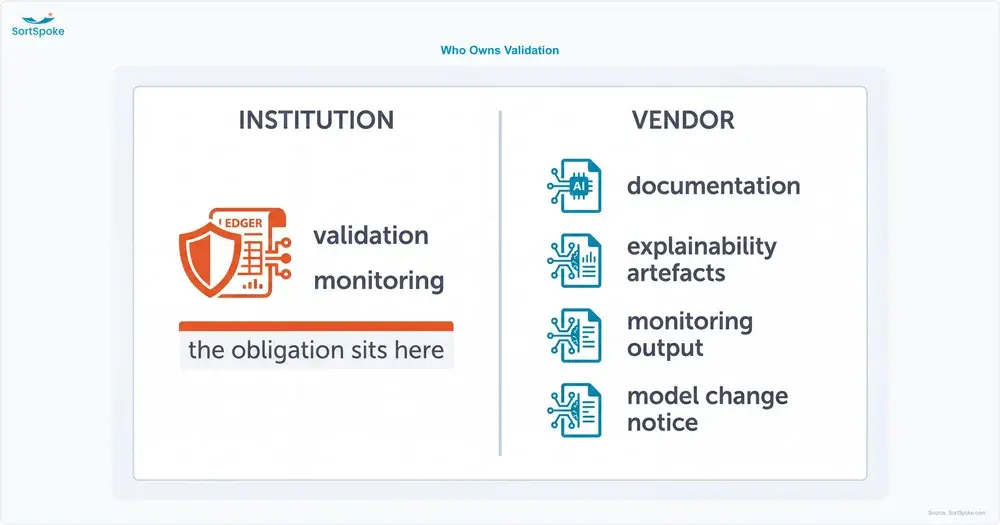
While E-23 waits for 2027, two OSFI guidelines are already in force and already govern how a federally regulated insurer buys and runs AI software.
| Guideline | Status | What it governs |
|---|---|---|
| B-13 Technology and Cyber Risk | Published 31 July 2022, effective 1 January 2024. In force. Amended 22 February 2024 (foreign-branch clarification only). | Technology and cyber risk management at FRFIs, including life and P&C insurers. |
| B-10 Third-Party Risk Management | Published and effective 30 April 2023. In force. | The guideline that actually governs the vendor relationship today — due diligence, contractual terms, monitoring, concentration and exit. |
| E-23 Model Risk Management | 2017 version in force, deposit-taking institutions only. Final 2027 version effective 1 May 2027. | Model risk, including AI/ML methods — for insurers, from May 2027. |
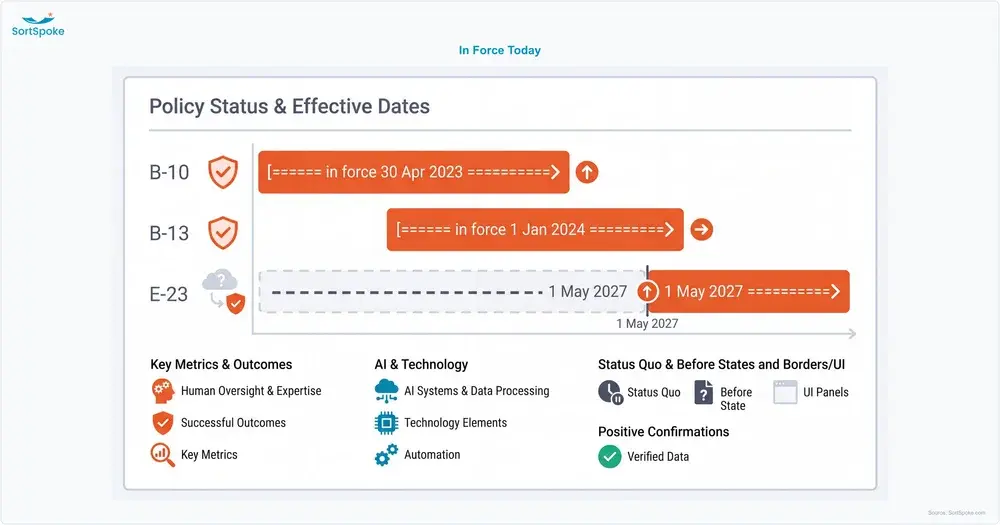
If you are running an AI vendor evaluation in 2026 and looking for the hook to hang it on, B-10 is the one that is live.
Two OSFI-associated publications get cited as though they were requirements. They are not, and treating them as such tends to undermine the credibility of the rest of a governance argument.
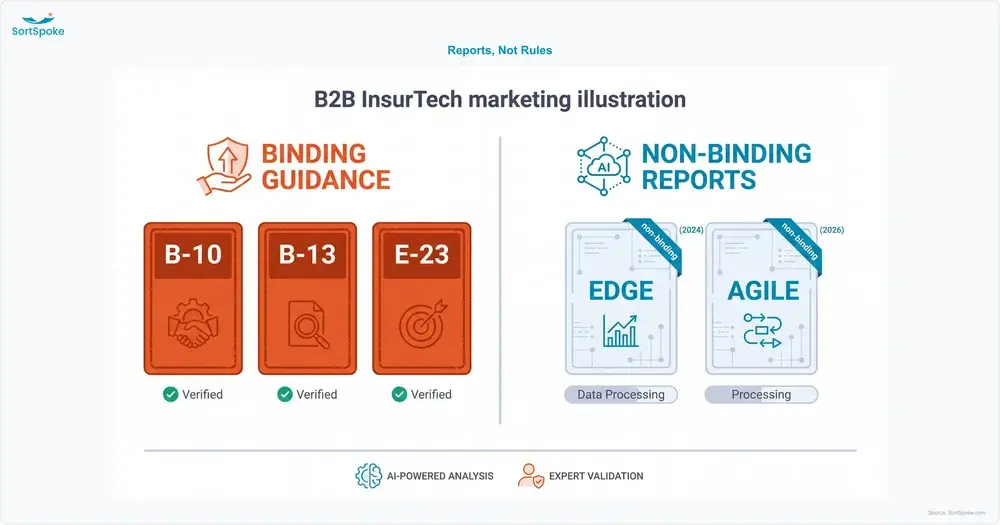
There is no standalone OSFI AI guideline, in force or in draft. The AI expectations live inside E-23.
Quebec's private-sector privacy statute — the Act respecting the protection of personal information in the private sector, CQLR c. P-39.1 — contains the most specific automated decision provision in Canadian law. Section 12.1 came into force on 22 September 2023. Here it is in full, because paraphrases of it are usually wrong:
"Any person carrying on an enterprise who uses personal information to render a decision based exclusively on an automated processing of such information must inform the person concerned accordingly not later than at the time it informs the person of the decision. He must also inform the person concerned, at the latter's request, (1) of the personal information used to render the decision; (2) of the reasons and the principal factors and parameters that led to the decision; and (3) of the right of the person concerned to have the personal information used to render the decision corrected. The person concerned must be given the opportunity to submit observations to a member of the personnel of the enterprise who is in a position to review the decision."
— CQLR c. P-39.1, s.12.1, in force 22 September 2023
Two points of precision matter more than anything else in that paragraph.
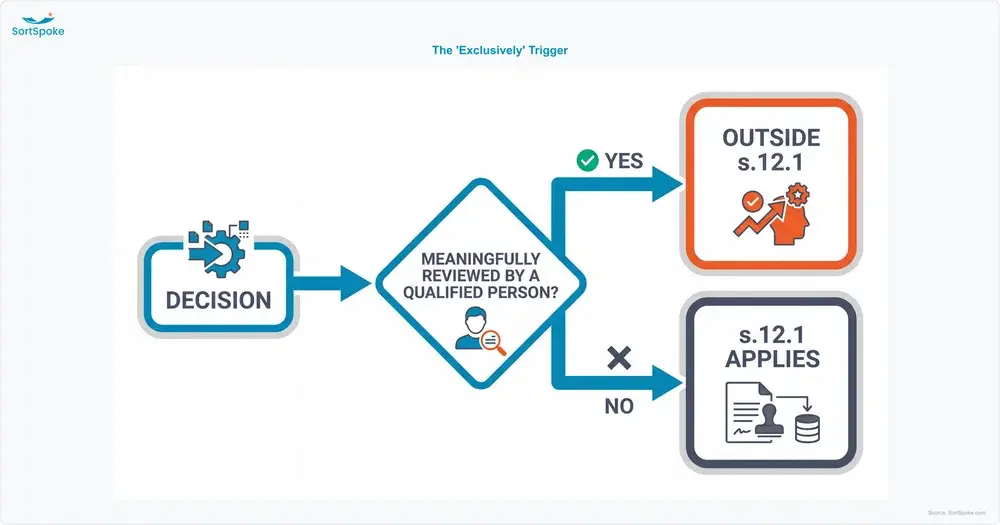
The trigger is "exclusively." Section 12.1 attaches to a decision based exclusively on automated processing. A decision that a qualified person meaningfully reviewed before it was rendered falls outside the trigger. That is not a loophole; it is the design of the provision, and it is the strongest and most honest argument available for human review in a Canadian underwriting or claims workflow. It is a far better argument than the overstatement that usually replaces it.
What it grants is observations, not a re-decision. Where s.12.1 does apply, the individual can be informed, can ask for the information used, the reasons and the principal factors and parameters, can have the personal information corrected, and can submit observations to a member of personnel who is in a position to review the decision. Quebec has not enacted a GDPR Article 22-style prohibition on automated decisions, and s.12.1 does not create a right to have the decision re-made by a human. Content that upgrades it into one is easy to disprove, and it takes the rest of the argument down with it.
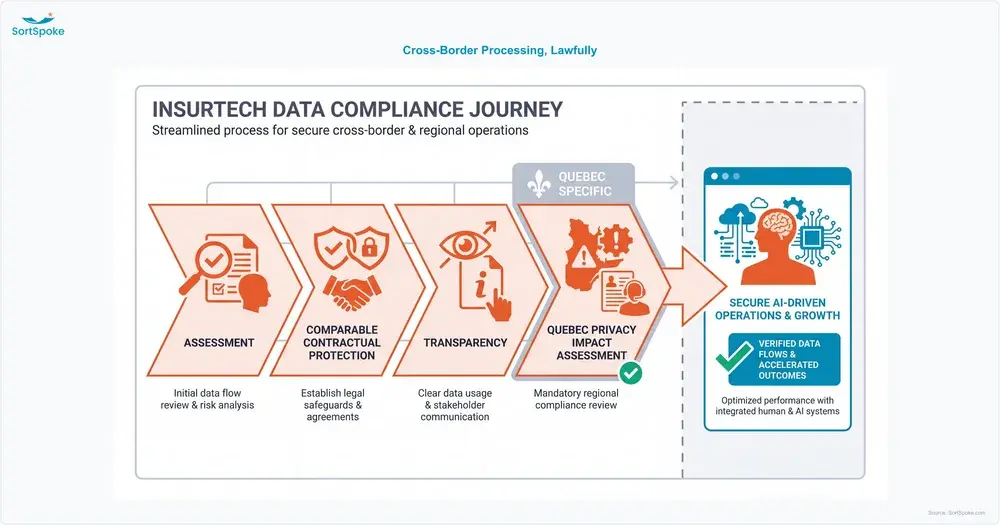
The provision with more day-to-day procurement consequence is s.17, also in force since 22 September 2023. Before communicating personal information outside Québec, an enterprise must conduct a privacy impact assessment that considers the sensitivity of the information, the purposes for which it is to be used, the protection measures — including contractual ones — that would apply to it, and the legal framework applicable in the destination jurisdiction. The communication may proceed if the assessment establishes that the information would receive adequate protection, and it must be covered by a written agreement.
That is an assessment obligation on the insurer, not a prohibition, and not something a vendor can discharge on your behalf. What a vendor can do is supply the inputs: the subprocessor list, the destination jurisdictions, the technical and contractual protection measures, and terms that survive in writing.
Law 25 is now fully in force. The final tranche, the data portability right in the third paragraph of s.27, landed on 22 September 2024. There is nothing further pending.
It would be convenient to write that OSFI mandates a human in the loop. It does not, and E-23 does not say so. What E-23 (2027) will require is explainability calibrated to the model's purpose, level of autonomy, regulatory requirements and potential impact on customers and stakeholders. Human review is a well-supported control, not a mandate.
Stated that way, the argument for it is still strong, and it rests on three legs.
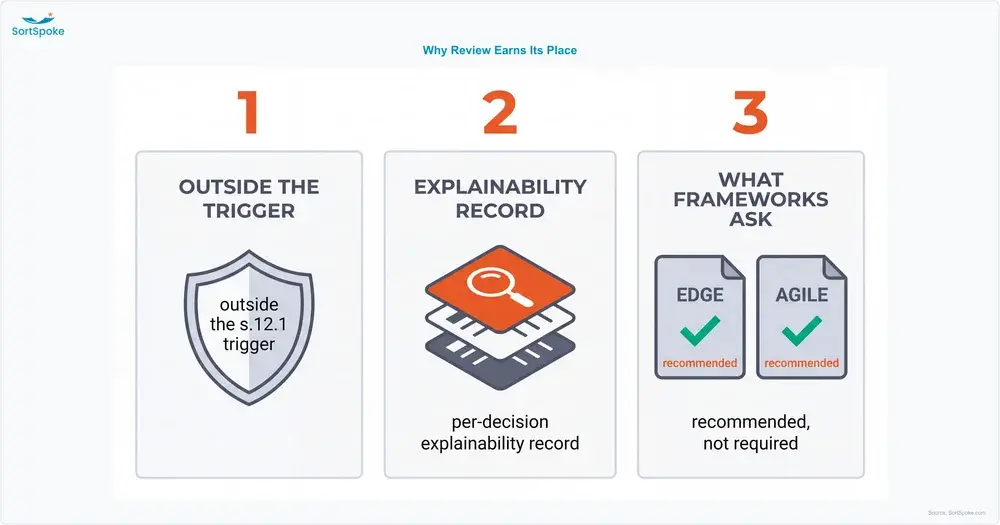
The counter-argument deserves an airing too, because a piece that only lists benefits is not a governance piece. Human review has a cost, it introduces its own error modes, and reviewer fatigue on a high-volume queue is a real failure mode rather than a theoretical one. The design question is not "human or not" but which decisions carry enough customer impact or model uncertainty to be worth a person's attention, and how you evidence that the attention was genuine rather than a click-through. An institution that cannot answer the second half of that is likely to have an awkward conversation in 2027.
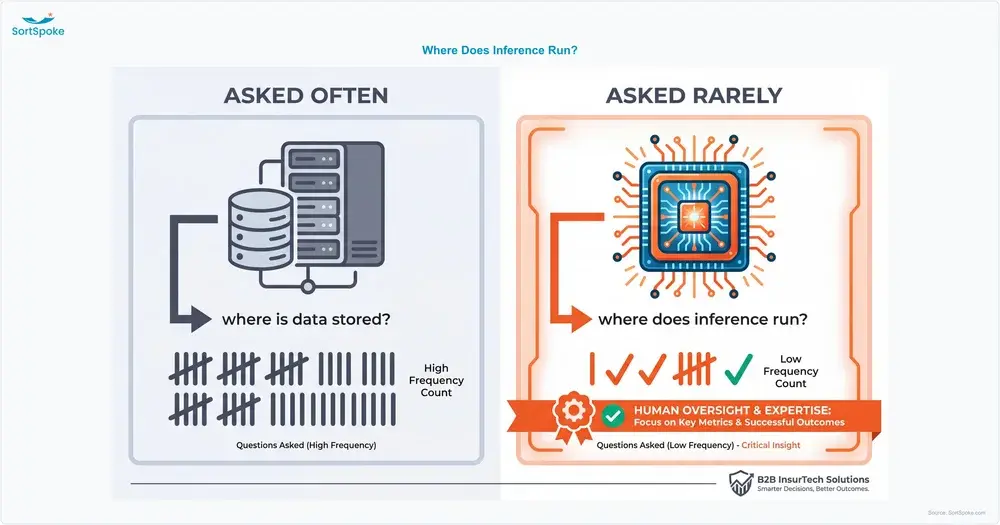
Data residency is the question that dominates Canadian AI procurement, and it is the one most often stated incorrectly — usually as a flat requirement that Canadian insurance data be held in Canada.
There is no general legal requirement that Canadian insurers hold customer or policy data in Canada.
The provision usually pointed at is the Insurance Companies Act. Section 262(1) does require that the records described in s.261 be kept at the head office or another place in Canada. But s.261 is a defined list of corporate records: incorporating documents, by-laws, minutes, returns to the Superintendent, corporate accounting records, and per-customer amounts owing. Claims files, submissions, loss runs and underwriting documents are not on that list. Applying a corporate records provision to an underwriting document pipeline is a category error, and it is one that has driven real procurement decisions.
OSFI itself contemplates records held outside Canada. B-10 s.2.3.2.2 expressly addresses that scenario, conditioned on OSFI having "immediate, direct, complete and ongoing access" to the records.
Federally, PIPEDA has been settled on this since the Office of the Privacy Commissioner published its Guidelines for processing personal data across borders on 27 January 2009, reaffirmed unchanged on 23 September 2019. The relevant lines:
"PIPEDA does not prohibit organizations in Canada from transferring personal information to an organization in another jurisdiction for processing."
"A transfer for processing is a 'use' of the information; it is not a disclosure."
— OPC, Guidelines for processing personal data across borders (2009, reaffirmed 2019)
What PIPEDA does impose is accountability and transparency. Under Schedule 1, Principle 4.1.3, an organization remains accountable for personal information transferred to a third party for processing and "shall use contractual or other means to provide a comparable level of protection" while it is there. Organizations are also expected to be transparent that information may be sent to another jurisdiction for processing, and that while the information is in that jurisdiction it may be accessed by the courts, law enforcement and national security authorities there.
Provincially, Alberta's PIPA and British Columbia's PIPA are recognised as substantially similar to PIPEDA by Governor in Council orders SOR/2004-219 and SOR/2004-220, both registered on 12 October 2004. The carve-out matters: the exemption applies only to organizations other than federal works, undertakings and businesses, and only to collection, use and disclosure occurring within that province. Quebec's regime, per s.17 above, sets its own assessment requirement rather than a prohibition.
So the accurate Canadian position is that cross-border processing is lawful, conditioned on assessment, comparable contractual protection, transparency, and — in Québec — a documented privacy impact assessment before the information goes. Residency can still be a sound commercial or risk-appetite preference. Plenty of Canadian buyers hold that preference for reasons that have nothing to do with statute, and it is a legitimate position to take in an RFP. It is just not a legal requirement, and describing it as one distorts the evaluation.
For completeness on our own security and data-handling position: Canadian data residency is available on request, and data does not leave the region your deployment is configured for. That is the whole of the accurate answer, and it is the level of specificity worth expecting from any vendor you ask.
This is the part worth keeping. It is written to be vendor-neutral, and it deliberately includes questions that are uncomfortable for AI vendors to answer, this one included. A checklist that only one supplier can pass is a sales document, not a governance tool.
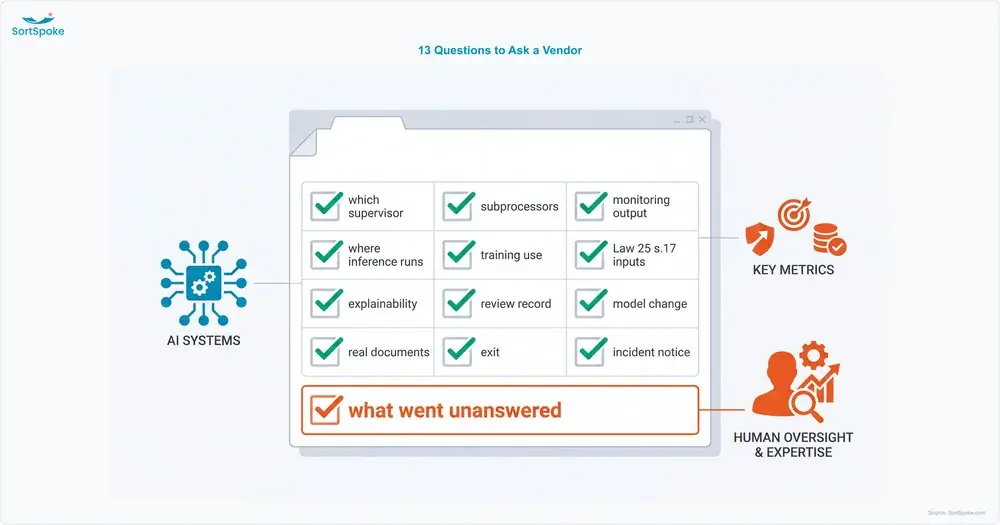
Nothing on that list requires E-23 to be in force. All of it is easier to do now, at evaluation, than in 2027 with a framework deadline behind it.
Yes — from 1 May 2027, not today. The final version of Guideline E-23 was published on 11 September 2025 with an effective date of 1 May 2027, and its scope includes life insurance and fraternal companies and property and casualty companies alongside banks, foreign bank branches, and trust and loan companies. The version in force in the meantime is E-23 (2017), whose scope is deposit-taking institutions only. Federally regulated insurers are therefore not currently subject to E-23 and come into scope on 1 May 2027. Federally regulated pension plans appeared in the draft and were removed from the final.
No. Section 12.1 of the Act respecting the protection of personal information in the private sector (CQLR c. P-39.1), in force since 22 September 2023, does not prohibit automated decision-making. It applies only where a decision is based exclusively on automated processing, and where it applies it requires notification, and on request disclosure of the personal information used, the reasons and the principal factors and parameters, and the right to have that information corrected. The individual must also be given the opportunity to submit observations to a member of personnel who is in a position to review the decision. That is a right to be heard, not a right to have the decision re-made by a human, and Quebec has no GDPR Article 22-style prohibition.
No. There is no general legal requirement that Canadian insurers hold customer or policy data in Canada. Section 262(1) of the Insurance Companies Act requires the records described in s.261 to be kept at the head office or another place in Canada, but s.261 lists corporate records — incorporating documents, by-laws, minutes, returns to the Superintendent, corporate accounting records and per-customer amounts owing — rather than claims files, submissions or underwriting documents. OSFI's B-10 s.2.3.2.2 expressly contemplates records held outside Canada where OSFI has immediate, direct, complete and ongoing access. Federally, the OPC's cross-border guidelines confirm that PIPEDA does not prohibit transfers to another jurisdiction for processing, subject to accountability, comparable contractual protection and transparency. Québec adds a privacy impact assessment requirement under s.17 before information is communicated outside the province. Residency remains a legitimate commercial preference; it is not a statutory rule.
No standalone one, in force or in draft. OSFI's expectations for AI sit inside Guideline E-23 on model risk management, whose definition of a model expressly includes AI and machine learning methods. The AI-specific documents OSFI has published are reports rather than guidance: the OSFI–FCAC risk report of 24 September 2024, which introduced the EDGE principles — Explainability, Data, Governance, Ethics — and the FIFAI II report of 23 March 2026, which set out the AGILE framework and carries an explicit disclaimer that it does not necessarily reflect the views of the sponsoring authorities. Neither should be cited as a requirement.
Commercial P&C Insurers Guide to Solving the Underwriting Bottleneck