What is a Loss Run Report
By SortSpoke

A roundup of Canadian Underwriter's 2026 Executive Outlook series—where 80% of industry leaders say AI moves from pilot projects to operational reality this year
Between December 2025 and early January 2026, Canadian Underwriter published its annual Executive Outlook series as partner content—perspectives from thought-leaders across Canada's property and casualty insurance industry, plus an overview article setting the stage. Canadian Underwriter states that it "reached out to 36 P&C insurance industry executives"; SortSpoke's analysis covers the 35 executive outlook articles available when this roundup was written, and every percentage below is calculated over those 35. The question Canadian Underwriter posed, in its own words: "We asked executives to tell us just one thing the industry will have to contend with in 2026 that it didn't have to face in 2025."
The answers revealed an overwhelming consensus.
After the SortSpoke team analyzed all 35 executive outlooks—featuring leaders from major carriers like Intact Financial and Aviva Canada, national brokerages including HUB International and BFL Canada, global advisory firms such as Aon and Marsh, reinsurers like Swiss Re, and industry organizations like the Insurance Bureau of Canada—a clear pattern emerged:
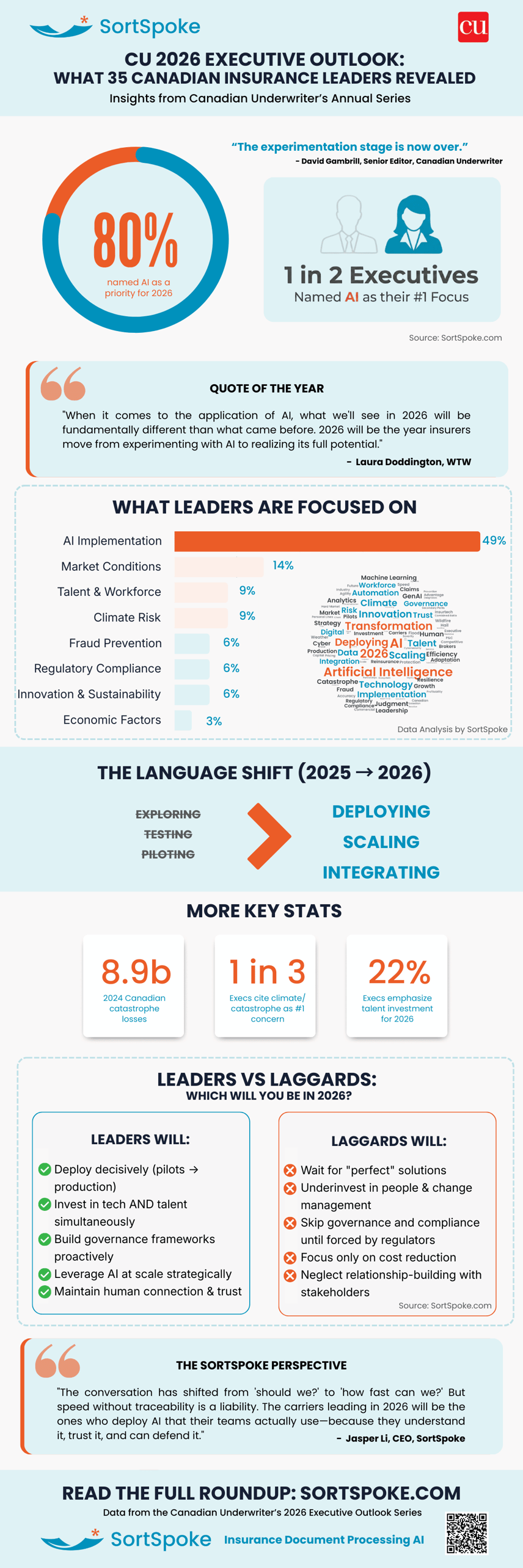
80% identified artificial intelligence as a key priority for 2026, with nearly half naming it their top focus.
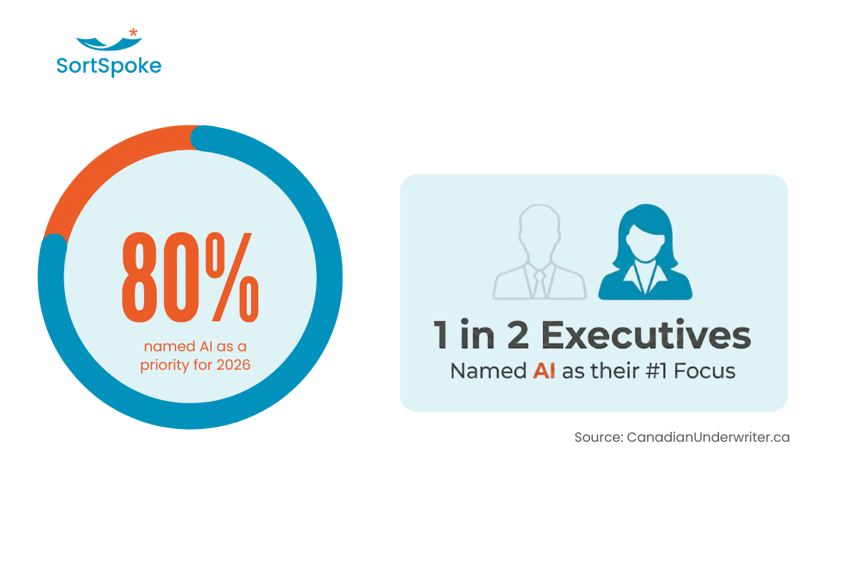
These aren't fringe predictions—they're the consensus view from thought-leaders at organizations just like yours.
But, this isn't about AI experimentation anymore. It's about implementation. For leaders like you navigating 2026, the message is clear: the time for pilots without a plan to implement has passed.
"Many point out the industry has dabbled in AI this past year, but they assert the experimentation stage is now over. Things will start to get real in 2026."
— Canadian Underwriter, 2026 Executive Outlook series overview
Canadian Underwriter set the tone in its series overview. That prediction played out across nearly every article that followed. From underwriting VPs to broker CEOs, from reinsurance executives to fraud investigators, the message was consistent: 2026 marks the year AI transitions from pilot projects to operational reality.
This roundup highlights the key themes from across the series—distilling 35 executive perspectives into actionable insights about what's changing, what's at stake, and what separates leaders from laggards as the industry enters this implementation phase.
To help you benchmark your team's readiness, we have included a few supplemental resources below, including our 2026 Industry Outlook Infographic and a full breakdown of all the outlook articles.
We hope you find these insights helpful as you navigate the year ahead!
We analyzed all 35 executive outlooks from Canadian Underwriter's 2026 Executive Outlook series. Here's what Canada's insurance thought-leaders revealed:
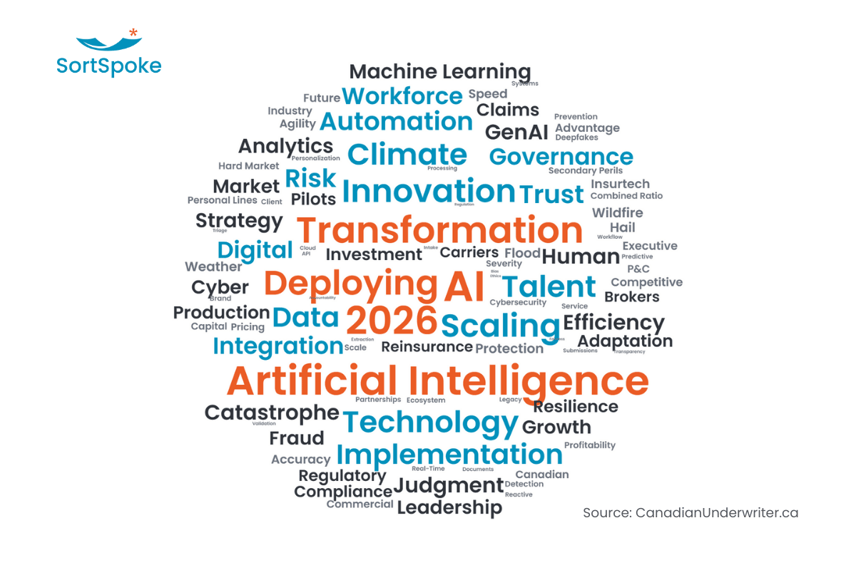
Across Canadian Underwriter's outlook series, the language these thought-leaders used marked a clear evolution. Where 2025 discussions centered on exploring and testing, the 2026 perspectives focused on deploying, scaling and integrating. The contrast below is SortSpoke's characterization of the series, not a quotation from it.
| 2025 Language | 2026 Language |
|---|---|
| Exploring | Deploying |
| Testing | Scaling |
| Piloting | Integrating |
"When it comes to the application of AI, what we'll see in 2026 will be fundamentally different than what came before. 2026 will be the year insurers move from experimenting with AI to realizing its full potential."
— Laura Doddington, WTW
With the quote of the year Laura Doddington of WTW captured this shift perfectly in her outlook article. The shift isn't just rhetorical—it's operational. And for leaders like you, it signals a clear imperative.
Here's how the 35 executives broke down by primary focus area:
| Primary Focus | Percentage |
|---|---|
| AI Implementation | 48.6% |
| Market Conditions | 14.3% |
| Talent & Workforce | 8.6% |
| Climate Risk | 8.6% |
| Fraud Prevention | 5.7% |
| Regulatory Compliance | 5.7% |
| Innovation & Sustainability | 5.7% |
| Economic Factors | 2.9% |
Across the 35 outlooks, executives identified AI applications touching every aspect of operations:
Swiss Re's Jolee Crosby highlighted how "AI is becoming increasingly embedded across the risk value chain," particularly for assessing secondary perils—wildfire, hail, and flood risks—that traditional methods struggled to model accurately. Read her full perspective.
For carriers looking to implement AI in their underwriting workflows, the challenge isn't just the technology—it's the data. Automated document processing for submissions is enabling underwriters to extract structured data from complex documents faster, freeing them to focus on actual risk assessment rather than manual data entry.
Multiple executives in the series pointed to proactive claims management as AI's breakthrough application. Desjardins' Valerie Lavoie described the industry's 2026 response to climate change as "shifting from a reactive model to a proactive one, where insurers help build stronger communities before disaster happens"—prediction and prevention rather than payout. Read more.
"Consumers are no longer passive recipients of quotes. They are active digital shoppers, using AI-powered platforms to find tailored coverage, compare rates in real-time and receive instant recommendations."
— Grant Ostir, Western Financial Group
Grant Ostir of Western Financial Group observed how consumer behavior is fundamentally changing as AI-powered platforms reshape how Canadians shop for insurance.
Équité Association's Terri O'Brien highlighted AI's capability to uncover patterns across massive datasets, though she cautioned that "criminals make AI their full-time job" too—creating an ongoing arms race. Read her perspective.
Several outlook articles pointed to concrete pressures driving this urgency. Canada recorded $9.2 billion in insured catastrophe losses in 2024 — a national record. CatIQ first put the total at $8.5 billion in January 2025, then revised it above $9.2 billion in October 2025 as claims developed. Market dynamics are diverging—commercial insurance softening while personal lines remain hard. In this environment, multiple executives positioned AI not as a luxury but as a competitive necessity.
"If this was the year when the property and casualty insurance industry embraced artificial intelligence (AI), 2026 will be the year it transforms because of it."
— Rob Rasberry, NFP Canada
As NFP Canada's Rob Rasberry put it, transformation isn't coming—it's already here.
While the Canadian Underwriter series revealed widespread enthusiasm for AI implementation, several executives raised critical concerns about rushing deployment without adequate safeguards.
"The pressing question for the industry next year is whether speed or security will prevail in the AI race."
— Alex Barker, AXA XL
Alex Barker of AXA XL framed the tension clearly in his outlook article. As organizations rush to deploy AI, interconnected systems create multiple potential failure points requiring organizations to "understand and mitigate new cyber risks."
Multiple outlook articles flagged cybersecurity as a primary concern. The threat is evolving in parallel with adoption. Mitch Insurance's Adam Mitchell warned: "Expect to see AI take cybercrime to unprecedented levels in 2026. Both the volume and sophistication of text, voice and video deepfakes are already making it harder to spot scams and determine what online content can be trusted." Read his full analysis.
The deepfake threat isn't theoretical—it's already impacting claims verification and customer authentication processes across the industry.
Beyond technical security, the series highlighted governance challenges. Allianz Commercial's Bernard McNulty emphasized that "the risks associated with AI use need to be identified and managed," noting that risks related to "reputation, culture and role displacement" may prove harder to address than technical failures. Read more.
"Contracts with third-party AI partners will need to be carefully crafted, bearing in mind regulators will hold the broker accountable for outcomes."
— Philomena Comerford, Baird MacGregor
Brokers face particular pressure, as Philomena Comerford of Baird MacGregor noted in her outlook. The regulatory accountability for AI-driven decisions remains squarely on the brokerage, regardless of which third-party tools they deploy.
One of the most consistent threads across Canadian Underwriter's outlook series was the focus on people. Eight executives explicitly identified talent and workforce transformation as critical to 2026 success—and their message may surprise those fearing wholesale automation.
"In insurance, we trade on trust; the reputations of individuals and organizations matter. Success in 2026 will be defined by our ability to deliver streamlined digital experiences without compromising the expert advice, judgment, and relationship-building that have long been hallmarks of our industry."
— Richard Grant, Trisura Group Ltd.
Richard Grant of Trisura Group captured this balance perfectly in his perspective. AI makes human expertise more valuable, not less.
Multiple outlook articles highlighted Canada's insurance talent crisis. Aviva Canada's Nav Dhillon identified it as "a defining challenge in 2026—a critical talent gap intensified by the rise of artificial intelligence." Read his full outlook.
The challenges are structural: retirements outpacing new entrants, particularly in specialized roles. Meanwhile, Gen Z professionals gravitate toward tech-enabled careers, creating fierce competition for talent that bridges insurance expertise with technological capability.
But several executives across the series pushed back against "AI replaces humans" narratives. BrokerLink's Joe D'Annunzio stated it directly: "Although AI is a powerful tool that can enhance many aspects of the insurance industry, it won't replace the need for human contact." Read more.
"Those adapting quickly and investing in both technology and people will be best positioned to excel in this new landscape, in which success relies on operational excellence and the strength of client relationships."
— Catherine Roe, President, CNA Canada
CNA Canada President Catherine Roe, in one of the series' most comprehensive outlooks, emphasized that leaders will be "those adapting quickly and investing in both technology and people."
"Market leaders will treat AI and data as accelerants, not substitutes for judgment."
— Rob Marsh, Liberty Mutual Canada
Liberty Mutual Canada's Rob Marsh captured the balance succinctly: "Market leaders will treat AI and data as accelerants, not substitutes for judgment."
This is the key insight: AI doesn't replace underwriter expertise in assessing complex risks. It eliminates the manual work—like extracting data from loss runs or chasing missing information—so underwriters can focus on what actually requires judgment.
"Winning in the AI era means building a future-ready workforce that attracts talent, invests in future leaders, and retains skilled experts."
— Nav Dhillon, Aviva Canada
If there's one force accelerating AI adoption across the Canadian Underwriter series, it's climate change. Twelve executives identified climate-related catastrophe risk as a primary 2026 concern—and nearly all positioned AI as essential to managing this exposure.
The $9.2 billion in insured catastrophe losses Canada experienced in 2024 featured prominently across the outlook series. Northbridge Insurance's Shari Dodsworth noted: "Customers will expect more than coverage. They will seek stability and confidence in our services and solutions." Read her outlook.
Meeting that expectation requires moving beyond traditional risk modeling to AI-powered predictive analytics that can assess secondary perils and emerging patterns.
Some executives in the series highlighted innovation beyond traditional approaches. Beneva's Christian Fournier advocated for "sustainable claims practices" applying circular economy principles—repair and reuse rather than demolish and replace. Read his perspective.
"2026 offers a critical opportunity to leverage favourable market conditions and strengthen resilience in an era of accelerating change."
— Stephane Lesperance, Aon Canada
Aon Canada's Stephane Lesperance framed climate risk as both challenge and opportunity. Organizations that integrate climate data with AI-powered risk assessment tools can differentiate through more accurate pricing and proactive client partnerships.
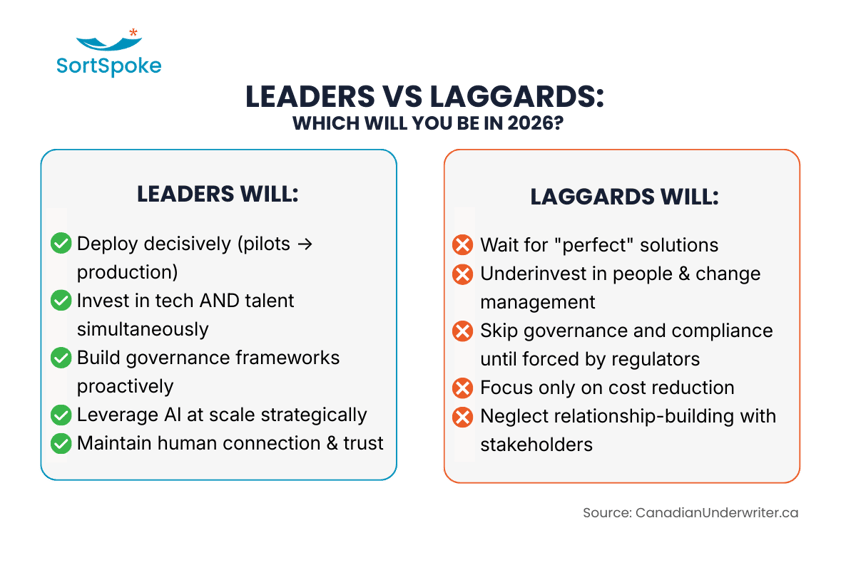
Analyzing the 35 perspectives from Canadian Underwriter's outlook series reveals clear patterns separating organizations positioned to thrive from those at risk of falling behind. Here's a comparison based on the insights:
| Leaders Will... | Laggards Will... |
|---|---|
| Deploy decisively (pilots → production) | Wait for "perfect" AI solutions |
| Invest in tech AND talent simultaneously | Underinvest in people & change management |
| Build governance frameworks proactively | Skip governance until forced by regulators |
| Leverage scale strategically | Focus only on cost reduction |
| Maintain human connection & trust | Neglect relationship-building with stakeholders |
"Those willing to reimagine how work happens will unlock greater efficiency, stronger client outcomes and the next chapter of innovation in Canada's P&C sector."
— Tina Osen, HUB International Canada
As HUB International Canada's Tina Osen noted, waiting for perfect solutions means falling behind. The leaders are deploying now and iterating based on real-world results.
This dual investment theme appeared across multiple outlooks, most explicitly in Catherine Roe's (CNA Canada) perspective. Organizations that treat these as either/or decisions will struggle. Those that invest in both will pull ahead.
Several executives emphasized establishing clear AI policies before regulatory mandates force reactive compliance. The governance gap is real, and early movers will avoid the scramble that comes with regulatory enforcement.
"The most important shift in 2026 will be the power of scale."
— Shawn DeSantis, Navacord
Navacord's Shawn DeSantis identified "the power of scale" as 2026's critical shift. Larger organizations can invest more effectively in AI infrastructure, data analytics, and specialized expertise. Several Canadian brokerages will surpass $1 billion in revenue in 2026, creating new competitive dynamics.
Despite technological capabilities, multiple executives in the series emphasized that trust remains paramount. As Trisura's Richard Grant reminded readers, "in insurance, we trade on trust"—something AI can support but not supply.
The themes across Canadian Underwriter's series point to specific actions depending on where you sit in the insurance value chain:
For Carrier Leaders: The shift from experimentation to implementation means moving AI projects out of innovation labs and into production environments. That requires investment in change management, data infrastructure, and workforce training—not just technology procurement.
For Broker Leaders: The message across multiple broker outlooks was clear: AI enables better service, not automated service. The leaders will be those who use technology to handle routine tasks while freeing advisors to focus on complex client needs and relationship building.
For All Insurance Leaders: Whether you're evaluating AI-powered document processing, building internal capabilities, or planning your 2026 technology roadmap, the Canadian Underwriter series makes one thing clear: the time for pilot projects has passed. Implementation is the imperative.
As a company built on AI-powered document processing for insurance, we've had a front-row seat to how carriers, MGAs, and brokers are approaching the AI transition. The executives above aren't just making predictions—they're describing the exact conversations we're having with industry leaders every day.
Three themes stand out to us as we work alongside insurers navigating this shift:
The most successful AI implementations we've seen aren't the most ambitious—they're the most practical. Leaders like you don't have time to wait for a "perfect" solution that may never arrive. They need AI that works today, deploys quickly, and delivers measurable ROI within weeks, not years.
The insurers pulling ahead in 2026 are choosing targeted, high-impact use cases—submission intake, document processing, data extraction—rather than boiling the ocean with enterprise-wide transformation projects that stall in committee.
Insurance is a regulated industry built on trust and accountability. When an underwriting decision is made, you need to explain why. When a claim is processed, there's an audit trail. AI should be no different.
The thought-leaders in this series repeatedly emphasized governance, transparency, and explainability—and for good reason. Black-box AI that can't show its work isn't just a compliance risk; it's a business risk. Traceable, auditable AI isn't a nice-to-have. It's table stakes.
We built SortSpoke around a core belief: AI should augment human judgment, not replace it. The executives in this roundup echo that sentiment. Richard Grant (Trisura) reminds us that "in insurance, we trade on trust." Rob Marsh (Liberty Mutual) emphasizes that AI and data should be "accelerants, not substitutes for judgment."
The leadership formula isn't AI or humans—it's AI and humans, working together. Automation handles the repetitive, time-consuming work. Your people handle the relationships, the judgment calls, and the exceptions that require expertise.
Here's what often gets underestimated: the technology is the easy part. The hard part is getting your team to embrace it.
Change management—training, communication, workflow redesign, addressing fears about job displacement—will consume more leadership energy than any vendor selection or implementation project.
The executives who called out talent investment as a priority understand this. You can buy the best AI in the world, but if your people don't trust it, use it, or understand it, you've bought expensive shelfware.
Prepare for change management to be your most important job in 2026.
"The AI conversation has shifted from 'should we?' to 'how fast can we?' But speed without traceability is a liability. Insurance runs on trust, and trust requires explainability. The carriers leading in 2026 will be the ones who deploy AI that their teams actually use—because they understand it, trust it, and can defend it to regulators and customers alike."
— Jasper Li, CEO, SortSpoke
We're proud to partner with carriers, MGAs, and brokers who are making the leap from experimentation to execution. If you're ready to see what practical, human-in-the-loop AI looks like for document processing, we'd love to show you.
Canadian Underwriter's 2026 Executive Outlook series captured an industry at an inflection point. The 35 executive perspectives—from thought-leaders spanning carriers and brokers, regional teams and global firms, established giants and agile specialists—revealed remarkable consensus.
The leaders won't be those with the most sophisticated technology or the largest budgets. For leaders like you, success will come from integrating what the series identified as three critical elements:
Strategic AI deployment delivering tangible business value across underwriting, claims, and distribution
Investment in people building the future-ready workforce capable of leveraging these tools effectively
Robust risk management balancing innovation speed with security, governance, and trust
"Our industry's biggest challenge and biggest opportunity in 2026 stems from the inevitable creep of artificial intelligence (AI) into the daily lives of Canadians. […] Whatever developments AI and other trends bring, and however the world changes, we know that being there for customers when they need us will keep us relevant."
— Louis Gagnon, Intact Financial Corporation
Intact Financial Corporation's Louis Gagnon perhaps captured it best: AI represents "our industry's biggest challenge and biggest opportunity in 2026."
The question isn't whether transformation is coming—the series makes clear it's already here.
The question is: will your organization lead it, follow it, or fall behind?
This roundup synthesizes key themes from Canadian Underwriter's 2026 Executive Outlook series. For leaders like you seeking deeper insights, explore all 35 executive perspectives plus the series overview—filtered by your role, line of business, or strategic focus:
| Executive & Company | Primary Topic | Line of Business | Coverage Type | Reader Interest |
|---|---|---|---|---|
| Series overview Canadian Underwriter |
AI Implementation | Broad P&C | All Lines | Tech Leaders, C-Suite |
| Peter Askew Guy Carpenter Canada |
Market Conditions | Reinsurance | Property Insurance | C-Suite, Operations Leaders |
| Abraham Baboujian KRGinsure |
Talent & Workforce | Broad P&C | All Lines | HR/Talent Leaders, Regulatory/Compliance |
| Alex Barker AXA XL |
AI Implementation | Broad P&C | Cyber Insurance, All Lines | Tech Leaders, Risk Managers |
| Jatinder Bassi Echelon Insurance |
Market Conditions | Commercial Lines | All Lines | Operations Leaders, Underwriters |
| Jolee Crosby Swiss Re |
AI Implementation | Reinsurance | Property Insurance | Tech Leaders, Risk Managers, Underwriters |
| Philomena Comerford Baird MacGregor / Hargraft Schofield |
AI Implementation | Broad P&C | All Lines | Tech Leaders, Broker Leaders, Regulatory/Compliance |
| Joe D'Annunzio BrokerLink |
AI Implementation | Broad P&C | Cyber Insurance, All Lines | Tech Leaders, Broker Leaders |
| Shawn DeSantis Navacord |
Market Conditions | Broad P&C | All Lines | C-Suite, Broker Leaders, HR/Talent |
| Nav Dhillon Aviva Canada |
Talent & Workforce | Broad P&C | All Lines | HR/Talent Leaders, Tech Leaders, Underwriters |
| Rohan Dixon Sompo |
Economic Factors | Broad P&C | All Lines | C-Suite, Risk Managers |
| Laura Doddington WTW |
AI Implementation | Broad P&C | All Lines | Tech Leaders, Operations Leaders |
| Shari Dodsworth Northbridge Insurance |
Climate Risk | Broad P&C | Property Insurance | Risk Managers, Operations Leaders |
| Christian Fournier Beneva |
Innovation & Sustainability | Claims & Adjusting | Property Insurance | Operations Leaders, Claims Professionals |
| Louis Gagnon Intact Financial Corporation |
AI Implementation | Broad P&C | All Lines | Tech Leaders, C-Suite, Operations Leaders |
| Lisa Giannone BFL Canada |
AI Implementation | Broad P&C | All Lines | Tech Leaders, Broker Leaders, Regulatory/Compliance, HR/Talent |
| Richard Grant Trisura Group Ltd. |
AI Implementation | Broad P&C | All Lines | Tech Leaders, HR/Talent Leaders, C-Suite |
| Aly Kanji InsureLine |
AI Implementation | Commercial Lines, Personal Lines | All Lines | Tech Leaders, Product Managers, Broker Leaders |
| Valerie Lavoie Desjardins General Insurance Group |
Climate Risk | Broad P&C | Property Insurance | Risk Managers, Claims Professionals |
| Stephane Lesperance Aon Canada |
Market Conditions | Commercial Lines | Property Insurance | C-Suite, Risk Managers, Underwriters |
| Marc Lipman Lloyd's Americas |
Market Conditions | Commercial Lines | Specialty Lines | C-Suite, Operations Leaders |
| Jamie Lyons Westland Insurance |
Climate Risk | Broad P&C | Property Insurance | Risk Managers, Broker Leaders |
| Rob Marsh Liberty Mutual Canada |
AI Implementation | Broad P&C | All Lines | Tech Leaders, C-Suite, Underwriters |
| Bernard McNulty Allianz Commercial |
AI Implementation | Commercial Lines | Specialty Lines | Tech Leaders, Regulatory/Compliance |
| Adam Mitchell Mitch Insurance |
AI Implementation | Broad P&C | Cyber Insurance | Tech Leaders, Broker Leaders |
| Terri O'Brien Équité Association |
Fraud Prevention | Claims & Adjusting | All Lines | Risk Managers, Claims Professionals |
| Tina Osen HUB International Canada |
AI Implementation | Broad P&C | All Lines | Tech Leaders, Broker Leaders, Operations Leaders |
| Grant Ostir Western Financial Group |
AI Implementation | Personal Lines | Cyber Insurance | Tech Leaders, Product Managers, Broker Leaders |
| Celyeste Power Insurance Bureau of Canada |
Regulatory Compliance | Personal Lines | Auto Insurance | C-Suite, Regulatory/Compliance, Product Managers |
| Rob Rasberry NFP Canada |
AI Implementation | Broad P&C | All Lines | Tech Leaders, Broker Leaders, Underwriters |
| Catherine Roe CNA Canada |
AI Implementation | Broad P&C, Commercial Lines | All Lines | Tech Leaders, Operations Leaders, C-Suite, Underwriters |
| Joanne Silberberg Marsh Canada |
Innovation & Sustainability | Commercial Lines | Property, Specialty Lines | Product Managers, Underwriters |
| Greg Smith Crawford & Company Canada |
Fraud Prevention | Claims & Adjusting | All Lines | Claims Professionals, Risk Managers |
| Michael Thornhill Gallagher |
Talent & Workforce | Commercial Lines | Casualty, All Lines | HR/Talent Leaders, Tech Leaders, Risk Managers |
| Matthew Turack CAA Club Group |
Regulatory Compliance | Personal Lines | Auto Insurance | Product Managers, Regulatory/Compliance |
Commercial P&C Insurers Guide to Solving the Underwriting Bottleneck