TL;DR
- The "100% straight-through" curve is a sales artifact. Operations leaders running real volume know the curve plateaus — not because the AI failed, but because exceptions are a structural property of insurance documents.
- Exception rates vary by document type, but never go to zero. Loss runs run ~20–25% exceptions, ACORDs ~12–18%, schedules and SOVs 25%+, broker email bundles 30%+. These are floors, not ceilings.
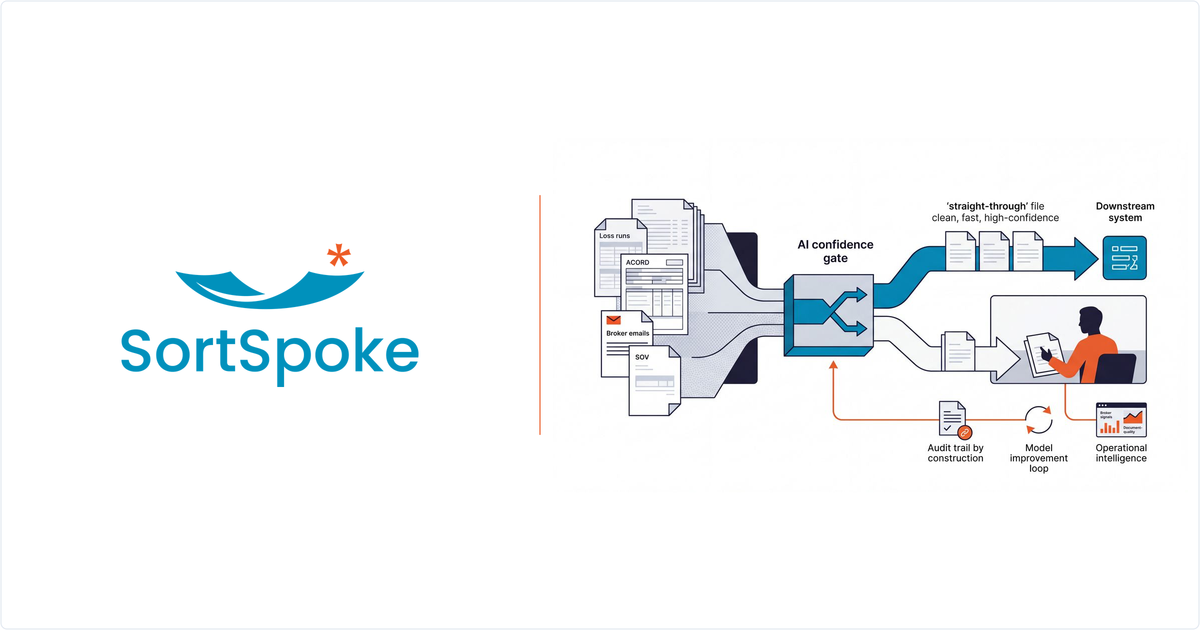
- Exceptions are the economic engine, not the failure mode. Designed right, they compound three returns: audit trail by construction, a model that improves on your specific variants, and operational intelligence about brokers and document quality.
- Carriers that win in 2026 don't try to eliminate exceptions — they architect for them. One workflow handles clean and exception files alike. Confidence routes; humans review where confidence is low; the system gets smarter with every correction.
Every insurance document automation vendor pitch ends the same way. There is a slide. The slide shows a curve. The curve starts at some baseline number — maybe 30% straight-through processing — and bends gracefully upward toward 100%. The vendor explains how their architecture, their training data, their model, their something will get the carrier to the top of that curve over the next twelve to eighteen months.
Every operations leader who has actually run a document automation pilot knows the curve does not bend that way.
The curve rises fast at first. It plateaus. It plateaus at 70%, or 80%, or 85% depending on the document type. And then it stops — not because the AI is broken, not because the team did something wrong, but because the remaining files contain genuine ambiguity, judgment calls, regulatory edge cases, and broker idiosyncrasy that no model will resolve without human input.
That gap between the pitch curve and the operator reality is what we call the exception economy. And the carriers that win in 2026 are not the ones still trying to close it. They are the ones who have learned to run it as a feature.
The 100% Lie
The "100% straight-through processing" promise is the most expensive marketing claim in insurance technology. It anchors RFPs, sets executive expectations, and frames every pilot as a failure if it does not eventually reach that asymptote.
It also bears almost no relationship to what working operations actually look like. Pilots that aim for 100% straight-through routinely overshoot on accuracy thresholds — accepting low-confidence extractions because the dashboard demands it — and produce silent errors that propagate downstream into pricing, coverage, and regulatory reporting. Pilots that aim more honestly for "80% straight-through with a fast, structured human review path for the rest" tend to ship, scale, and survive.
The vendors selling the 100% curve are not lying in the literal sense. They are showing a curve that could be approached under conditions that do not exist in commercial insurance: standardized documents, uniform broker behavior, regulatory permissiveness on edge cases, and downstream systems that can absorb a 1% error rate without consequence. None of those conditions hold. The Trust Gap research showed 78% of insurance AI pilots never reach production, and the reason is rarely the model itself — it is the operational architecture around the model.
What an Exception Actually Is
The word "exception" gets used loosely. It is worth being precise.
Exception (working definition)
A document, or a field within a document, where the model's extraction confidence falls below the threshold required by the downstream system, the regulatory regime, or the carrier's own appetite for risk on that data point.
Critically: an exception is not a failure of the model. It is the model correctly identifying that a human should look at this case.
This reframing matters. The dominant narrative treats exceptions as "the AI couldn't do it" — an admission of weakness. The accurate framing is the opposite. A model that produces clear confidence signals on hard cases is doing the most useful thing a model can do: telling you where to spend human attention.
The structural cause of exceptions in insurance is not technical. It is the document layer itself — the intake, classification, extraction, and routing work that sits between digital front-ends and structured back-end systems. That layer absorbs every quirk of every broker, every legacy form revision, every handwritten annotation, every multi-page email thread with attachments. Variation is the substrate. Exceptions are the natural output.
The Exception Rate by Document Type
Different document types produce different exception rates, and the rates are remarkably consistent across carriers running mature operations. The numbers below are operator benchmarks — what working teams actually see, not what vendor slides promise.
- ACORD applications (125, 126, etc.): 12–18% exception rate. Field positions shift between broker submissions. Supplemental schedules get appended in arbitrary order. Handwritten annotations override printed values. The ACORD standard is nominal; the practical variation is real.
- Loss runs: 20–25% exception rate. Every prior carrier formats loss runs differently. Column names vary. Date conventions vary. Reserve methodologies vary. Multi-year reconciliation across mixed formats is a steady source of cases the model should flag for human eyes.
- Schedules of Values and SOVs: 25–35% exception rate. No standard schema. Excel templates per broker. Custom columns for property characteristics. Multi-tab workbooks with summary and detail in inconsistent locations.
- Broker email submissions: 30–40% exception rate. Multi-document bundles. PDFs with embedded scans. Body-text instructions that change what the attachments mean. Supplementals that arrive hours or days after the initial submission.
The point is not that these numbers are bad. The point is that they are floors, not ceilings — and that the vendor curves bending toward 100% are pricing in conditions that do not exist for any of these document types. A working automated document processing operation uses these benchmarks to set realistic targets and design the human review path for the volume of exceptions it will actually generate.
Why the Curve Plateaus (And Always Will)
If exception rates were a matter of model quality, better models would drive them toward zero. They do not. The remaining cases — the ones a model in its tenth iteration still flags — share a small number of structural causes that no amount of training resolves.
Long-tail document variability. A loss run from a prior carrier the model has never seen before. A schedule template the broker built last week. An ACORD revision adopted by one region of one brokerage. The long tail is permanent because the broker market is permanent.
Regulatory carve-outs. A state-specific reporting requirement that adds a field most documents do not contain. A line of business with audit obligations that demand traceable human approval at specific points. Compliance does not yield to confidence scores.
Downstream system rigidity. A policy administration system that requires a specific data type or a specific lookup against a structured registry. The extraction may be correct in human terms but ambiguous in the format the downstream system can accept.
Broker idiosyncrasy. A submission that comes in three separate emails over four hours, with the meaningful information in the third email's body rather than in any attachment. The model can extract every attachment perfectly and still need a human to assemble the intent.
These are not edge cases. They are the routine condition of commercial insurance document workflows. Any architecture that does not plan for them is planning to fail in production, no matter how confident the demo was.
The Exception Economy: Three Compounding Returns
The carriers running document automation well have stopped treating exceptions as a cost center and started running them as a return-generating layer. There are three returns specifically — and they compound.
1. Audit Trail by Construction
Every exception that flows through a structured human review path produces a record: the original extraction, the model's confidence, the human reviewer's correction, the timestamp, the authority level of the reviewer. That record is exactly what regulators ask for. It is not a compliance bolt-on; it is a byproduct of doing the work. Carriers that build exception review correctly find they have already solved most of the documentation problem the NAIC AI Model Bulletin asks them to produce.
2. Model Improvement on Your Specific Variants
A correction is more than a fix. It is training data on the exact document variants your brokers send you. A generic model trained on industry-wide data hits a ceiling on your specific operational reality. A model that learns from your reviewers' corrections does not hit that ceiling — it pushes through it on the cases that matter to your book. The carriers winning here understand that insurance-specific AI paired with human validation outperforms generic models because the feedback loop is doing the work.
3. Operational Intelligence
Exception patterns are a sensor. They tell you which brokers send the lowest-quality submissions, which document types are generating the most rework, which lines of business have the highest regulatory friction. Carriers that treat exception data as operational intelligence — rather than as a bug count to suppress — make better decisions about broker relationships, appetite, and capacity allocation. The data was always there. The exception review process is what surfaces it.
The Inversion
The carriers running document automation well do not have lower exception rates than their peers. They have better-structured exception workflows. That is the entire competitive advantage. Exceptions are not the problem you solve once and forget about. They are the steady-state economic engine you architect for.
What Carriers Get Wrong
The most common operational mistakes are not technical. They are organizational. Three failure patterns recur across carriers that have tried document automation and either stalled at the pilot stage or shipped a system that nobody uses.
Treating exceptions as a separate workflow. Some carriers build a "main" automated pipeline and a "secondary" exception queue that lives in a different tool, with different reviewers, and a different escalation path. The result: exceptions become organizational debris. The reviewers do not see the clean cases, so they have no comparison baseline. The model never sees the corrections, so it does not improve. The exception queue grows.
Building separate "exception teams." Variants of the above. A dedicated exception team is structurally cut off from the underwriters whose decisions the exceptions feed. The team becomes a clearinghouse — fast at processing, but disconnected from the judgment context that determines whether an exception was actually resolved correctly. The cleaner pattern is integrated workflows where the same underwriters see both clean and exception files, with confidence-based routing handling the volume.
Measuring "automation rate" instead of throughput and quality. The metric that gets reported to executives — "what percentage of submissions are now automated?" — drives the wrong behavior. Teams game it by setting low confidence thresholds. They claim higher automation while shipping more silent errors downstream. The honest metric is total throughput per underwriter at a stable quality bar — which the integrated, HITL approach optimizes for and the "raise the automation rate" approach actively undermines. This is the same dynamic that explains how teams handle more submissions without adding headcount — capacity gain comes from the integrated path, not from the automation percentage on a slide.
What an Exception-First Architecture Looks Like
The architecture that wins is straightforward to describe and uncomfortable for most vendors to sell, because it requires honesty about what AI is for.
- Confidence-based routing, not binary automation. Every extracted field carries a confidence score. High-confidence fields flow straight through. Low-confidence fields surface to a human reviewer. The routing is field-level, not document-level — most documents contain a mix of confident and uncertain extractions.
- One workflow for clean and exception files. The reviewer's interface is the same regardless of whether a file is 95% confident or 60% confident. The difference is how many fields the reviewer needs to touch. Underwriters never bounce between tools.
- Embedded review, not a separate portal. The review happens inside the systems the team already uses — the underwriting workbench, the email client, the policy administration view. Keeping humans in the driver's seat works only when "the driver's seat" is the seat they were already sitting in.
- Corrections feed back to the model automatically. Every reviewer action becomes training data. The system improves on the carrier's specific document variants over weeks and months without a separate "retraining project."
- Audit-grade logging on by default. Reviewer ID, timestamp, original extraction, corrected value, authority level — captured automatically for every touch. The compliance documentation is a byproduct of running the workflow, not a separate effort.
This is what BCG's framing on human oversight looks like operationalized. The BCG analysis identified that successful AI-first insurers consistently invest in human oversight infrastructure at the same rate they invest in models. The architecture above is what that investment buys.
The Quiet Compound Advantage
Operations advantages compound, but they compound slowly. A carrier that builds the exception economy correctly in 2026 will not look dramatically different from a peer in 2026. They will look different in 2028.
By then, the model trained on their specific variants will outperform any newly-deployed competitor. The audit trail accumulated across 24 months of structured reviews will be the most credible documentation in their compliance program. The operational intelligence — which brokers, which document types, which lines — will be informing decisions that touch every part of the underwriting P&L.
The carrier that spent those 24 months pushing for a higher "automation rate" — chasing a curve that does not bend — will be in roughly the same place they started, but with a more confused organization and more silent errors in the back-end systems.
The bet on the exception economy is the bet on what insurance documents actually are, rather than what vendors wish they were. It is also, quietly, the bet that wins.
Key Takeaways
1
The "100% straight-through" curve is a sales artifact, not an operational reality. Working teams plateau at 70–85% depending on document type, and the remaining files contain genuine ambiguity that no model resolves without human input. Plan for the plateau.
2
Exceptions are not failures — they are the economic engine. Designed correctly, exception flows compound three returns: an audit trail by construction, a model that improves on your specific document variants, and operational intelligence about brokers and document quality.
3
Architect for confidence-based routing inside the tools the team already uses. One workflow for clean and exception files. Embedded review, not a separate portal. Corrections that feed back to the model automatically. Audit-grade logging on by default.
4
The advantage compounds over years, not quarters. Carriers running the exception economy well in 2026 will be uncatchable by 2028 — on accuracy, on compliance documentation, and on operational intelligence — by competitors still chasing the 100% curve.
See What an Exception Economy Architecture Looks Like in Production
If your team is running a document automation pilot, evaluating one, or trying to scale one that has stalled — the exception economy is where the architectural decisions actually get made.
Curious what your real exception rate looks like across response time, appetite fit, and conversion? Our Underwriting Efficiency Calculator scores your submission workflow in two minutes. Or book a 15-minute demo to see how SortSpoke's HITL architecture turns exceptions into compounding value rather than throwing them over a wall.