The Trust Gap: Why 78% of Insurance AI Pilots Never Scale
By Jasper Li
You've seen the benchmarks. You know sub-48-hour response time is the competitive baseline. You understand that broken intake has hidden costs.
Now what?
The gap between knowing there's a problem and actually fixing it is where most teams stall. They wait for budget approval, IT availability, or the "right time" to tackle intake—and months pass without meaningful progress.
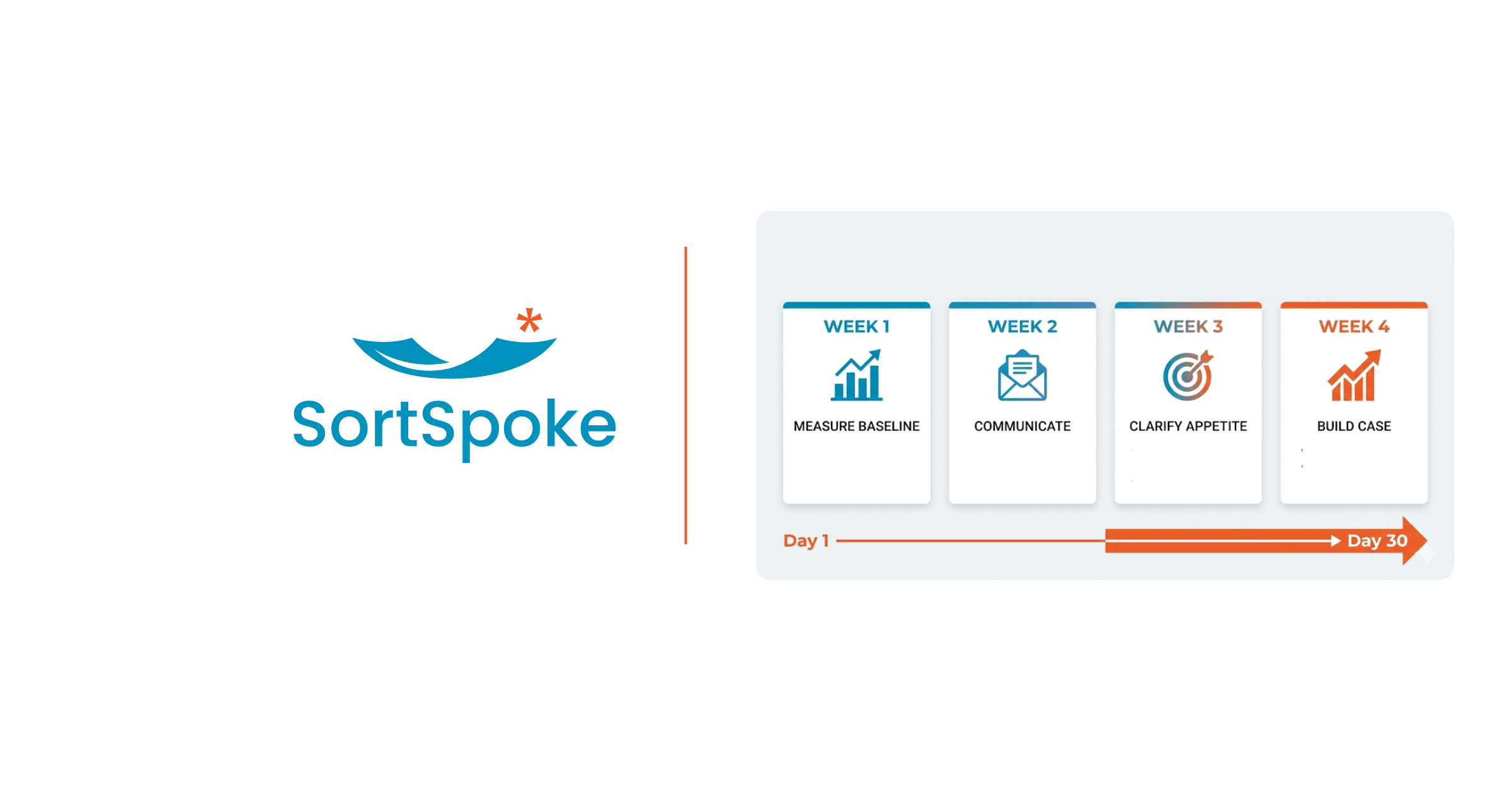
This article is the Monday morning playbook. It's designed for the underwriting leader who wants to make visible progress on intake efficiency within 30 days—without waiting for a major technology initiative or executive sponsorship. Some of these steps require nothing more than spreadsheets and calendar blocks.
Let's start your clock.
Before you can fix intake, you need to know where you actually stand—not where you think you stand. Most teams are surprised by what the data reveals.
The goal: Know your actual response time, not what you assume it is.
What to do:
What you're looking for:
If you can't easily pull timestamps from your systems, don't let that stop you. Ask two underwriters to manually log received and response times for one week. Even a small sample gives you baseline data that's better than assumptions.
The goal: Know how much of your queue is out-of-appetite work.
What to do:
What you're looking for:
Shortcut: If you don't have clean decline data, ask 3-5 underwriters: "What percentage of the submissions you see this week should never have reached you?" Their estimates will cluster around a number—that's your starting point.
The goal: Understand where underwriter time actually goes.
What to do:
What you're looking for:
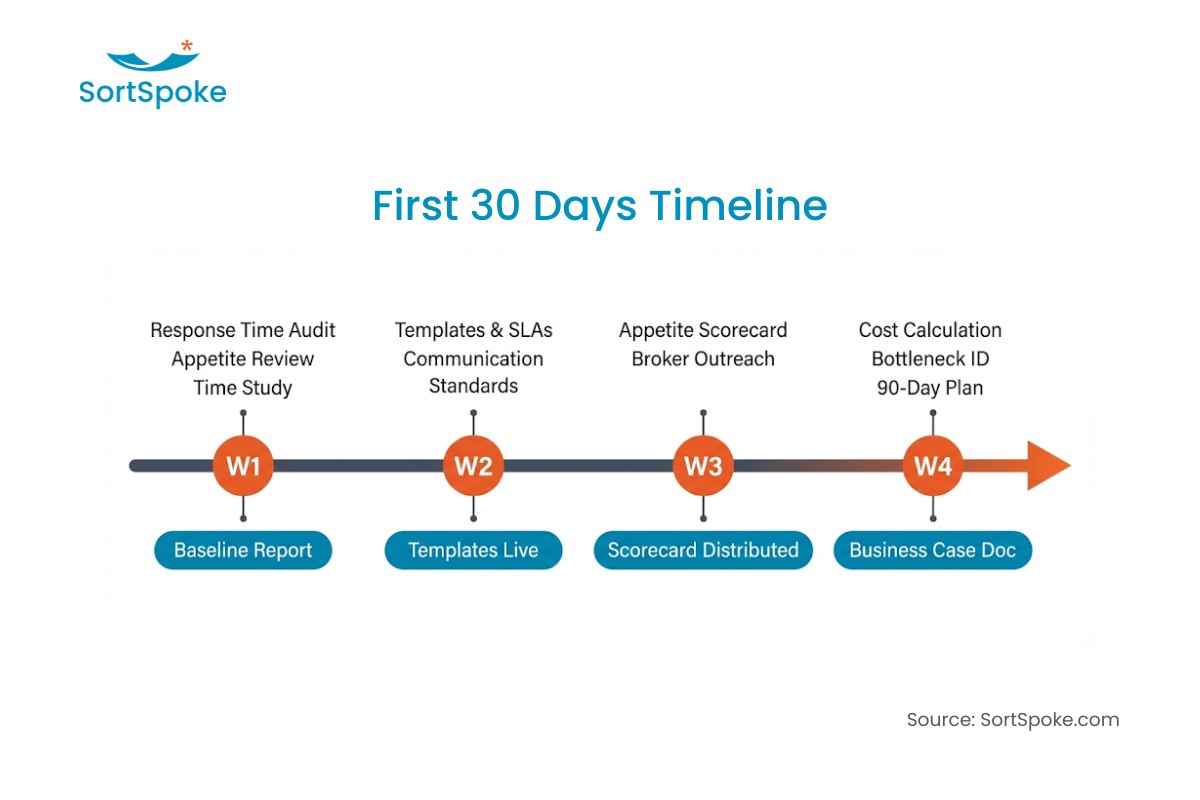
Week 1 Deliverable: A one-page baseline report with your actual numbers—response time distribution, out-of-appetite rate, and underwriter time allocation.
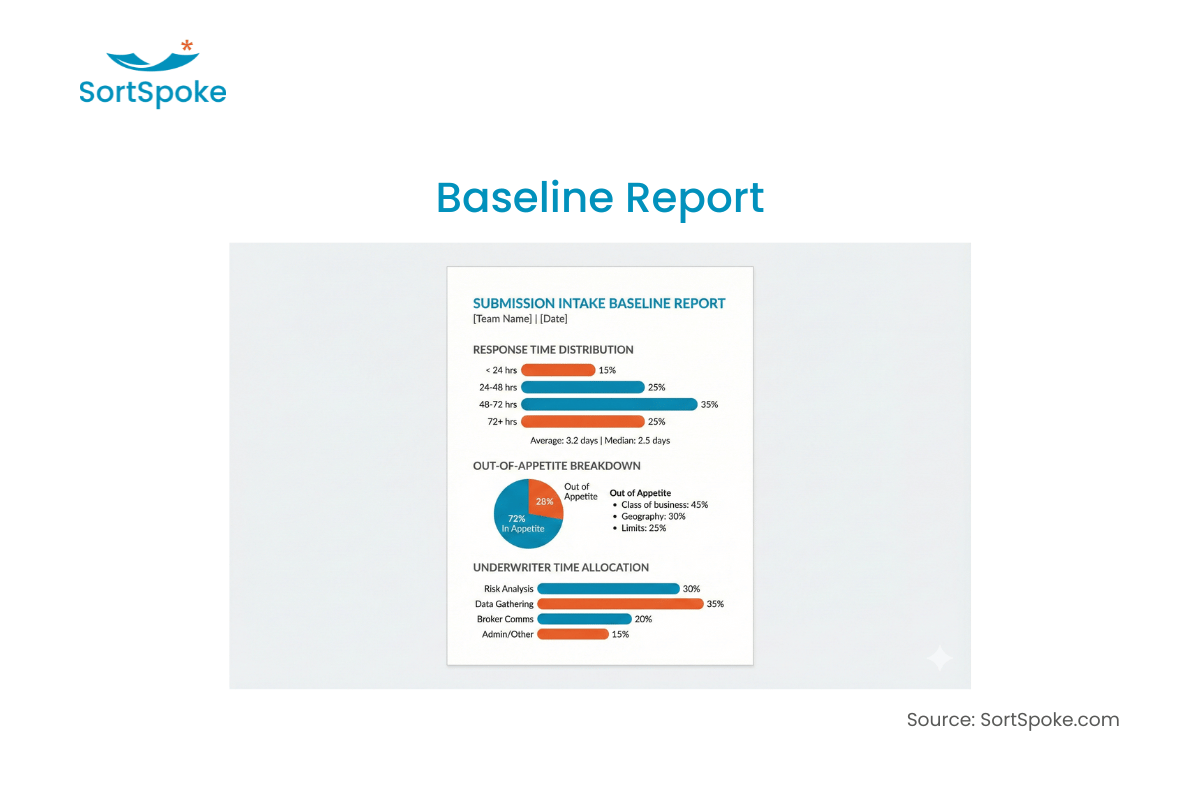
Now that you have data, it's time for quick wins that don't require IT support or budget approval.
Most teams waste time drafting similar emails from scratch. Creating standardized templates can compress response time by 20-30%.
Templates to create:
Include merge fields for personalization—risk name, broker name, specific reasons. The goal is faster response, not robotic communication.
If your team doesn't have explicit response time targets, now is the time to set them.
Suggested starting SLAs:
Make these visible. Put them on a whiteboard in the underwriting area, add them to your workflow dashboard, or review them in daily standups. Accountability drives consistency.
Week 2 Deliverable: Response templates live in your email system; SLAs communicated to the team.
The single highest-leverage fix for most teams: make appetite explicit enough that brokers can self-screen.
Most appetite documents are too long, too vague, or buried in a portal nobody uses. Your goal: a single page that answers "should I send this to you?"
What to include:
Don't just post it to a portal. Proactively send it to your top broker relationships with context:
"We want to make it easier for you to send us the right opportunities. Here's a quick reference for what we're looking for—and what falls outside our appetite. If you're unsure about a submission, reach out before sending."
Ask for feedback: "What else would help you know when we're a fit?" Brokers will tell you where your appetite communication is confusing.
Expected impact: Teams that implement clear appetite communication typically see 10-15% reduction in out-of-appetite submissions within 30 days.
Week 3 Deliverable: Appetite scorecard created, reviewed by senior underwriters, and distributed to top 20 broker relationships.
You've measured your baseline and captured some quick wins. Now it's time to quantify the opportunity and make the case for larger investments.
Use your Week 1 data to calculate real numbers:
Hours lost to out-of-appetite work:
Estimated premium lost to slow response:
FTE equivalent of wasted capacity:
Your data will point to one of three primary constraints:
Based on your bottleneck, outline what comes next:
Week 4 Deliverable: Business case document with baseline metrics, cost-of-inefficiency calculation, identified bottleneck, and proposed 90-day roadmap.
The first 30 days establish baseline, capture quick wins, and build the case for bigger moves. Here's what typically comes next:
If response time is your bottleneck:
If out-of-appetite is your bottleneck:
If low conversion is your bottleneck:
For a deeper dive on scaling capacity without headcount, see how high-throughput teams handle 2-3X volume.
Not sure where you stand on intake efficiency? Run the Submission Intake Calculator to benchmark your team—then start your 30-day clock.
Commercial P&C Insurers Guide to Solving the Underwriting Bottleneck