What is a Loss Run Report
By SortSpoke
Published April 2, 2026 | Updated October 1, 2026
Intelligent Document Processing (IDP)
Intelligent document processing combines machine learning, large language models, and computer vision to read, classify, and extract structured data from unstructured insurance documents — regardless of format, layout, or carrier-specific template.
Unlike basic OCR (which reads characters) or template-based extraction (which breaks when layouts change), IDP understands document context the way an experienced underwriter does.
Every commercial insurance submission arrives as a pile of documents. ACORD applications, loss runs from three different carriers, a broker email with seven attachments, a schedule of values in a format you've never seen before. Multiply that by dozens of submissions per day, and you start to understand why underwriting teams spend more time on data entry than actual underwriting.
The work compounds quickly. A single commercial submission can span several document types, each in its own format, and every field has to be keyed into your underwriting workbench before anyone can assess the risk. Across dozens of submissions a day, that adds up to skilled people spending much of their week typing numbers from PDFs into spreadsheets.
This isn't a technology problem that appeared yesterday. It's the reason automated document processing has become a strategic priority for carriers and MGAs. But not all automation is created equal — and that's where intelligent document processing changes the equation.
If you've explored IDP as a concept, you know the technology has evolved from OCR to IDP to LLM-powered extraction. Today's systems can handle the messy reality of insurance documents: handwritten notes, inconsistent carrier formats, multi-page tables that span different layouts, and documents that mix typed text with scanned images on the same page.
But here's what most IDP guides won't tell you: the technology only matters if it's built for the specific documents your team processes. A system trained on invoices and receipts will choke on an ACORD 125 or a loss run from Hartford. Insurance-specific IDP means models that understand the vocabulary, structure, and business logic of underwriting documents.
Not every document type delivers the same ROI from automation. Here's where intelligent document processing for insurance has the biggest impact — ranked by the combination of volume, complexity, and time saved.
The pattern is clear: the more complex and variable the document format, the greater the ROI from intelligent document processing. ACORD forms have standardized fields but still require manual keying. Loss runs vary wildly by carrier — every insurer formats their claims history differently. SOVs are the worst offenders: spreadsheets with inconsistent columns, merged cells, and property data scattered across multiple tabs.
This is exactly why generic document AI fails in insurance. A system that works brilliantly on invoices has never seen a Hartford loss run or a Zurich bordereaux. Insurance-specific IDP means models pre-trained on ACORD forms, loss runs, SOVs, FNOL reports and policy documents, which read a new carrier's layout without a template built for it — and it's why a purpose-built intelligent document processing platform outperforms generic solutions.
ACORD forms are where most intelligent document processing programs in insurance start, because the ACORD 125 (commercial application), 126 (general liability section) and 140 (property section) arrive in nearly every commercial submission. SortSpoke's internal benchmarks put manual keying of an ACORD 125 at 20–30 minutes, against under two minutes with automated extraction.
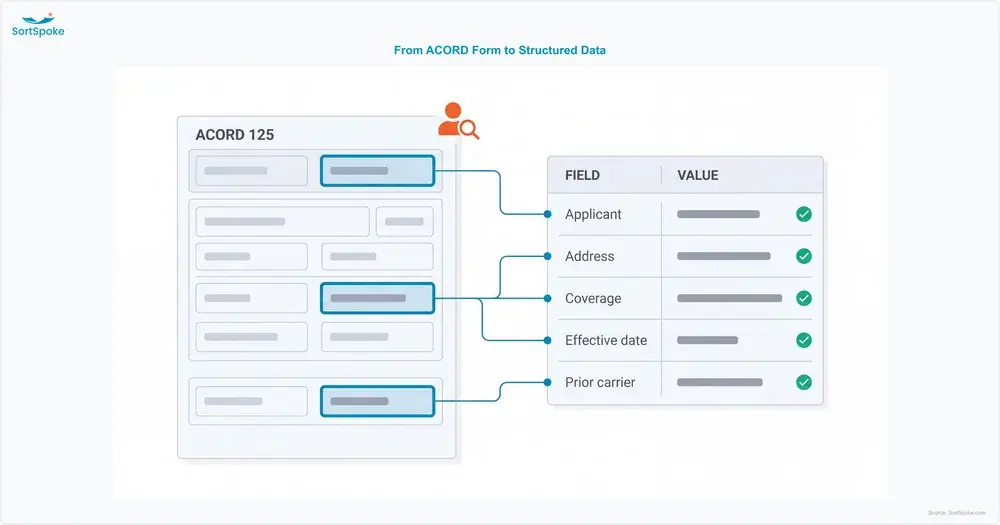
We cover each form in depth elsewhere rather than repeating it here: the ACORD forms data extraction hub, field guides to the ACORD 125, ACORD 126 and ACORD 140, and a side-by-side guide to ACORD 125 vs 126 vs 140. To see intelligent ACORD document processing on a real form, the free ACORD 25 extractor returns every field of a certificate of liability insurance as structured data, with a confidence score on each value.
Intelligent document processing for insurance isn't a single technology — it's a pipeline. Understanding the five stages helps you evaluate whether a vendor's solution actually handles the full workflow or just does the easy part.
Notice that the Validate stage is orange, not blue. That's intentional. This is the human-in-the-loop checkpoint where your team reviews what the AI extracted before it flows into downstream systems. Most IDP vendors skip this step entirely — and that's exactly where trust breaks down.
For a deeper look at how automation fits into the full document lifecycle, see our complete guide to automated document processing.
Here's the part that most IDP vendors would rather you didn't read. The technology works — that's not the problem. The problem is how it gets implemented, and there are four failure patterns we see repeatedly across the insurance industry.
Failure #1: The black box problem. The AI extracts data, but nobody on the underwriting team can see how it arrived at those values. When an underwriter can't verify a coverage limit or a loss total, they re-key it manually anyway. The trust gap kills adoption before the technology can prove its value.
Failure #2: Generic models in an insurance-specific world. IDP platforms trained on invoices, contracts, and receipts can't parse an ACORD 140 or interpret a loss run from a regional carrier. The document structures, terminology, and business logic are fundamentally different. When accuracy on insurance-specific fields drops, the time spent correcting errors negates the automation benefit.
Failure #3: Bolted-on integration. Another login. Another portal. Another system your underwriters have to check between their email, their underwriting workbench, and their policy admin system. The best IDP technology in the world fails if it adds friction to the workflow instead of removing it. Document AI belongs inside your existing workflow — embedded in the tools they use every day, not in a separate application.
Failure #4: No plan for exceptions. What happens when the AI's confidence is low? When a document is damaged, handwritten, or in a format it hasn't seen before? Systems without a clear escalation path to human reviewers create a bottleneck that's worse than the manual process they replaced. Your team needs to know exactly when and how they'll be pulled into the loop.
These aren't hypothetical risks. Research shows that the majority of AI pilots in insurance never make it to production — and these four failure modes are the most common reasons why. Understanding the difference between automation and augmentation is key to avoiding them.
This is where intelligent document processing for insurance diverges from IDP in every other industry. Insurance is regulated. Decisions have financial consequences. An incorrect coverage limit or a missed exclusion isn't a data quality issue — it's an E&O exposure.
That's why keeping humans in the driver's seat isn't a nice-to-have. It's the difference between an IDP pilot and a production system that underwriters actually trust.
Here's how human-in-the-loop IDP actually works in practice:
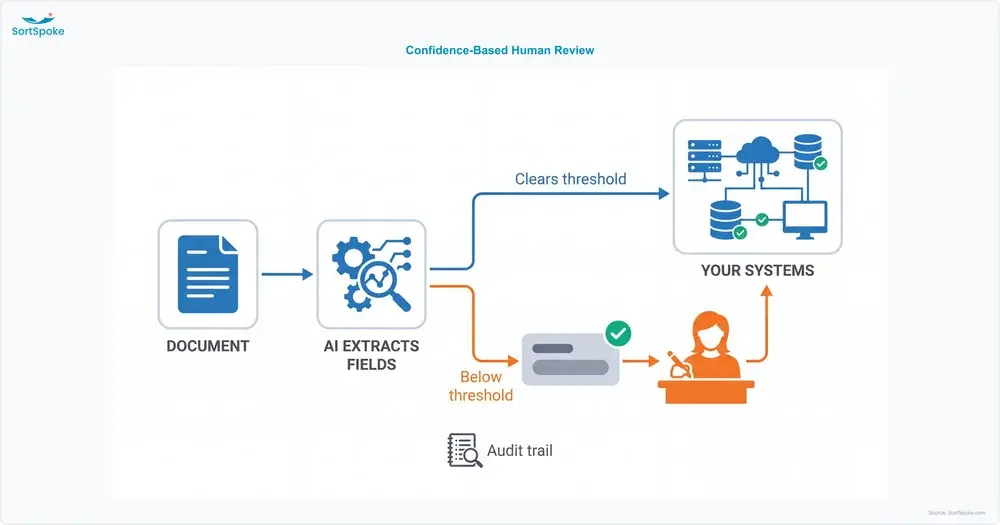
The result is a system that earns trust incrementally. Underwriters start by reviewing most extractions. As confidence builds, they review only the exceptions. Eventually they trust the system enough to focus their time on handling more submissions without adding headcount — because the data verification work has been absorbed by AI with human oversight.
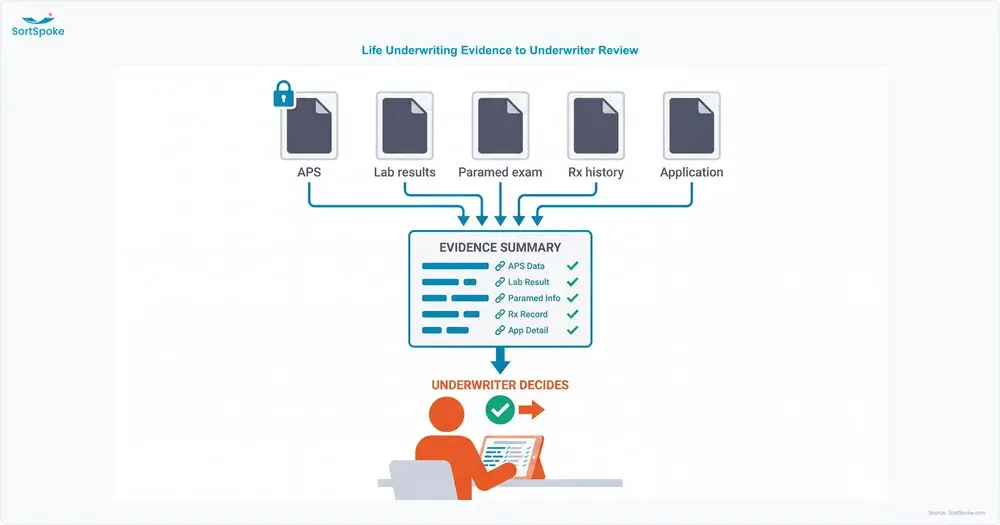
Intelligent document processing for life insurance underwriting extracts medical and financial evidence — attending physician statements, lab results, paramedical exams, prescription histories and applications — into structured data an underwriter can review. These files differ from commercial P&C submissions: long narrative medical records instead of forms, with protected health information on nearly every page.
Three differences change what a life underwriting team should ask of an IDP system:
Reinsurers feel the problem at scale, because evidence arrives from many ceding carriers in many formats. RGA, a global reinsurer, uses SortSpoke in its underwriting; its Manager of Global Digital Underwriting reported "great accuracy levels achieved" and that "training was quick." A leading UK life and health carrier applied SortSpoke to quoting and membership-change processing.
Evaluating intelligent document processing vendors for insurance comes down to four questions. Does the system read insurance documents without per-carrier templates? Who verifies the output before it reaches your systems? Does it work inside the tools your team already uses? Can the vendor prove its security with current audit reports? The vendor's approach answers most of them.
Most options fall into four approach types. The table compares approaches, not individual vendors. SortSpoke sits in the third column, so weigh our framing accordingly.
| Criterion | OCR + templates | Generic IDP platform | Insurance-specific IDP with human-in-the-loop | BPO / outsourced keying |
|---|---|---|---|---|
| New carrier format | Needs a new template; breaks when a layout changes | Handles layout variation; insurance fields often need custom training | Pre-trained on insurance documents; no per-carrier template | No setup, but every document is keyed by hand |
| Insurance meaning (limits, TIV, paid vs incurred) | None: reads characters, not meaning | General-purpose; results on insurance-specific fields vary | Built around underwriting fields and document structures | Depends on staff training and turnover |
| Who verifies the output | Your team, often by re-checking everything | Varies; review is often optional or outside your workflow | Confidence scoring routes uncertain fields to your own reviewers | The provider's QA process, outside your view |
| Audit trail | Minimal | Varies by platform | Field-level link back to the source document | Sample-based QA reports |
| As volume grows | Template maintenance grows with every new format | Tuning effort per document type | Reviewer time concentrates on flagged fields | Cost and turnaround track headcount |
| Best fit | One stable, high-volume form | Mixed back-office documents across industries | Carriers, MGAs and reinsurers with variable submission documents | Low or spiky volume, or teams not ready to change workflow |
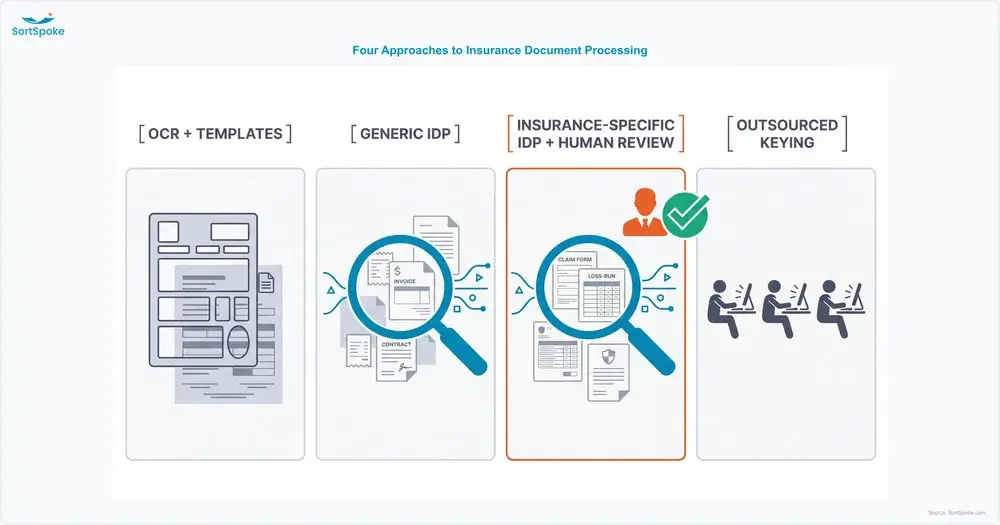
The categories blur at the edges. Many BPOs now run IDP underneath their keying teams, and some generic platforms add insurance templates. SortSpoke is built as insurance-specific IDP with human-in-the-loop review: every field either clears a confidence threshold your team sets or goes to your own reviewers, and each accepted value keeps its provenance to the exact page, region and character span it came from.
Whichever approach you shortlist, skip the vendor demos that show perfect extractions on cherry-picked documents. Instead, ask these questions:
Then run a bake-off on your own files. Bring your messiest real submissions — handwritten ACORD notes, non-standard loss runs, SOVs with merged cells — and score each vendor on what reaches your system after review, not on the demo. For a more detailed evaluation framework, see our guide to the 9 questions you should ask before buying underwriting AI.
The gap between manual document processing and intelligent automation isn't theoretical. Here's what the figures show, and where each one comes from.
The 5x efficiency boost is what Great American Custom Insurance reported; the 85% faster processing and the fall in error rates from about 4% to under 1% with human review come from SortSpoke's internal benchmarks. OneDigital transformed their quoting intake process using intelligent document processing, delivering faster turnarounds and winning more business. RGA accelerated its underwriting innovation with SortSpoke, and its VP Underwriting summed up the result:
"SortSpoke solves one of underwriting's messiest problems. Enables faster reviews, better risk assessment, greatly reduced manual effort."
— VP Underwriting, RGA
The ROI math is straightforward. Take an illustrative team that processes 40 submissions a day at 30 minutes of manual data entry each: that's 20 person-hours daily. Apply the 85% faster processing from SortSpoke's internal benchmarks and roughly 17 of those hours come back every day, for underwriting decisions instead of copying data between systems.
Want to benchmark your team's current efficiency? Try the underwriting efficiency calculator to see where you stand.
Intelligent document processing (IDP) in insurance uses AI, machine learning, and large language models to automatically read, classify, and extract structured data from insurance documents like ACORD forms, loss runs, statements of value, and broker submissions. Unlike basic OCR, IDP understands document context and handles the inconsistent formats common in insurance workflows.
OCR (optical character recognition) converts images of text into machine-readable characters — it reads letters and numbers. IDP goes further: it understands what those characters mean in context. OCR might read "500,000" from a loss run; IDP knows that's an incurred loss amount for a specific claim, in a specific policy period, and structures it accordingly. For the full technology evolution, see our guide to how data extraction evolved from OCR to IDP to LLMs.
Modern IDP platforms handle the full spectrum of commercial insurance documents: ACORD applications (125, 126, 130, 140), loss run reports from any carrier, statements of value (SOVs), bordereaux reports, first notice of loss (FNOL) forms, broker emails and attachments, policy declarations, endorsements, and supplemental applications. The best systems handle carrier-specific formats without requiring custom templates for each one.
IDP implementation timelines vary widely by vendor. Legacy platforms that require extensive customization and on-premise deployment can take many months. Modern cloud-based IDP solutions purpose-built for insurance can deliver measurable results much sooner. The key factors are whether the system has pre-built insurance document models (vs. training from scratch) and whether it integrates via API or requires custom infrastructure work.
Any IDP solution handling insurance documents must meet strict security requirements. Look for SOC 2 Type 2 certification (not just Type 1), HIPAA compliance for health insurance data, encryption at rest and in transit, and clear data residency policies. Avoid vendors that can't provide current audit reports or that process documents through consumer-grade AI services without proper enterprise security controls.
Whether an IDP vendor trains its AI on your documents depends on the vendor, so ask before you sign. SortSpoke trains its extraction models per customer, on that customer's labelled data only. Customer data is not used to train shared or foundation models, and the foundation-model provider does not retain prompts or responses for its own training.
Want to see how IDP handles your specific insurance documents? Book a demo and bring your messiest submissions — the ACORD forms with handwritten notes, the loss runs from carriers with non-standard formats, the SOVs with merged cells. That's where the real test happens.
Commercial P&C Insurers Guide to Solving the Underwriting Bottleneck